
CareView Communications: Patented Patient Monitoring, Expanding Use Cases, and Acute Liquidity Pressures
CareView Communications delivers AI-powered video monitoring systems that promise to reduce patient falls and operational costs for hospitals and long-term care facilities. With a pivot to sales-based contracting, a sizable installed base, and government access, the company holds competitive technology assets—but faces immediate financial headwinds that could constrain execution.
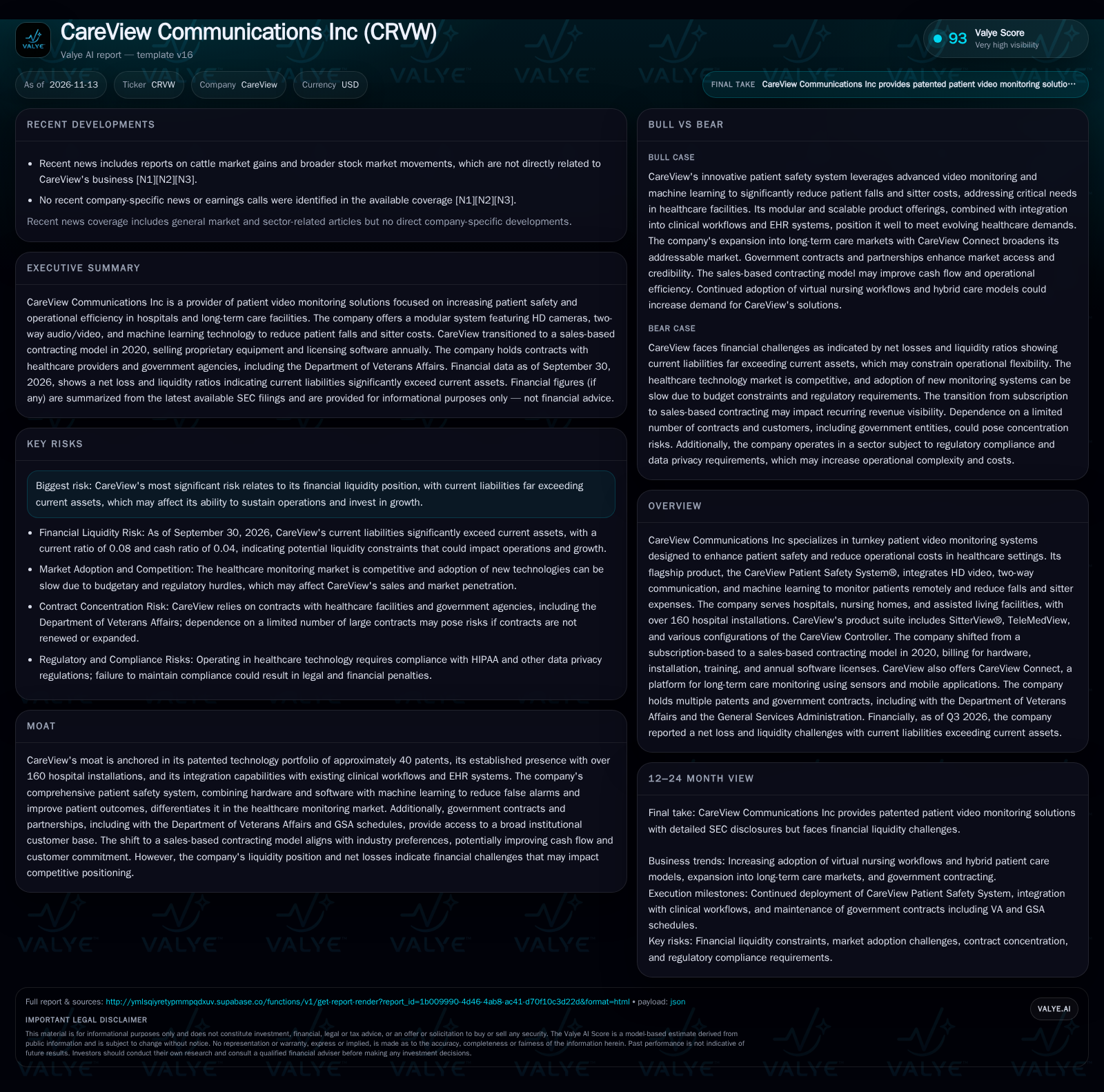
CareView Communications provides advanced patient video monitoring solutions, leveraging machine learning to deliver measurable safety and efficiency benefits for healthcare providers. It has over 160 hospital installations, a broad patent portfolio, and established government contracts. The company’s shift to a hardware/software sales model aims to improve cash flow and customer commitment, but recurring revenue visibility and contract concentration risks remain key challenges. Sustained growth will depend on market adoption, regulatory navigation, and urgent resolution of its capital structure.
CareView Communications stands at the intersection of healthcare technology innovation and acute financial vulnerability. Its AI-enhanced video monitoring systems, now deployed in over 160 hospitals, have delivered measurable gains in patient safety and operational efficiency. The company’s recent pivot to a sales-based contracting model aims to align incentives and improve cash flow, while government contracts expand its institutional reach. However, as of Q3 2026, CareView’s liquidity position is severely strained, with current liabilities vastly exceeding current assets and a persistent net loss. The next phase will test whether technology differentiation and market opportunity can outpace mounting financial constraints.
Liquidity Strain, Contracting Shift, and Institutional Access Define the Present
Three developments currently shape CareView’s outlook. The company reported a current ratio of 0.08 for the period. The company reported cash and liquidity metrics for the period; these figures do not by themselves establish operating runway, investment capacity, financial flexibility, or financing capacity. [S2]
Second, CareView has shifted from a recurring subscription model to a sales-based contracting approach, now selling proprietary hardware and billing for installation, training, and annual software licenses. Standard contracts reportedly span two to five years, with shorter pilot agreements [S1]. This change could accelerate cash collection and align with hospital procurement preferences, but may reduce revenue visibility compared to pure SaaS models.
Third, the company maintains government access through contracts with the Department of Veterans Affairs and a General Services Administration Multiple Award Schedule, enabling sales to VA and DOD facilities [S1]. This institutional channel supports credibility and volume potential but also introduces contract concentration and renewal risk.
How CareView’s Revenue Model and Cost Structure Could Scale—Or Stall
CareView’s economics now hinge on a hybrid of product sales and recurring software/service fees. Under the current model, hospitals and facilities purchase CareView’s proprietary hardware (HD cameras, controllers), pay for installation and training, and commit to annual software licenses. This structure front-loads cash inflows from hardware sales, while annual license renewals provide ongoing but less predictable recurring revenue.
Variable costs likely include hardware manufacturing, installation labor, and ongoing support. The company’s 24/7 service obligation adds a fixed cost layer, though it may also underpin customer retention and differentiate CareView from less service-oriented competitors. The modular product suite and platform integration allow for up-selling and cross-selling, particularly as healthcare providers seek to standardize across sites or add new monitoring features.
Operating leverage could improve as the installed base grows—software margins and support revenues should scale more efficiently than hardware and installation costs. However, the current acute liquidity deficit may force CareView to prioritize contracts with shorter payback periods or larger upfront payments, potentially constraining its ability to pursue longer-term, higher-margin opportunities. Capital needs are immediate: unless the company can restructure liabilities or secure additional financing, even attractive unit economics may not translate to sustainable operations.
Defensible Technology, but Competitive and Regulatory Headwinds Persist
CareView’s competitive edge rests on several pillars: a portfolio of approximately 40 patents, integration with EHR and clinical workflows, and demonstrated efficacy in reducing patient falls and sitter costs [S1]. The ability to offer modular hardware/software configurations and seamless workflow integration has helped the company secure over 160 hospital installations and government contracts.
However, the healthcare monitoring market is crowded, with incumbent technology vendors, EHR providers, and emerging AI-driven startups all targeting hospital safety and efficiency budgets. Substitution risk is substantial—hospitals may opt for in-house solutions, alternative telehealth platforms, or software-only monitoring tools, especially if capital budgets are tight.
CareView’s government access is a differentiator, but also a double-edged sword: VA and DOD contracts can provide volume and credibility, but contract renewals are competitive and subject to shifting procurement priorities. Regulatory compliance (HIPAA, data privacy) is a baseline requirement, and any lapse could erode trust and trigger financial penalties.
If Technology Adoption Accelerates and Funding Is Secured, a Virtuous Cycle Could Emerge
A favorable chain of events starts with CareView securing bridge financing or renegotiating its current liabilities, relieving immediate liquidity pressure. This would allow the company to maintain operational continuity and invest in sales execution. If hospitals and long-term care facilities continue to prioritize patient safety and hybrid care models, demand for CareView’s modular, AI-enhanced monitoring systems could accelerate—particularly if the company leverages its government access to win larger contracts or expand within existing VA/DOD sites.
Confirmation of this scenario would include new contract wins, revenue growth outpacing cost increases, rising annual software license renewals, and evidence of cross-sell/up-sell into long-term care settings. Gross margin expansion—driven by a higher mix of recurring software/license revenue—would further validate the thesis. Evidence that CareView can reduce customer churn and extend contract durations, especially in the government segment, would strengthen the long-term outlook.
Sustained Operations May Require Restructuring or Dilution, Even If Technology Finds a Market
The most plausible trajectory is that CareView remains operational but under financial duress. The technology continues to attract some hospital and government customers, especially where patient safety mandates and hybrid care models align with CareView’s value proposition. However, the acute liquidity shortfall forces the company to pursue debt restructuring, asset sales, or equity dilution to bridge the funding gap.
Revenue growth is likely to be lumpy, with contract wins offset by renewal risk and budget-driven delays in hospital procurement. The sales-based model provides upfront cash but reduces predictability of recurring revenue, challenging long-term planning. Confirmation would come from stabilization of cash balances (if disclosed), reduction in current liabilities, and a steady cadence of contract renewals—particularly in the government segment. Falsification would be signaled by missed payroll, vendor non-payment, or abrupt service interruptions.
Liquidity Crisis Forces Contraction or Restructuring, Undermining Customer and Partner Confidence
If CareView is unable to secure new funding or renegotiate its obligations, the liquidity gap could trigger rapid contraction: layoffs, curtailment of service/support, or even bankruptcy proceedings. In this scenario, hospitals and government entities may move to alternative vendors, particularly if service reliability or data privacy is perceived to be at risk.
Lost customer confidence could result in contract terminations or non-renewals, further reducing cash inflows and accelerating the downward spiral. Technology assets (patents, software) might retain residual value for a strategic acquirer, but existing customers could face disruption. Confirmation of this scenario would include public disclosures of missed payments, legal actions from creditors, or abrupt reductions in service levels.
Milestones and Metrics That Will Reveal Whether CareView Can Convert Innovation into Resilience
Announcement of new financing, debt restructuring, or equity issuance—any event that addresses the current liquidity shortfall.
Number, value, and renewal rate of hospital and government contracts signed or renewed in the next two quarters (if disclosed).
Reported gross margin trends, especially the mix of hardware sales versus recurring software/license revenue.
Churn rate or customer retention metrics for both acute and long-term care markets—would help test the durability of the installed base.
Evidence of expansion or cross-sell of CareView Connect into long-term care and assisted living facilities.
Any regulatory or data privacy incidents, fines, or legal proceedings that could affect reputation or operational continuity.
Trends in service reliability and customer support performance—customer complaints or service interruptions would signal operational strain.
Material changes to contract terms, such as shorter durations, lower minimums, or increased pilot agreements, which could affect revenue visibility.
Disclaimer: This is research-only, informational analysis and not investment advice. It may include AI-generated interpretation and general industry context. Always verify important details using primary sources.

Comments