
ERock, Inc.: Distributed Power Solutions at Scale—Profitability, Adoption, and Grid Transition Risks
ERock delivers modular, quick-response natural gas power systems and embedded software for data centers, utilities, and large commercial clients, targeting grid reliability and flexible capacity. With positive net income, substantial cash, and a platform spanning design, installation, and O&M, the company stands at the intersection of grid transition needs and competitive pressures from alternative technologies.
ERock, Inc. offers vertically integrated, modular natural gas power solutions with embedded software, primarily for data centers and critical infrastructure in Texas and California. As of Q3 2026, it reported modest net income, strong cash reserves, and serves about 450 operational sites. The challenge is scaling profitably as grid modernization, renewables growth, and customer financing constraints shape the distributed power landscape. [S1]
ERock, Inc. is positioning itself as a proven provider of distributed, quick-response natural gas power systems and embedded software, targeting critical infrastructure like data centers, utilities, and large commercial clients—especially in grid-stressed states such as Texas and California. With roughly 450 operational sites and a platform spanning design, installation, and ongoing services, ERock reported a positive but modest net income in Q3 2026 and holds a substantial cash position post-IPO. As the distributed power market rapidly evolves amid grid modernization and renewable integration, ERock’s ability to scale, defend margins, and manage customer/project risk will be central to its long-term value creation. [S1]
Recent Financials and Market Position: Where ERock Stands Today
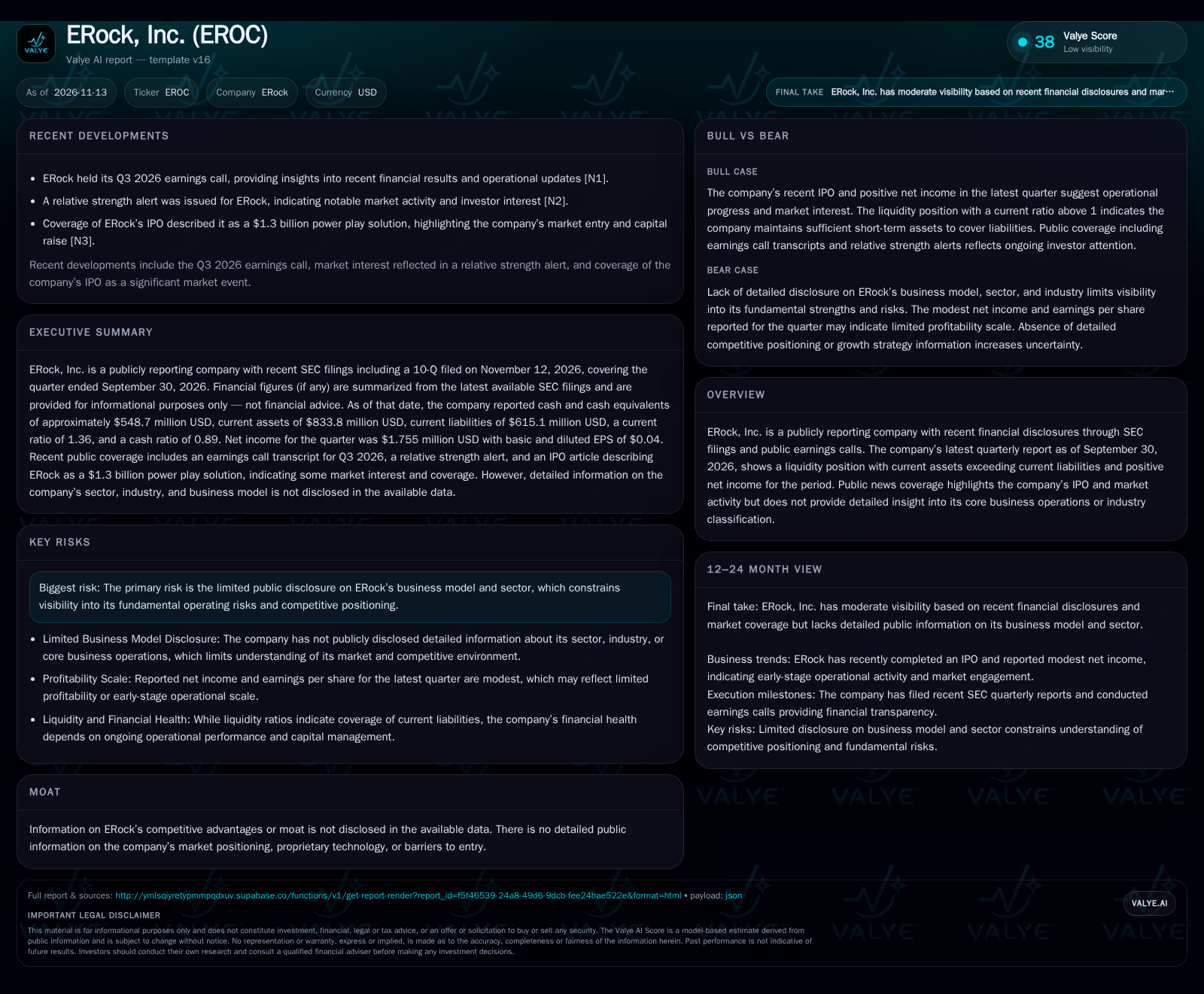
As of September 30, 2026, ERock reported $548.7 million in cash and cash equivalents, $833.8 million in current assets, and $615.1 million in current liabilities, yielding a current ratio of 1.36 and a cash ratio of 0.89. Net income for the quarter was $1.755 million, with basic and diluted EPS of $0.04. The company operates approximately 450 distributed power sites, primarily in Texas and California, and positions itself as a vertically integrated provider with a turnkey platform for design, delivery, and ongoing management of modular natural gas power systems. Its recent IPO and positive net income suggest early-stage operational momentum, while public coverage and earnings calls indicate growing market and investor attention. [S1]
How ERock’s Platform Could Drive Profits—And Where Economics May Tighten
ERock’s core business model centers on the design, deployment, and long-term operation of modular, quick-response natural gas generator systems with embedded software, sold primarily as comprehensive solutions that include equipment supply, installation, operations and maintenance (O&M), and asset management. The platform’s value proposition is built on reliability (targeting 99.999% uptime), rapid deployment, and multi-mode usage—covering bridge, backup, and dispatchable power.
Revenue streams could be a mix of upfront project-based sales (equipment, installation), recurring service contracts (O&M, asset management), and potentially performance-based or capacity payments, especially in markets facing grid instability or rapid data center growth. The economics hinge on capital intensity (upfront equipment and installation costs), the ability to secure multi-year service agreements, and asset utilization rates. High fixed costs in manufacturing and project development may be offset by operating leverage as the installed base grows, but margins could be pressured by project delays, customer payment risk, or cost overruns. Customer financing constraints and the significant upfront cost of power systems remain structural hurdles, potentially slowing adoption or compressing margins if ERock must subsidize deployments or offer vendor financing. [S1]
Resiliency and Reliability: ERock’s Edge—But Substitution and Scale Loom
ERock claims deep expertise and a long operational track record in complex, integrated power-system deployments, with a focus on reliability, rapid deployment, and a turnkey service approach. This could establish switching frictions for customers seeking continuity of operations, especially data centers and critical infrastructure in grid-stressed regions. However, competition is likely to intensify from several fronts: established backup power providers (including diesel and gas generator OEMs), distributed energy resource (DER) aggregators, and integrated energy storage or microgrid solution providers.
The push toward cleaner energy and grid decarbonization may drive substitution toward hybrid or all-renewable distributed solutions (e.g., battery storage, solar-plus-storage, fuel cells), especially as regulatory and customer preferences shift. Larger competitors with broader portfolios and access to lower-cost capital could challenge ERock on both price and project scale. ERock’s ability to maintain a differentiated platform will depend on continued asset reliability, seamless integration with customer operations, and evolving its technology stack to accommodate changing grid and environmental requirements. [S1]
If Data Center and Grid Demand Surges: The Virtuous Cycle for ERock
A favorable scenario would see continued acceleration in data center construction and grid reliability concerns in core markets like Texas and California, driving urgent demand for resilient, dispatchable power. If ERock can secure a growing share of new deployments and expand its installed base, operating leverage could improve as recurring service revenues compound. Successful execution on large, multi-site contracts—particularly with hyperscale data centers or utilities—would validate the platform’s scalability and deepen customer lock-in.
Evidence confirming this scenario would include sustained growth in contracted project backlog (if disclosed), an increasing share of revenue from multi-year service agreements, improved gross margins as fixed costs are absorbed, and public announcements of new marquee customer wins or geographic expansion. A shift toward hybrid or lower-carbon system offerings could further differentiate ERock and open new verticals.
Integrated Solutions in a Transitional Market: Growth with Margin Constraints
The most plausible trajectory is steady, project-driven growth as ERock builds on its installed base and reputation for reliability, but faces persistent margin pressure from customer financing constraints, project complexity, and competition from both traditional and emerging distributed power technologies. Revenue may be lumpy, tied to the timing of large deployments and the pace of new data center or utility projects. Operating leverage could be slow to materialize if customer acquisition or project development cycles are long or subject to regulatory/budget delays.
Confirmation would come from stable or modestly expanding net income, gradual growth in the number of operational sites, and ongoing renewal or expansion of O&M and asset management contracts. Falsification would include flat or declining site count, shrinking service revenue, or rising project delays/cost overruns. [S1]
Project Delays, Customer Payment Risk, and Clean Tech Substitution—Potential Adverse Outcomes
A negative scenario would see project development slow due to tighter customer financing, regulatory hurdles, or delays in data center construction. If key customers defer or cancel deployments, ERock could face asset underutilization, revenue shortfalls, and pressure on working capital. Rising competition from battery storage, solar, or fuel cell providers—especially if regulators or customers prioritize lower-emission solutions—could erode ERock’s addressable market or force margin concessions.
Evidence of downside would include missed project delivery milestones (if disclosed), rising accounts receivable or bad debt expense, declining cash balances without a corresponding asset base increase, or public loss of major customers to alternative solutions. [S1]
Milestones and Metrics That Will Shape ERock’s Distributed Power Thesis
Quarterly growth in operational site count and total installed capacity—if disclosed—would indicate demand momentum and platform scale.
Revenue mix between upfront equipment/project sales and recurring O&M/service contracts would clarify business model durability and margin trajectory.
Gross margin trends, especially as the installed base grows, would signal effectiveness in managing project costs and realizing operating leverage.
Disclosure of contracted backlog or pipeline—if available—would provide visibility into near-term revenue and execution risk.
Customer concentration metrics and renewal rates for multi-year service agreements would help test customer stickiness and revenue visibility.
Any announcements of new market/geography entries or marquee customer wins would support the expansion narrative.
Emergence of hybrid or cleaner power system offerings, or integration with renewable/DER platforms, would indicate responsiveness to market and regulatory trends.
Cash flow from operations versus net income—if disclosed—would help validate the quality and sustainability of reported earnings.
Disclaimer: This is research-only, informational analysis and not investment advice. It may include AI-generated interpretation and general industry context. Always verify important details using primary sources.

Comments