
HUMBL’s Blockchain Real Estate Pivot: Can Proprietary Tech and Patents Overcome Early-Stage Hurdles?
Rebranded as TAP Real Estate Technologies, HUMBL is betting on blockchain-enabled real estate tokenization.
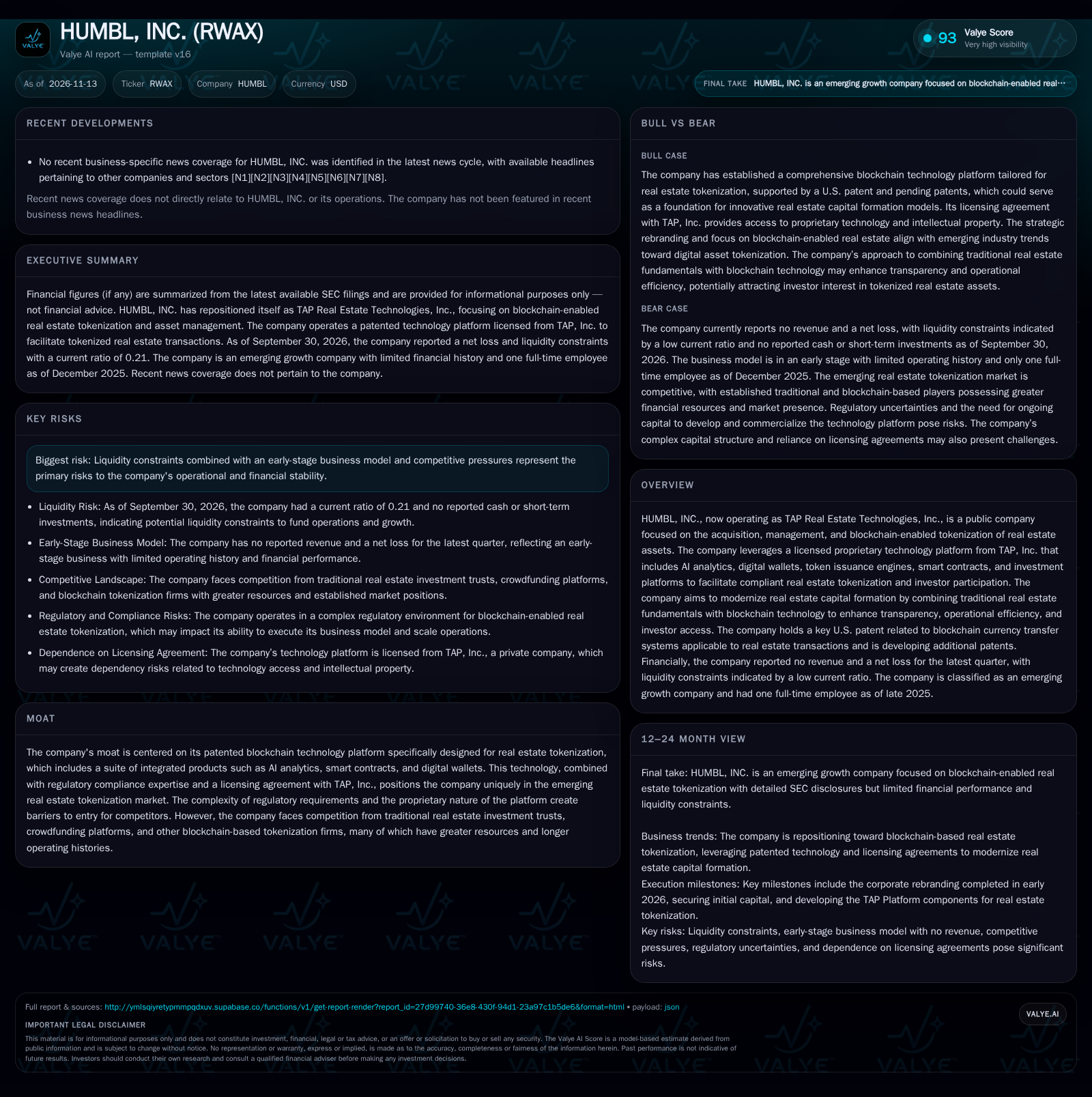
HUMBL, now operating as TAP Real Estate Technologies, has fully pivoted to blockchain-based real estate tokenization. Despite holding a U.S. patent and licensing a proprietary tech platform, the company reported no revenue and a net loss for the latest quarter, with current assets far short of current liabilities as of September 30, 2026. Execution risk is high, with a single full-time employee and dependency on a licensing agreement. The company’s future hinges on its ability to generate initial traction, secure funding, and differentiate in a crowded, regulatory-heavy market. [S2]
HUMBL’s transformation into TAP Real Estate Technologies marks a bold bet on the future of real estate capital formation: blockchain-powered asset tokenization. With a suite of proprietary and patented tech—licensed rather than owned outright—the company aims to bring transparency, efficiency, and broader investor access to real estate markets. Yet as of late 2026, the business remains entirely pre-revenue, with only one employee and acute liquidity pressures. The challenge is not just technical execution, but also proving commercial demand, securing regulatory compliance, and raising enough capital to bridge the gap from concept to scale in a fiercely competitive and highly regulated sector.
From Rebrand to Reality: Where HUMBL Stands Now
HUMBL, INC. completed its rebranding to TAP Real Estate Technologies, Inc. in March 2026, signaling a strategic pivot from its prior business lines to a singular focus on blockchain-enabled real estate tokenization. This shift is underscored by the company’s exclusive licensing of a proprietary technology platform from TAP, Inc., which includes AI analytics, smart contracts, and a patented blockchain currency transfer system tailored to real estate transactions. However, the company’s financials paint a stark picture: as of September 30, 2026, HUMBL reported no revenue for the previous quarter and a net loss of $1,309,225, with current assets of $1,054,476 dwarfed by current liabilities of $5,126,233. The company reported cash and liquidity metrics for the period; these figures do not by themselves establish operating runway, investment capacity, financial flexibility, or financing capacity. As of late 2025, the company had just one full-time employee, making resource limitations a critical operational challenge. [S1] [S2]
Tokenizing Real Estate: The Economics and Execution Hurdles
HUMBL’s business model aims to monetize real estate tokenization via management fees, listing fees, success fees on completed tokenized listings, and potential returns from balance-sheet real estate holdings. In theory, tokenization could democratize access to real estate investing, reduce transaction friction, and enable fractional ownership. However, the economics are unproven at this stage: the company has yet to generate revenue, and the cost structure is likely to be heavily front-loaded given technology development, regulatory compliance, and go-to-market needs.
The platform’s mechanics—if successfully commercialized—could create recurring fee streams from asset listings, ongoing investor management, and perhaps secondary market transactions. Fixed costs may be high initially (platform development, legal, licensing), while variable costs could scale with transaction volume. Operating leverage is plausible if the platform achieves network effects or standardizes onboarding and compliance, but this remains hypothetical absent evidence of traction.
Differentiation in a Crowded and Evolving Market
HUMBL’s competitive thesis rests on its proprietary, patent-backed technology platform and the ability to deliver compliant, transparent, and efficient real estate tokenization. The U.S. patent on blockchain currency transfer for real estate, along with pending patents, could provide some defensibility against direct imitators. The suite of platform components—AI analytics, smart contracts, digital wallets, and investor portals—suggests a broad technical ambition.
However, the competitive landscape is formidable. Traditional real estate investment trusts (REITs), crowdfunding platforms, and a growing roster of blockchain-native tokenization startups all vie for investor attention and asset origination. Many competitors have deeper financial resources, established brands, and larger teams. Moreover, the company’s reliance on a licensing agreement with TAP, Inc. introduces dependency risk: should the relationship change, HUMBL’s access to its core technology could be jeopardized.
Switching costs for institutional investors or real estate sponsors are not yet proven, and regulatory complexity may favor more established players. Ultimately, the question is whether HUMBL’s technology and compliance architecture can deliver a meaningfully better experience or lower cost than incumbents—and whether it can secure the capital and partnerships needed to scale.
If Tokenization Gains Traction: What Success Could Look Like
In a favorable scenario, HUMBL leverages its technology stack and patent position to attract early real estate partners willing to pilot tokenized offerings. The company demonstrates regulatory compliance and ease of use, leading to successful listings and the first inflows of management and success fees. If these pilots show investor demand and operational reliability, HUMBL could secure additional financing—either through equity issuance or strategic partnerships—enabling it to expand its team and accelerate business development.
A virtuous cycle could emerge: each successful tokenized asset increases platform credibility, attracts more listings, and potentially builds a network effect among investors and sponsors. Confirmation would come from the announcement of the first revenue-generating real estate tokenization, new asset listings, onboarding of third-party investors, and perhaps an uptick in platform engagement metrics. A demonstration of regulatory acceptance (e.g., no enforcement actions following initial offerings) would further validate the model.
Falsification of this scenario would occur if, after pilot launches, the company fails to convert listings into revenue, cannot raise needed capital, or faces regulatory pushback that stalls or invalidates its offerings.
Proving Product-Market Fit Under Severe Constraints
The most plausible near-term outcome is that HUMBL continues to operate in a pre-commercial state, focusing on refining its platform, pursuing regulatory approvals, and seeking initial asset partners. With only one full-time employee and reported liquidity position, progress is likely to be slow and dependent on raising new capital or inking a strategic partnership.
Partial validation could come in the form of a single pilot project, a signed letter of intent from a real estate sponsor, or the onboarding of early investors—none of which guarantee sustained revenue but would serve as proof of concept. The company may need to issue additional equity, further diluting existing shareholders, to fund ongoing operations. Confirmation of this scenario would be continued disclosures of net losses, equity issuances, and incremental progress in platform development or pilot negotiations.
This scenario would be falsified by either the company generating meaningful revenue and onboarding multiple partners (upside), or by running out of capital and ceasing operations (downside).
Liquidity Crunch and Execution Stall: The Failure Mechanism
The most acute risk is a liquidity-driven halt to operations. If the company cannot raise new capital—whether via equity, debt, or strategic investment—it may be forced to suspend platform development, lose its single employee, or default on licensing agreements.
A lack of commercial traction (no listings, no investor demand, or regulatory setbacks) would further erode confidence, making fundraising even more difficult. In this scenario, the company could enter a downward spiral: failure to execute leads to greater dilution or unfavorable financing terms, or even insolvency. Confirmation would come from SEC filings disclosing going concern warnings, layoffs, missed payments, or the termination of technology licensing agreements.
The downside would be partially falsified if the company secures bridge funding, closes a pilot deal, or demonstrates any revenue-generating activity that extends its runway.
Milestones That Will Define HUMBL’s Blockchain Real Estate Ambitions
Announcement and completion of the first tokenized real estate asset listing using the TAP Platform.
Disclosure of any revenue from management, listing, or success fees—if and when reported.
New SEC filings addressing the company’s liquidity position, capital raises, or going concern status.
Expansion of the team beyond the sole full-time employee, indicating operational scaling.
Updates on the status or terms of the technology licensing agreement with TAP, Inc., including renewal or renegotiation.
Evidence of regulatory acceptance or approval for tokenized offerings, such as successful filings or lack of enforcement actions.
Signed partnerships or pilot agreements with real estate sponsors or asset managers.
If disclosed, metrics on platform usage, investor onboarding, or transaction volumes would help test the thesis.
Disclaimer: This is research-only, informational analysis and not investment advice. It may include AI-generated interpretation and general industry context. Always verify important details using primary sources.

Comments