
Commercial Bancgroup: Regional Banking Expansion, Deposit Dynamics, and the Challenge of Sustainable Growth
Commercial Bancgroup’s recent IPO and technology investments support its ambition to build a leading community bank franchise across Tennessee, Kentucky, and North Carolina. With a high proportion of core deposits and a focus on small and mid-sized business clients, the company faces both opportunities and pressures as it navigates a competitive, rapidly evolving regional banking landscape.
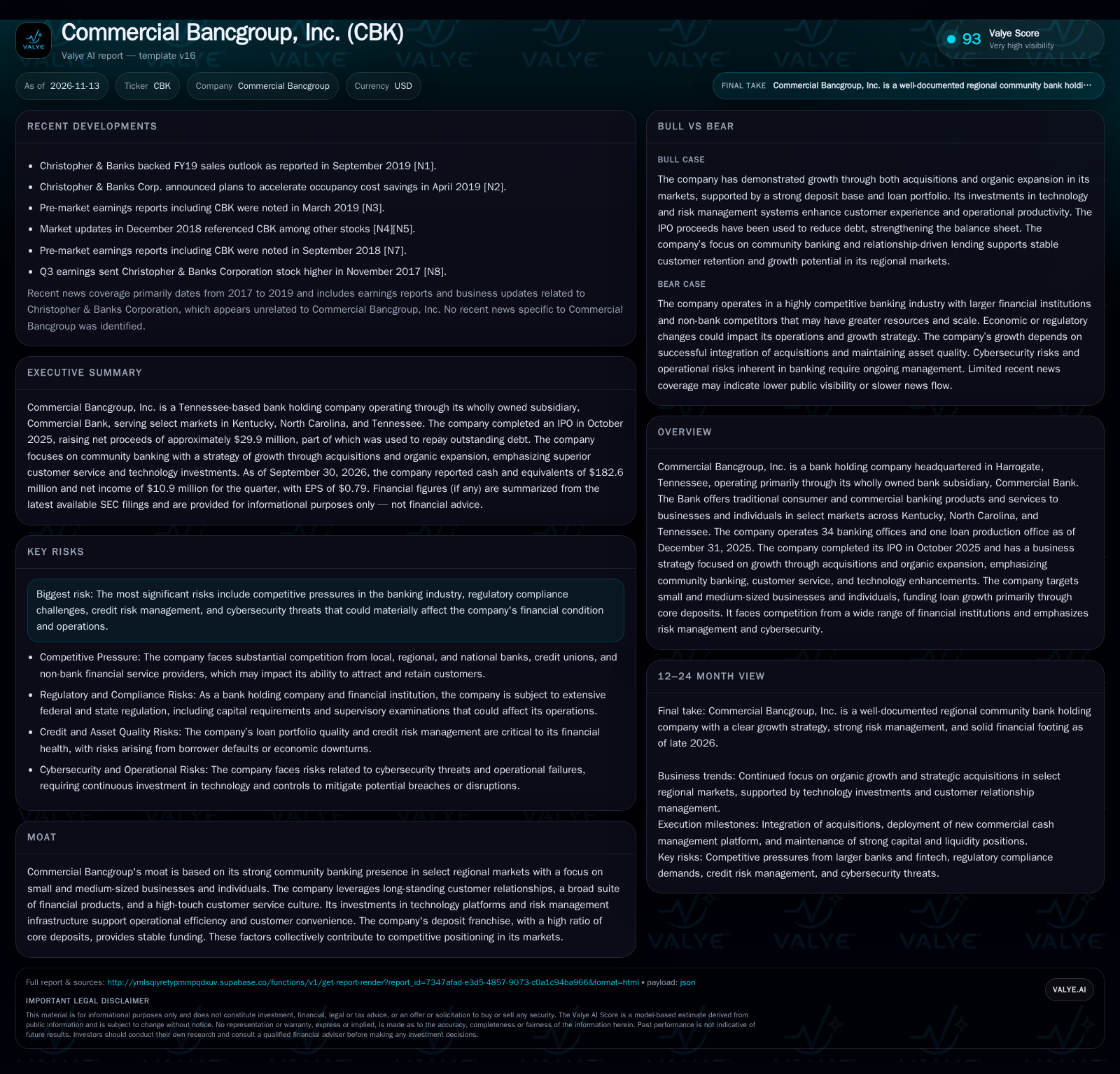
Commercial Bancgroup, Inc. (CBK) leverages a strong core deposit base and recent capital infusion from its 2025 IPO to pursue organic and acquisition-driven growth in the Southeastern U.S. While technology upgrades and a relationship-driven model underpin customer retention and operational efficiency, the bank’s high loan-to-deposit ratio and exposure to regional economic cycles pose ongoing risks. Sustainable expansion will hinge on maintaining asset quality, integrating acquisitions, and defending market share against larger banks and fintech entrants.
Commercial Bancgroup, Inc. embodies the classic ambitions of a regional community bank aiming to scale in the modern era: organic growth, targeted acquisitions, and a customer-centric approach underpinned by technology upgrades. With a recent IPO providing new capital and a robust core deposit base, the bank is well-positioned to compete in select Southeastern markets. However, its high loan-to-deposit ratio, regional concentration, and exposure to stiff competition from both traditional and non-bank rivals create a complex operating environment. The company’s ability to grow profitably will depend on balancing expansion with prudent risk management and adapting to evolving customer expectations.
IPO Proceeds, Deposit Structure, and Loan Growth: The Current Operating Picture
Commercial Bancgroup completed an IPO in October 2025, issuing over 7.17 million shares at $24.00 each and receiving net proceeds of roughly $29.9 million. Of these proceeds, $20.5 million was used to repay holding company debt, bolstering the company’s capital structure as it pursues expansion [S1]. As of September 30, 2026, the bank reported $1.9 billion in net loans and $1.89 billion in deposits, resulting in a loan-to-deposit ratio of approximately 100%—a level that signals aggressive loan deployment relative to funding [S2]. Cash and equivalents stood at $182.6 million, and the third quarter saw net income of $10.9 million, with EPS at $0.79 [S2].
The bank’s deposit mix is notable: at year-end 2025, over 91% of deposits were core (customer) deposits, with noninterest-bearing demand deposits constituting roughly 22% of total deposits and the remainder split between interest-bearing and time accounts [S1] [S2]. This structure provides low-cost funding but also implies sensitivity to market competition for deposits and potential pressure on funding costs if customer preferences shift.
How Commercial Bancgroup Earns: Funding, Lending, and Scale Opportunities
Commercial Bancgroup’s core economics are anchored in the traditional spread business: earning interest on loans funded primarily by low-cost core deposits. With 91.6% of deposits coming from stable, relationship-driven sources as of December 2025, the cost of funds is likely lower than peers reliant on wholesale or brokered funding [S1]. The high loan-to-deposit ratio (103.2% at year-end 2025) suggests that the company is maximizing its earning asset base, but also leaves less room for liquidity flexibility if deposit outflows occur [S1] [S2].
The company targets small and medium-sized businesses and individuals, segments that often value personalized service and may be less rate-sensitive than larger corporate clients. However, these customers can also be more vulnerable to local economic fluctuations, which could affect credit quality and loan growth. Recent investments in digital and real-time payment platforms may improve efficiency and customer retention, but the cost of these upgrades could pressure expense ratios unless balanced by revenue growth.
Operating leverage may improve as the company scales—particularly if new acquisitions and technology adoption drive incremental revenue without proportionate increases in overhead. However, the need for ongoing compliance, risk management, and digital investment means that fixed costs will remain significant. Capital raised from the IPO alleviates immediate funding constraints, but future growth may require additional capital or careful balance sheet management.
Defending Local Share Against Larger Banks and Digital Disruptors
Commercial Bancgroup operates in a banking landscape characterized by intense competition from local community banks, regional and national institutions, credit unions, and increasingly, fintech and non-bank financial service providers [S1]. While its community focus and high-touch service differentiate it from larger, less nimble competitors, scale disadvantages could limit its ability to match the technology investments and product breadth of national banks.
The bank’s core deposit franchise and strong customer relationships create some switching frictions, especially among small business clients who value responsiveness and local decision-making. However, digital-first competitors can erode these advantages if they offer superior convenience or lower pricing. The planned commercial cash management platform could attract and retain business clients, but success will depend on execution and the ability to deliver features on par with larger institutions.
In its current markets, Commercial Bancgroup may benefit from being a known local entity, but geographic concentration in Tennessee, Kentucky, and North Carolina increases vulnerability to regional economic downturns or demographic shifts. Ultimately, sustainable differentiation will require a balance between personalized service and digital capability, with ongoing investment needed to keep pace.
Unlocking Value Through Smart Acquisitions and Digital Adoption
If Commercial Bancgroup can successfully integrate acquisitions and leverage its technology investments, it could expand its market share, improve operating leverage, and drive earnings growth. The high proportion of core deposits provides a stable funding base, potentially allowing the bank to outcompete rivals on pricing and service, especially if it continues to attract small and mid-sized business clients.
A favorable scenario would see the company’s upgraded digital platforms and new commercial cash management offerings leading to increased customer acquisition and retention, higher fee income, and improved cost efficiency. Evidence for this would include accelerating deposit growth, rising noninterest income, improved efficiency ratios, and successful acquisition announcements with seamless integration. Expansion into adjacent markets without significant deterioration in asset quality or customer satisfaction would further support this thesis.
Balancing Growth Ambitions with Prudent Risk and Capital Management
The most plausible trajectory is steady, measured expansion in existing and nearby markets, with organic loan and deposit growth supplemented by occasional acquisitions. The company’s capital position, bolstered by the IPO, supports moderate balance sheet growth, but a continued high loan-to-deposit ratio implies the need for careful liquidity and risk management.
In this scenario, net interest margins may remain under modest pressure as competition for deposits intensifies, but ongoing technology investments and customer service initiatives help retain core clients. Asset quality remains stable, with nonperforming assets and charge-offs within manageable historical ranges. The bank maintains profitability, but outsized growth or margin expansion is limited by competitive and regulatory constraints.
Confirmation of this scenario would come from stable or gradually improving loan and deposit balances, consistent earnings, and absence of major asset quality or regulatory issues. Falsification would involve unexpected deposit outflows, sharp rises in credit losses, or inability to execute on planned technology and market expansion initiatives.
Adverse Credit Cycles or Deposit Flight Could Pressure Funding and Profitability
A negative scenario could unfold if economic weakness or local shocks lead to rising loan defaults, particularly given the bank’s concentration in small and medium-sized business lending and its high loan-to-deposit ratio. Deterioration in asset quality would force higher loan loss provisions, directly impacting earnings and potentially eroding capital.
Significant competition for core deposits, or shifts in customer preferences toward higher-yield alternatives, could result in deposit outflows or require the bank to offer higher rates, squeezing net interest margins. If digital investments fail to keep pace with customer expectations or if a cybersecurity incident occurs, customer attrition could accelerate.
Evidence of downside risks would include rising nonperforming loan balances, declining deposit levels, shrinking net interest margins, or a spike in technology and compliance costs. Failure to integrate acquisitions or regulatory actions would further undermine the growth story.
What Will Determine Commercial Bancgroup’s Long-Term Franchise Value?
Quarterly trends in core deposit growth and shifts in deposit mix—especially the proportion of noninterest-bearing deposits—will indicate franchise strength and funding cost trajectory.
Changes in the loan-to-deposit ratio, particularly if it rises further or if liquidity buffers shrink, could signal increased risk or funding stress.
Asset quality metrics such as nonperforming loan ratios, net charge-offs, and loan loss provisions (if disclosed) are key for monitoring credit cycle exposure.
Adoption rates and customer satisfaction for new digital platforms, including the commercial cash management system, would help test the return on technology investment.
Efficiency ratio trends and noninterest expense growth (if disclosed) will show whether operating leverage from technology and scale is materializing.
Evidence of successful acquisition integration, measured by retention of acquired customers and realization of expected cost or revenue synergies, would support the expansion thesis.
Regulatory capital ratios and any commentary on capital planning or future capital needs would provide insight into the company’s ability to sustain growth.
Market share data or customer retention rates in core geographies (if disclosed) would help evaluate the resilience of the community banking model.
Disclaimer: This is research-only, informational analysis and not investment advice. It may include AI-generated interpretation and general industry context. Always verify important details using primary sources.

Comments