
Smith Micro’s Carrier-Grade Software: Managing Customer Concentration and Expanding AI-Driven Products
Smith Micro leans on deep operator relationships and a growing suite of AI-enhanced mobile safety and messaging solutions, but faces ongoing net losses and significant customer concentration risk. The company’s strategic future hinges on scaling new products—like SafePath Global and SafePathOS—while contending with rapid technological change and the persistent threat of in-house development by its largest clients.
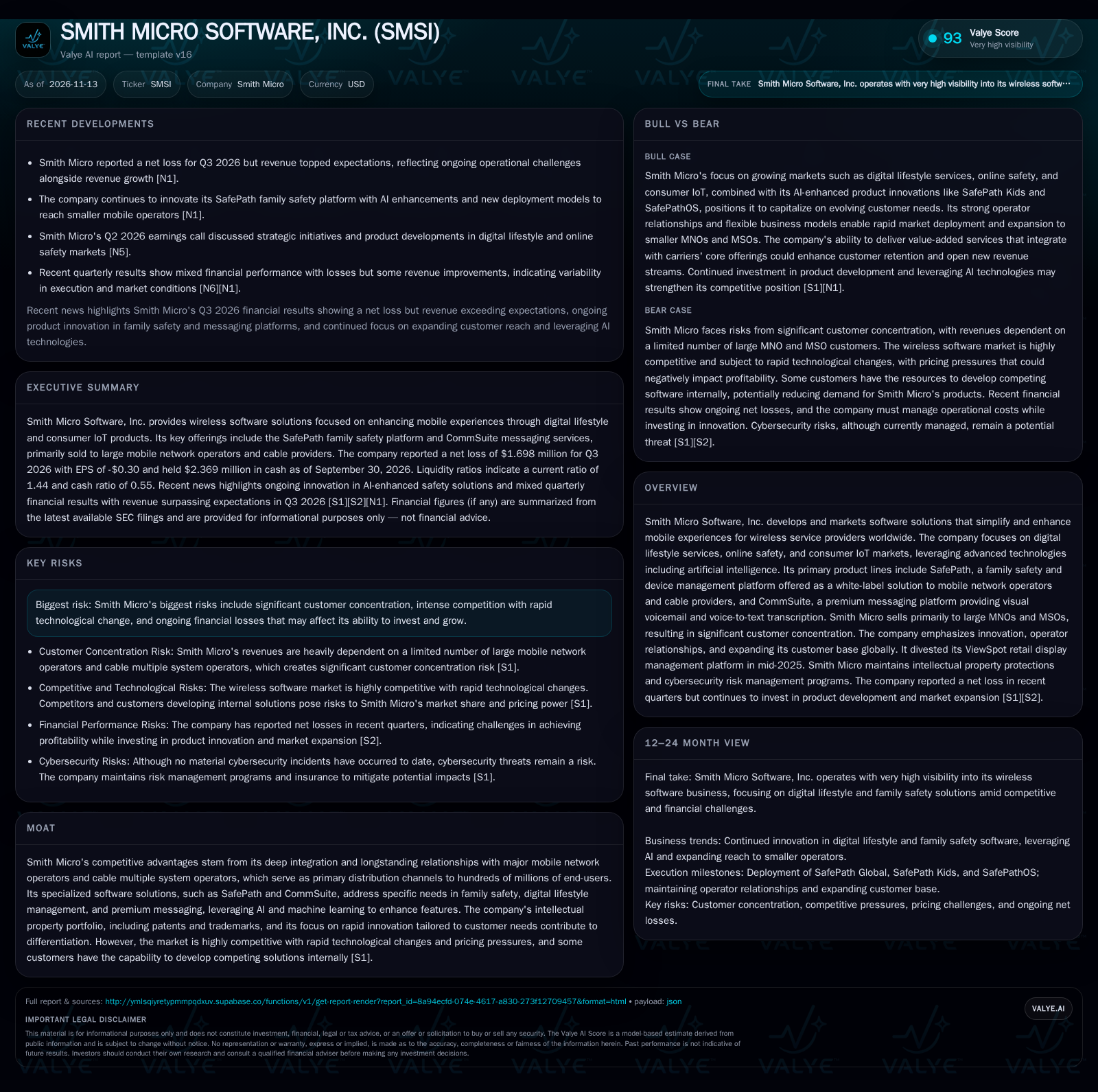
Smith Micro continues to report net losses despite revenue improvements, reflecting the tension between innovation spend and profitability. Its product roadmap targets high-growth digital safety and IoT markets through MNO and MSO channels, but substantial customer concentration and competitive pressures remain unresolved. The next phase depends on successful deployment of new solutions, broadening its customer base, and managing cost structure as the wireless software landscape evolves. [S1] [S2] [N1] [N6]
Smith Micro Software, Inc. is at a strategic crossroads: the company’s carrier-grade digital safety and messaging platforms are gaining traction—evidenced by better-than-expected Q3 revenue—but persistent net losses and heavy reliance on a handful of operator customers threaten to overshadow recent product innovation. As Smith Micro pushes new AI-powered SafePath solutions into a rapidly evolving wireless ecosystem, its ability to expand beyond its concentrated customer base and manage cost discipline will be pivotal in determining whether recent momentum translates into sustainable growth or is eroded by competitive and internal development pressures.
Operational Losses and Product Innovation Define Smith Micro’s Present
Smith Micro reported a net loss of $1.698 million for Q3 2026, with basic and diluted EPS at -$0.30, despite revenue surpassing expectations for the quarter. This juxtaposition of improved top-line performance with continued operational losses highlights the company’s ongoing struggle to balance innovation investment with profitability. [S2] [N1]
The company’s cash position as of September 30, 2026, stood at $2.369 million, with a current ratio of 1.44 and a cash ratio of 0.55. [S2]
Smith Micro’s most recent product launches—SafePath Global, SafePath Kids, and SafePathOS—signal a strategic push into new market segments and an effort to accelerate adoption among both large and smaller MNOs/MSOs. This diversification is designed to reduce dependence on a small number of large operator customers. [S1]
How Smith Micro’s White-Label Model and Product Mix Influence Economics
Smith Micro’s core business model centers on licensing and deploying white-label software platforms—primarily SafePath and CommSuite—to mobile network operators and cable MSOs. These platforms are designed to be deeply integrated into operator offerings, which can drive high initial deployment costs but also create the potential for recurring revenue streams if embedded in consumer rate plans or device sales.
The economics of this model are shaped by several factors: pricing is typically negotiated at the operator level, often with tiered or per-subscriber arrangements, which may deliver volume leverage but also expose Smith Micro to price pressure from large customers. The company’s capital intensity is relatively low compared to hardware businesses, as its main costs are R&D, support, and integration, but fixed operating expenses—especially in engineering and operations—can limit near-term operating leverage when revenue growth is modest or variable.
Recent product innovations, such as AI-enhanced safety features and modular deployments (SafePath Global), could improve average contract value and reduce time-to-revenue by enabling smaller operators to launch quickly. However, the success of this strategy depends on adoption rates among new customers and the ability to upsell existing ones. Without explicit evidence of recurring or multi-year revenue structures, the stickiness and lifetime value of these deployments remain an open question.
Customer Concentration and Internal Development Loom Over Competitive Landscape
Smith Micro’s most significant vulnerability is its reliance on a small number of large MNO and MSO customers. While deep integration and long-term relationships can provide some switching friction, these same customers possess the resources and incentive to develop competing solutions in-house—especially as digital safety and messaging features become table stakes in operator offerings. [S1]
The competitive field includes other independent software vendors targeting the same operator base, as well as in-house IT teams at major carriers. Pricing pressure is intensified by the commoditization of basic features and the entry of new players leveraging cloud-native or open-source architectures.
Smith Micro’s defensible assets include its intellectual property portfolio, integration expertise, and the breadth of its carrier-grade solutions. The recent divestiture of ViewSpot suggests a sharpening focus on core products, but also reflects the need to allocate resources carefully in a market where scale and rapid adaptation are critical. The question is whether Smith Micro’s pace of innovation—particularly in AI-driven features—can outstrip both external competitors and the internal development arms of its largest customers.
If AI-Driven Safety Platforms Accelerate Adoption and Deepen Operator Partners
The most favorable outcome for Smith Micro would be rapid, broad adoption of its new SafePath variants—especially SafePath Global and SafePathOS—across a wider swath of MNOs and MSOs, including smaller operators previously underserved. This would diversify revenue, reduce customer concentration risk, and potentially establish Smith Micro as the potentially leading provider of digital safety and family management solutions in the operator channel.
Evidence that would confirm this scenario includes: a series of new operator contract announcements (especially outside the top-tier customer base), clear disclosure of recurring or multi-year revenue agreements, and a shift toward positive operating leverage as revenue growth outpaces R&D and integration spend. Additional signs would be public endorsements from operators regarding the differentiation provided by Smith Micro’s AI and social media intelligence tools, and a visible reduction in customer churn.
This scenario would likely be falsified if new product launches fail to gain traction, customer concentration remains high, or if reported gross margins do not expand as new deployments scale.
Incremental Expansion Amid Margin Pressure and Customer Risk
The most plausible near-term path is continued incremental product expansion—Smith Micro wins some new business with smaller MNOs/MSOs and modestly increases penetration with existing customers, but the overall revenue base remains concentrated. Operational losses persist as the company balances R&D and integration costs against competitive pricing and slow contract ramp-ups.
Confirmation of this scenario would be a steady trickle (not a surge) of new deployments, stable or slightly improved top-line growth, but ongoing quarterly net losses and limited improvement in gross margin. If Smith Micro discloses contract wins that are mostly add-ons or upsells to existing customers, rather than true greenfield accounts, this would reinforce the base case. Likewise, continued caution in expense management and a lack of multi-year revenue visibility would point to this middle ground.
A break from this scenario—either toward sustainable profitability or toward deeper losses—would be indicated by a step-change in customer mix, margin expansion, or a material shift in operating cost structure.
Churn, Internal Competition, and Cost Pressures Undermine Recovery
The adverse scenario would see one or more major operator customers reduce or terminate their relationship with Smith Micro, either by developing equivalent platforms internally or switching to a lower-cost external provider. This could trigger a sharp revenue decline, exacerbate operational losses, and force the company into cost-cutting or restructuring mode.
Confirmation of this scenario would be a public loss of a top customer, a sudden drop in reported revenue, or material layoffs/reductions in R&D spend. If Smith Micro’s new products are met with tepid adoption or are quickly replicated by competitors (including operator IT teams), the company’s ability to recover would be further challenged.
Conversely, stabilization of the core customer base and maintenance of current revenue levels would help falsify the immediate downside, though not eliminate longer-term risk.
Milestones That Will Shape Smith Micro’s Competitive Trajectory
The pace and breadth of new operator contract announcements, especially with smaller MNOs/MSOs or in new geographies, would help test whether product expansion is translating into revenue diversification.
Evidence of recurring or multi-year contract structures—if disclosed—would clarify revenue visibility and customer stickiness.
Gross margin trends and the ratio of R&D/integration spend to revenue will indicate whether operating leverage is improving or eroding.
Retention and churn rates among top operator customers (if disclosed) are critical for assessing customer concentration risk.
Adoption rates and active user metrics for new SafePath variants (SafePath Global, SafePathOS, SafePath Kids) would validate product-market fit.
Any disclosure of internal development efforts or competitive launches by major operator customers would signal growing threat from in-house solutions.
Disclaimer: This is research-only, informational analysis and not investment advice. It may include AI-generated interpretation and general industry context. Always verify important details using primary sources.

Comments