
Cerebras Systems: Scaling Ambitions in AI Hardware Amid High Burn and Relentless Competition
Cerebras boasts reported liquidity position and high-profile partnerships but must convert technical prowess into durable revenue and defend its niche against formidable incumbents. The company’s steep losses underscore the urgency of demonstrating operating leverage and sustainable customer traction as the AI chip market matures.
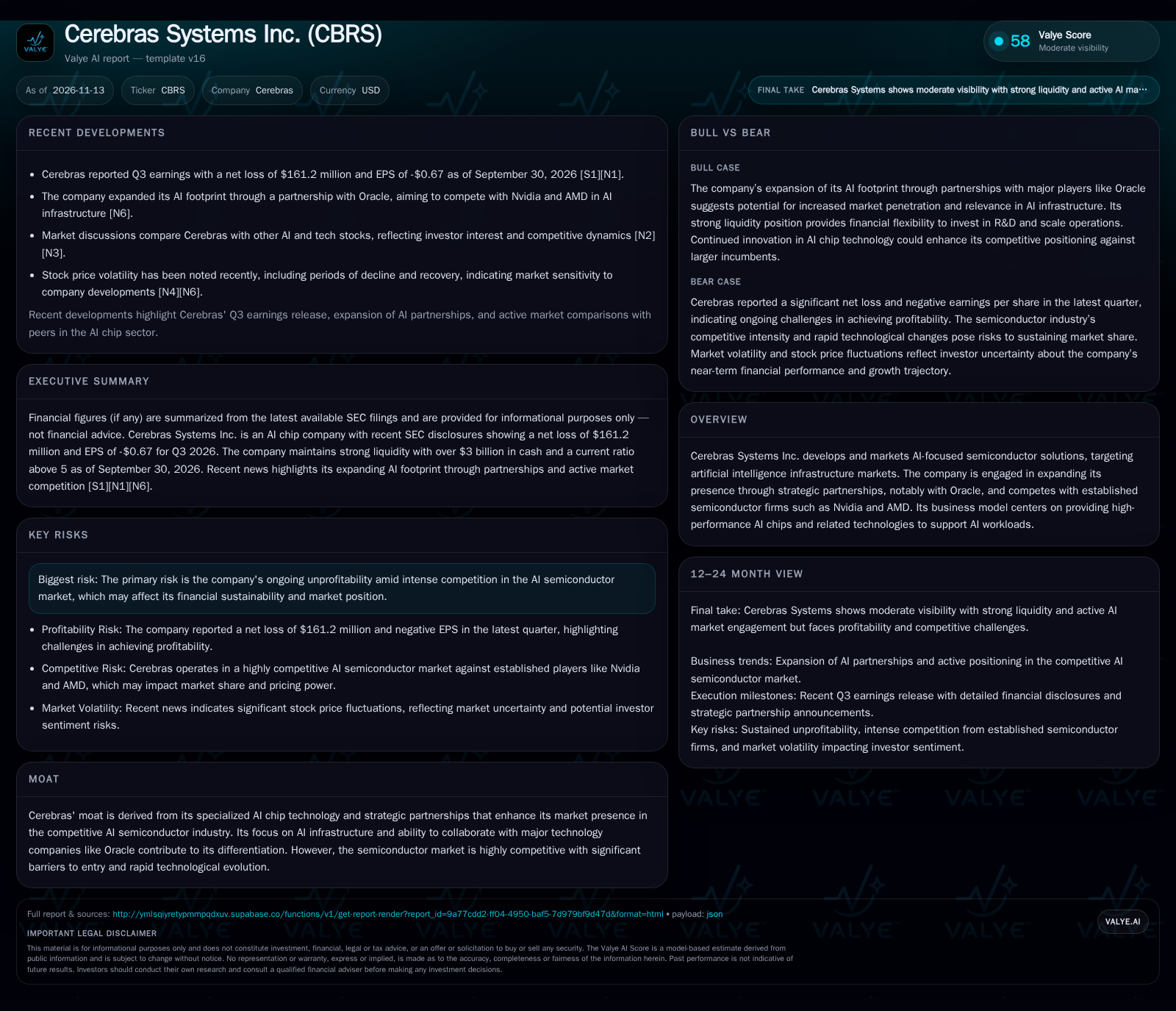
Cerebras Systems is flush with cash and deep in the AI hardware race, reporting a Q3 2026 net loss of $161.2 million despite $3.07 billion in cash and new partnerships with major tech players. The core challenge: scaling sales and margins fast enough to offset persistent losses in a fiercely contested semiconductor landscape.
Cerebras Systems stands at a critical juncture in the AI chip race: flush with cash and forging high-profile partnerships, yet burning capital at a rate that demands rapid operational progress. While its liquidity and technical ambition buy time, the company must demonstrate it can scale revenue, secure sticky customers, and defend its niche against entrenched semiconductor titans. The coming quarters will test whether Cerebras’ differentiated hardware and strategic alliances can translate into sustainable economics—or if high burn and relentless competition will force a strategic reset.
Liquidity Cushion Buys Cerebras Time, but Losses Mount as AI Competition Heats Up
Cerebras reported a net loss of $161.2 million for Q3 2026, with negative earnings per share of -$0.67, underscoring persistent challenges in reaching profitability [S1] [N1]. The company reported a current ratio of 5.27 for the period. [S1] Strategic partnerships, including a notable expansion with Oracle, are designed to drive adoption of Cerebras’ AI hardware in large-scale data infrastructure [N6]. Meanwhile, recent news coverage and market activity reveal heightened volatility and scrutiny, with investors weighing the company’s burn rate against its technical promise and competitive standing [N4] [N6].
How Cerebras’ Business Model Could Scale—If Execution and Market Fit Align
Cerebras’ core business model centers on designing and selling advanced AI-optimized chips and systems for data centers and enterprise AI workloads. Revenues are likely driven by a mix of hardware system sales and, potentially, complementary software or services, though the precise commercial mechanics—such as recurring revenue, hardware margins, or subscription overlays—are not detailed in the current evidence. The capital intensity of chip design and manufacturing, combined with the need for ongoing R&D to stay ahead of rapidly evolving AI workloads, creates high fixed costs and substantial operating leverage. If customer adoption accelerates, incremental unit economics could improve meaningfully, given the fixed-cost base. However, with a Q3 net loss exceeding $160 million, the company is currently operating well below breakeven, and scaling to profitability will require a combination of higher sales volumes, improved gross margins, and possibly new revenue streams. [S1]
The interplay between fixed and variable costs in Cerebras’ business model is critical to understanding its path to profitability. Given the capital-intensive nature of semiconductor development, the company must achieve significant scale in hardware sales to dilute fixed R&D and manufacturing overheads. Moreover, the potential introduction of subscription-based software or AI-as-a-service offerings could transform the revenue profile from one-time sales to recurring streams, enhancing predictability and customer lock-in. However, this pivot requires not only technical integration but also a shift in sales and support capabilities, which entails upfront investment and operational complexity. The timing and success of such a transition would materially affect margin expansion and cash flow dynamics.
Another dimension to consider is the role of supply chain and manufacturing partnerships in scaling Cerebras’ business. Collaborations with foundries and component suppliers influence cost structure, production lead times, and capacity flexibility. If Cerebras can negotiate favorable terms or secure prioritized access to advanced process nodes, it may gain cost advantages or speed to market relative to competitors. Conversely, supply constraints or cost inflation could compress margins and delay customer deployments. Therefore, operational execution in manufacturing and supply chain management is a key lever that interacts with market demand to determine financial outcomes.
Defending Differentiation in an Arena Dominated by Nvidia and AMD
Cerebras competes directly against industry giants Nvidia and AMD—firms with entrenched ecosystems, vast R&D budgets, and proven track records in AI hardware [N2] [N3] [N6]. Its differentiated value proposition lies in specialized chip architectures, potentially offering faster or more efficient AI model training for certain workloads. Strategic partnerships, such as with Oracle, may expand Cerebras’ market access and credibility, especially for large-scale data center deployments [N6]. However, barriers to entry in high-performance AI chips are matched by high barriers to sustained differentiation: competitors are quick to close technology gaps, and switching costs for customers are only durable if Cerebras’ solution is tightly integrated into workflows or delivers clear performance/cost advantages. The competitive threat is compounded by the possibility of new entrants and rapid shifts in AI software and hardware standards, which could commoditize hardware or shift value upstream to software and services.
From Technical Edge to Commercial Breakout: What a Cerebras Inflection Would Look Like
A favorable scenario for Cerebras would involve its partnerships—especially with Oracle—translating into major, repeatable deployments within hyperscale and enterprise customers, validating its technology at scale and driving a step-change in sales volumes. If Cerebras can demonstrate that its chips deliver superior performance or efficiency for leading AI workloads, and if these advantages are recognized by influential customers, the company could carve out a durable niche even in a market dominated by Nvidia and AMD. Evidence that would confirm this scenario includes: multi-quarter acceleration in recognized revenue, announcements of large, multi-year customer contracts, and visible adoption by high-profile enterprises or cloud providers. Early signs could also include public reference customers and integration into major AI cloud platforms. Falsification would come from stagnant or declining revenue, lack of high-profile customer wins, or continued high losses with no sign of operating leverage.
Sustained Heavy Burn with Select Wins, but Profitability Remains Over the Horizon
The most plausible near-term outcome is a continuation of Cerebras’ current trajectory: significant R&D and commercialization spending, some incremental customer and partnership wins, but persistent losses as the company battles for relevance in a market defined by scale and incumbent power. Revenue may grow, driven by partnerships and pilot deployments, but the pace may be insufficient to reach breakeven within the next several quarters. Confirmation of this scenario would be visible in ongoing losses of similar or slightly reduced magnitude, incremental—but not transformative—revenue growth, and continued announcements of partnerships or technical milestones, without clear evidence of widespread adoption or operating leverage. A falsification would be a decisive swing to profitability or, conversely, a sharp contraction in customer interest or strategic partnerships.
When Cash Burn Outpaces Adoption: Risks of Strategic Retrenchment or Dilution
In a more adverse scenario, Cerebras’ losses persist or worsen, with revenue failing to accelerate and partnerships not converting to material sales. Competitive responses from Nvidia, AMD, or emerging rivals could erode Cerebras’ differentiation, reducing pricing power or leading to customer churn. Continued high cash burn, if not offset by clear progress toward commercial adoption, could eventually force the company to retrench—potentially curtailing R&D, seeking dilutive capital raises, or exploring strategic alternatives such as asset sales or partnerships under less favorable terms. Confirmation of this downside would include flat or declining revenue, rapid erosion of cash reserves, and signals of cost-cutting or restructuring. A falsification would require evidence of sharply improved revenue growth or a meaningful reduction in losses due to improved gross margins or operating efficiency.
Milestones That Will Define Cerebras’ Transition from Technical Leader to Commercial Contender
Quarterly revenue growth rate and the underlying driver—whether from hardware sales, software/services, or recurring contracts—if disclosed, will reveal whether adoption is accelerating or stalling.
Gross margin evolution: A meaningful uptick would suggest improved pricing power or cost discipline, while compression could signal competitive or operational pressures.
Number and scale of enterprise or hyperscale customer wins, especially public reference deployments, would help confirm commercial traction.
Updates on the Oracle partnership and any disclosed revenue or contract value derived from it would clarify the real-world impact of strategic alliances.
Cash burn rate and runway projections: Persistent high burn without clear sales ramp would raise concerns about future dilution or retrenchment.
Competitive product launches and pricing moves from Nvidia, AMD, or new entrants, as these could rapidly alter the market landscape.
Disclosures or commentary on customer retention, repeat business, or integration depth—if available—would shed light on switching costs and stickiness.
Announcements of new strategic partnerships or ecosystem integrations that could expand Cerebras’ addressable market or embed its technology more deeply.
Disclaimer: This is research-only, informational analysis and not investment advice. It may include AI-generated interpretation and general industry context. Always verify important details using primary sources.

Comments