
Oragenics: Progressing ONP-002 in Concussion Treatment Under Capital and Regulatory Strains
Oragenics is moving its lead drug candidate ONP-002 through Phase 2a trials for concussion, leveraging external partnerships for manufacturing and regulatory support. While clinical momentum is evident, the company faces acute capital, dilution, and listing compliance risks that will shape its ability to reach later-stage development and potential commercialization.
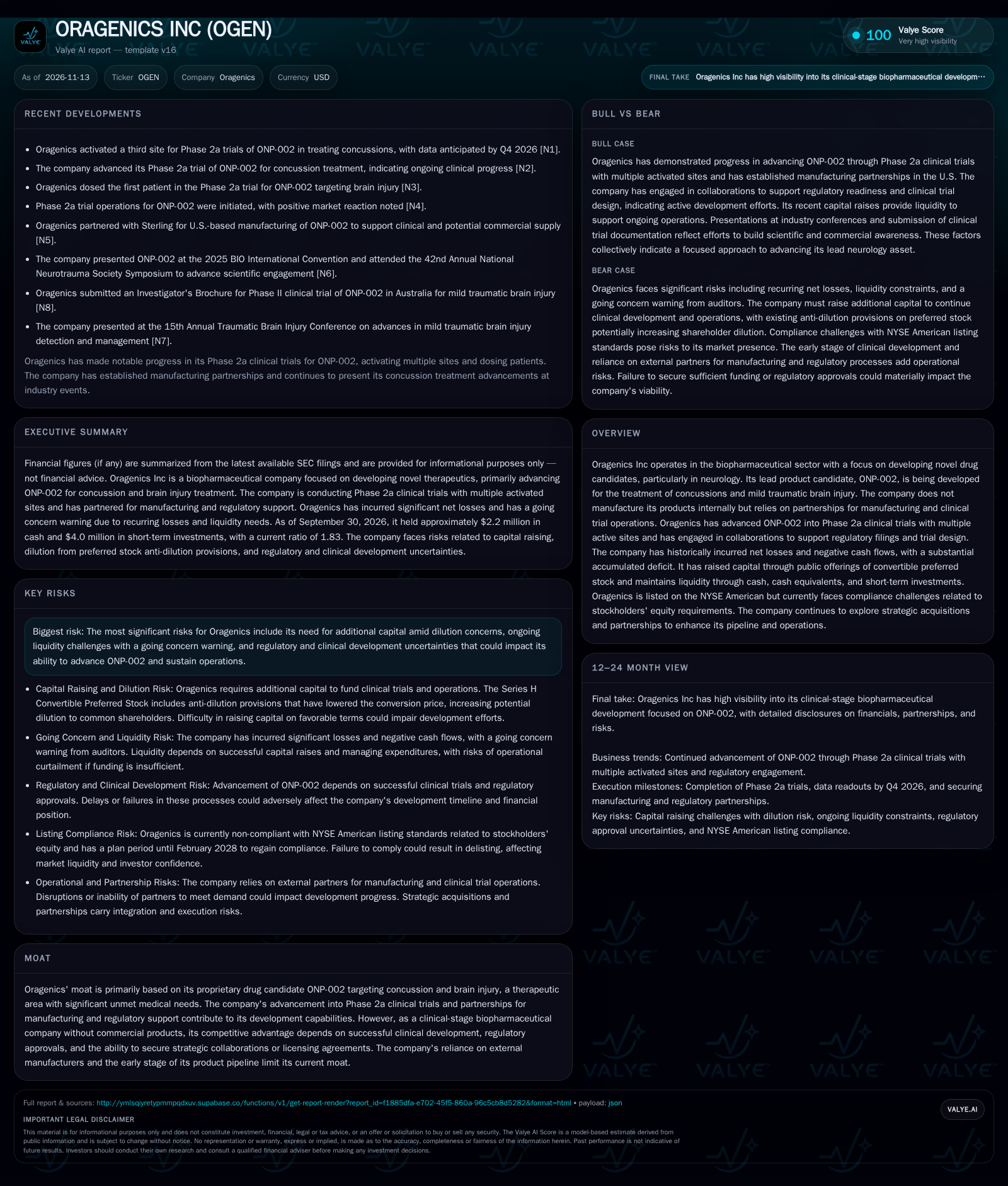
Oragenics is focused on ONP-002 for concussion and brain injury, with Phase 2a trials underway and new clinical sites activated. The company relies on manufacturing partners and has raised capital via convertible preferred stock, but faces recurring losses, a going concern warning, and NYSE American compliance issues. The next year hinges on trial progress, capital access, and strategic partnership outcomes. [N1] [N5] [S2]
Oragenics Inc. is pressing forward with ONP-002, its investigational treatment for concussion and mild traumatic brain injury, having recently activated a third Phase 2a clinical trial site and dosed its first patient. With NYSE American compliance at stake and clinical milestones approaching, the next year will test Oragenics’ ability to convert scientific progress into sustainable business viability. [N1] [N3] [N5] [S2]
Recent Clinical and Financial Updates Shape Oragenics' Immediate Prospects
Oragenics has advanced ONP-002, its lead candidate for concussion and mild traumatic brain injury, into Phase 2a clinical trials, activating a third site and dosing the first patient in 2026. These milestones signal tangible clinical progress and increase the probability of generating meaningful human data by the anticipated Q4 2026 readout. [N1] [N3]
Manufacturing for ONP-002 is conducted through a partnership with Sterling, supporting both clinical trial supply and potential future commercial needs. This externalization reflects Oragenics’ asset-light approach and enables scalability, but introduces reliance on partner performance. [N5]
Financially, the company reported a net loss of approximately $2.6 million for the quarter ending September 30, 2026, with cash and equivalents of $2.2 million and short-term investments of $4.0 million. Despite recent capital raises, the company received a going concern warning from auditors and faces substantial accumulated deficits. [S2]
Oragenics is currently non-compliant with NYSE American listing standards regarding stockholders’ equity, with a plan period extending through February 2028 to regain compliance. The potential for delisting introduces additional risk to market access and investor confidence. [S2]
Economics of Clinical Stage: Fixed Costs and Reliance on Capital Events
Oragenics’ current business model is typical of clinical-stage biopharma: high fixed R&D and regulatory costs with minimal revenue generation until successful product approval. The company’s primary value creation pathway is through ONP-002, which—if it demonstrates efficacy and safety in clinical trials—could be licensed or commercialized, potentially yielding milestone payments, royalties, or future product sales.
Operating leverage is limited in the near term, as expenses for clinical trials, regulatory filings, and external manufacturing are largely fixed and must be covered regardless of trial outcomes. Variable costs may rise modestly with trial expansion, but the bulk of spending is tied to the pace and scope of clinical development.
The company reported cash and liquidity metrics for the period; these figures do not by themselves establish operating runway, investment capacity, financial flexibility, or financing capacity. The July 2025 $16.5 million public offering of Series H Convertible Preferred Stock and warrants provided a temporary cushion but also introduced anti-dilution provisions, increasing dilution risk for existing shareholders as conversion prices are adjusted downward. [S2]
Future revenue, if achieved, would depend on successful progression through clinical and regulatory milestones, followed by either out-licensing (which could bring upfront and milestone payments) or direct commercialization (requiring further investment in sales and distribution infrastructure).
Positioning Oragenics Within a Competitive Neurology Pipeline
ONP-002 targets concussion and mild traumatic brain injury—areas with significant unmet need but intense competition, as many companies and academic groups pursue both pharmaceutical and non-pharmaceutical interventions. Oragenics’ potential advantage lies in being among the few advancing a novel agent into mid-stage clinical trials specifically for concussion, a market with limited FDA-approved options.
The company’s competitive position is currently defined by its intellectual property around ONP-002, early clinical progress, and its ability to engage partners for manufacturing and regulatory support. However, its lack of internal manufacturing, commercial infrastructure, or a diversified pipeline constrains its ability to create barriers to entry or sustain pricing power if ONP-002 succeeds.
Competing modalities include repurposed drugs, biologics, neuroprotective agents, and digital therapeutics. Larger pharmaceutical companies with established neurology franchises may have resource and distribution advantages, making partnership or acquisition a likely scenario if ONP-002 demonstrates strong clinical data.
Oragenics’ ability to stand out will depend on the magnitude and durability of ONP-002’s clinical effect, safety profile, and the company’s capacity to secure strategic collaborations or licensing deals before competitors reach the same stage.
Value Creation Opportunities from Clinical Breakthroughs
If ONP-002’s Phase 2a trial yields positive efficacy and safety data by late 2026, Oragenics could see a significant re-rating of its asset value. Positive results may attract licensing or co-development partners, particularly as larger companies look to fill neurology pipeline gaps. Such a deal could provide upfront capital, milestone payments, and potential royalties, alleviating immediate funding needs and reducing dilution pressure.
Validation at Phase 2a would also support advancing to larger, multi-center Phase 2b/3 trials, potentially enabling Oragenics to raise capital on more favorable terms. A strategic partnership with a pharmaceutical company could also bring non-dilutive funding, regulatory expertise, and commercial infrastructure.
Confirmation of this scenario would come from: (1) successful Phase 2a data readout, (2) announcements of strategic partnerships or licensing deals, and (3) new capital raises at improved terms or with less dilutive structures.
Ongoing Clinical Development Faces Funding and Dilution Challenges
The most plausible outcome is that Oragenics completes its Phase 2a study on schedule, but results are mixed or only modestly positive. The company continues to present at scientific and industry conferences, maintaining visibility and seeking partners, but must pursue additional dilutive capital raises to fund ongoing development and operations.
In this scenario, ONP-002 remains a promising but unproven asset, and Oragenics’ valuation is constrained by uncertainty over clinical outcomes, capital availability, and the risk of further dilution. Listing compliance remains a source of overhang, and the market may discount the stock until either a clear clinical win or a strategic transaction occurs.
Evidence confirming this scenario would include: (1) continued incremental trial progress and regular scientific updates, (2) additional equity or convertible security offerings, and (3) no major partnership or licensing deal in the near term.
Business Survival at Risk Without Funding or Clinical Advances
A negative outcome would result if ONP-002’s Phase 2a trial fails to demonstrate meaningful efficacy or safety, or if trial enrollment is delayed, leading to missed milestones. In parallel, if Oragenics cannot raise sufficient capital—due to clinical setbacks, poor market conditions, or loss of investor confidence—the company may be forced to halt development, curtail operations, or pursue asset sales under duress.
Additional dilution from further capital raises at depressed valuations, or failure to regain NYSE American compliance, could also erode shareholder value and restrict access to public markets. The going concern warning underscores the risk that insufficient funding could trigger insolvency or delisting.
Indicators confirming this scenario would be: (1) negative or inconclusive Phase 2a data, (2) delays in trial enrollment or site activation, (3) inability to complete capital raises, and (4) formal delisting from the NYSE American.
Upcoming Milestones and External Influences Impacting Oragenics' Path
Progress and timing of Phase 2a ONP-002 data readout, especially efficacy and safety outcomes.
Updates on new clinical site activations, patient enrollment rates, and trial completion timelines.
Announcements of strategic partnerships, licensing deals, or co-development agreements with larger pharmaceutical or biotech companies.
Capital raising activity—terms, size, and structure of any new financings, especially dilution impact.
Changes in NYSE American listing compliance status and outcomes of the plan period through February 2028.
Manufacturing and supply chain continuity with Sterling and other partners, including any disruptions or delays.
Presentations at major neurotrauma or biotech conferences, and subsequent industry or investor response.
If disclosed, cost per patient or per site for clinical trials, to better estimate future funding needs.
Disclaimer: This is research-only, informational analysis and not investment advice. It may include AI-generated interpretation and general industry context. Always verify important details using primary sources.

Comments