
B&R Technology Merger Corp.: SPAC Structure, Capital Moves, and the Countdown to a Defining Business Combination
B&R Technology Merger Corp. (BRTM) is a Cayman Islands-based SPAC listed on Nasdaq, with a mandate to acquire a technology growth company—ideally AI-focused—by mid-2028. Recent share capitalization and over-allotment option activity reflect active capital management, but the critical value inflection remains the successful identification and execution of a business combination within the 24-month window.
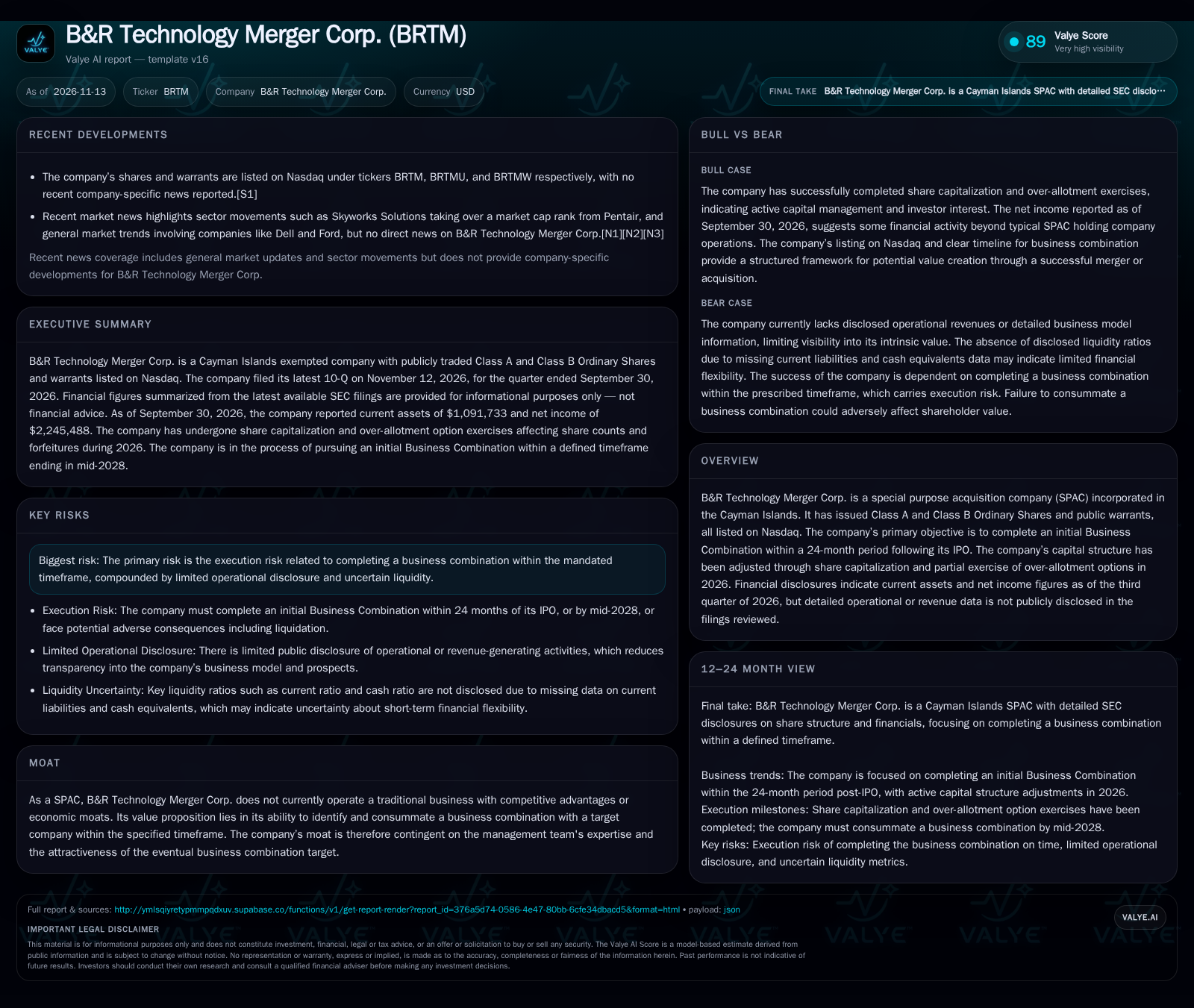
B&R Technology Merger Corp. is a SPAC with a technology and AI focus, listed on Nasdaq and operating under a strict timeline to finalize a business combination. Recent capital structure adjustments and the partial exercise of over-allotment options signal active sponsor engagement, but the absence of disclosed operational revenue or liquidity ratios underscores the binary nature of SPAC value: success or failure hinges on the quality and completion of a merger within the next 20 months. [S1]
B&R Technology Merger Corp. (BRTM) exemplifies the high-stakes, binary nature of the SPAC (Special Purpose Acquisition Company) model. With a strict 24-month window—ending by July 2028—to identify and merge with an attractive technology or AI-driven target, the company’s recent capital moves show its commitment to keeping all options on the table. Yet with minimal operational disclosure and no clear revenue streams, investors must focus on execution risk, sponsor alignment, and the ultimate quality of the business combination, which will determine whether BRTM delivers value or faces the default route of liquidation.
Recent Capital Structure Moves and the Business Combination Clock
B&R Technology Merger Corp. has recently adjusted its share structure through a share capitalization and the partial exercise of its over-allotment option, resulting in 36,740,000 Class A Ordinary Shares and 12,000,000 Class B Ordinary Shares outstanding as of November 12, 2026. The underwriter’s purchase of 3,500,000 Option Units and the forfeiture of the remaining allowed units led to founder share forfeitures, refining sponsor alignment. The company’s net income for the third quarter of 2026 was $2,245,488, and it reported current assets of $1,091,733. The company reported cash and liquidity metrics for the period; these figures do not by themselves establish operating runway, investment capacity, financial flexibility, or financing capacity. Most importantly, BRTM faces a hard deadline: it must complete a business combination by July 22, 2028, or October 22, 2028 if a letter of intent is executed, or face liquidation as per standard SPAC terms. [S1]
How Value Is Created—Or Lost—In the SPAC Lifecycle
SPACs like BRTM are essentially capital pools with a defined timeline and mandate: raise funds via IPO, identify a private company with strong growth prospects (in this case, ideally in the technology/AI sector), and complete a merger to bring that company public. Until a merger, operating expenses are generally low, focused on diligence, legal, and administrative costs. The company’s net income figure may reflect interest income from the IPO trust account or non-operating gains rather than recurring business activity.
BRTM’s business model is binary: success means closing a merger with a high-quality, growth-oriented target, potentially unlocking value for shareholders through the de-SPAC process. Failure to execute within the 24-month window leads to liquidation and return of capital to public shareholders, typically at the IPO price plus accrued interest. The economics for sponsors and founders are asymmetric; they stand to gain significantly if a deal closes, but lose their at-risk capital and founder shares if not.
The presence of public warrants exercisable at $11.50 per share creates potential for further equity capital if the post-merger entity performs well, but these instruments dilute existing holders and only become valuable above the exercise threshold. The company’s capital needs beyond the IPO proceeds—such as for a PIPE (private investment in public equity) or additional financing—will be determined by the size and capital requirements of the eventual target.
SPAC Market Dynamics and BRTM’s Position in the Technology Acquisition Race
BRTM operates in a highly competitive SPAC environment, especially for technology and AI-driven targets, where dozens of SPACs and traditional acquirers are vying for high-growth private companies. The competitive advantage of a SPAC often lies in the sponsor team’s track record, network, and ability to identify credible targets ahead of peers. However, the market has become crowded, and targets have grown more selective, often negotiating hard on valuation and terms.
Unlike operating companies, BRTM does not currently possess a traditional economic moat. Its value proposition is contingent on the management team’s ability to source and close a deal that the market will value above the trust redemption price. Counterforces include the risk of target companies opting for traditional IPOs, direct listings, or sales to strategic buyers. The partial exercise of the over-allotment option and subsequent capital management actions may signal sponsor engagement, but do not guarantee a superior outcome.
The existence of public warrants and the Nasdaq listing could make BRTM attractive to certain targets, as these features offer ready access to public capital and investor liquidity post-merger. However, the dilution from warrants and the scrutiny of public markets can be a deterrent for some private companies.
Unlocking Value Through a High-Quality, AI-Focused Business Combination
The best-case scenario for BRTM involves identifying and consummating a merger with a technology or AI company that is both fast-growing and underrepresented in public markets. If the sponsor team leverages its network to secure an exclusive LOI with a compelling target, and the transaction is structured to minimize redemptions and maximize post-merger growth prospects, BRTM could deliver substantial value to shareholders. Confirmation of this scenario would come from a deal announcement featuring a credible, high-visibility target, strong PIPE investment commitments, and limited public shareholder redemptions.
Further evidence would include the market reacting positively to the announced deal, with BRTM shares trading meaningfully above trust value, and the target’s management team committing to stay and drive growth post-merger. A successful de-SPAC process could also unlock additional warrant exercise proceeds, providing the new entity with further growth capital.
Typical SPAC Trajectory: Incremental Progress and Execution Uncertainty
The most plausible scenario is that BRTM continues its target search and incurs moderate operating expenses while seeking a business combination in the technology or AI space. Over the next 12-18 months, the company may announce a letter of intent or engage in merger negotiations, but the competitive landscape could lead to protracted timelines, shifting deal terms, or less optimal targets. Confirmation would come from regular SEC filings, proxy statements, and public updates about the status of deal discussions.
A base outcome would likely see some shareholder redemptions at the time of the merger vote, especially if the market perceives the target as overvalued or the growth story as unconvincing. The merged company’s post-close performance would depend on its operational execution and how well it communicates its value proposition to public investors. Falsification would include extended periods without deal progress, sponsor resignations, or signals that high-quality targets are out of reach.
Failure to Secure a Target: Liquidation and Sponsor Losses
The primary risk is that BRTM fails to identify or close a business combination within its mandated window, resulting in the SPAC’s liquidation. In this scenario, public shareholders would receive their pro-rata share of the trust account, typically the IPO price plus accrued interest, but would forgo any upside from a successful merger. The sponsor and early investors would lose their at-risk capital and founder shares, a significant economic penalty.
This outcome could be confirmed by a lack of substantive deal announcements as the deadline approaches, increased sponsor share forfeitures, or public statements about difficulties in sourcing attractive targets. Other red flags include a rapid rise in SPAC liquidations industry-wide, regulatory changes further tightening SPAC rules, or adverse macroeconomic conditions that make private companies reluctant to enter public markets via a de-SPAC.
Milestones and External Factors That Will Define BRTM’s Next Act
Announcement of a letter of intent or definitive merger agreement with a technology or AI-focused target.
Level of public shareholder redemptions at the time of the merger vote—high redemptions would challenge post-merger liquidity and public float.
Quality and size of any PIPE (private investment in public equity) commitments accompanying the merger announcement, if disclosed.
Post-announcement share price performance relative to trust value, which would signal market confidence in the deal.
Sponsor and management team changes or additional founder share forfeitures, which may indicate shifts in deal confidence or alignment.
Updates on regulatory or Nasdaq listing compliance, as failure to meet requirements could jeopardize the deal process.
Disclosure of operating expenses or use of proceeds, which would help assess the SPAC’s burn rate and remaining timeline.
Clarity on the target’s financials, growth trajectory, and management commitment post-merger, as revealed in merger proxies or investor presentations.
Disclaimer: This is research-only, informational analysis and not investment advice. It may include AI-generated interpretation and general industry context. Always verify important details using primary sources.

Comments