
Lafayette Digital Acquisition I: SPAC Structure, Strategic Targeting, and the Clock on Execution
With $287.5 million in trust and a 24-month window to secure a deal, Lafayette Digital Acquisition Corp. I must convert its sector focus and sponsor network into a compelling fintech or blockchain transaction—or risk forced liquidation. The company’s economics, competitive positioning, and ultimate value hinge on deal sourcing, market conditions, and regulatory headwinds as the deadline approaches.
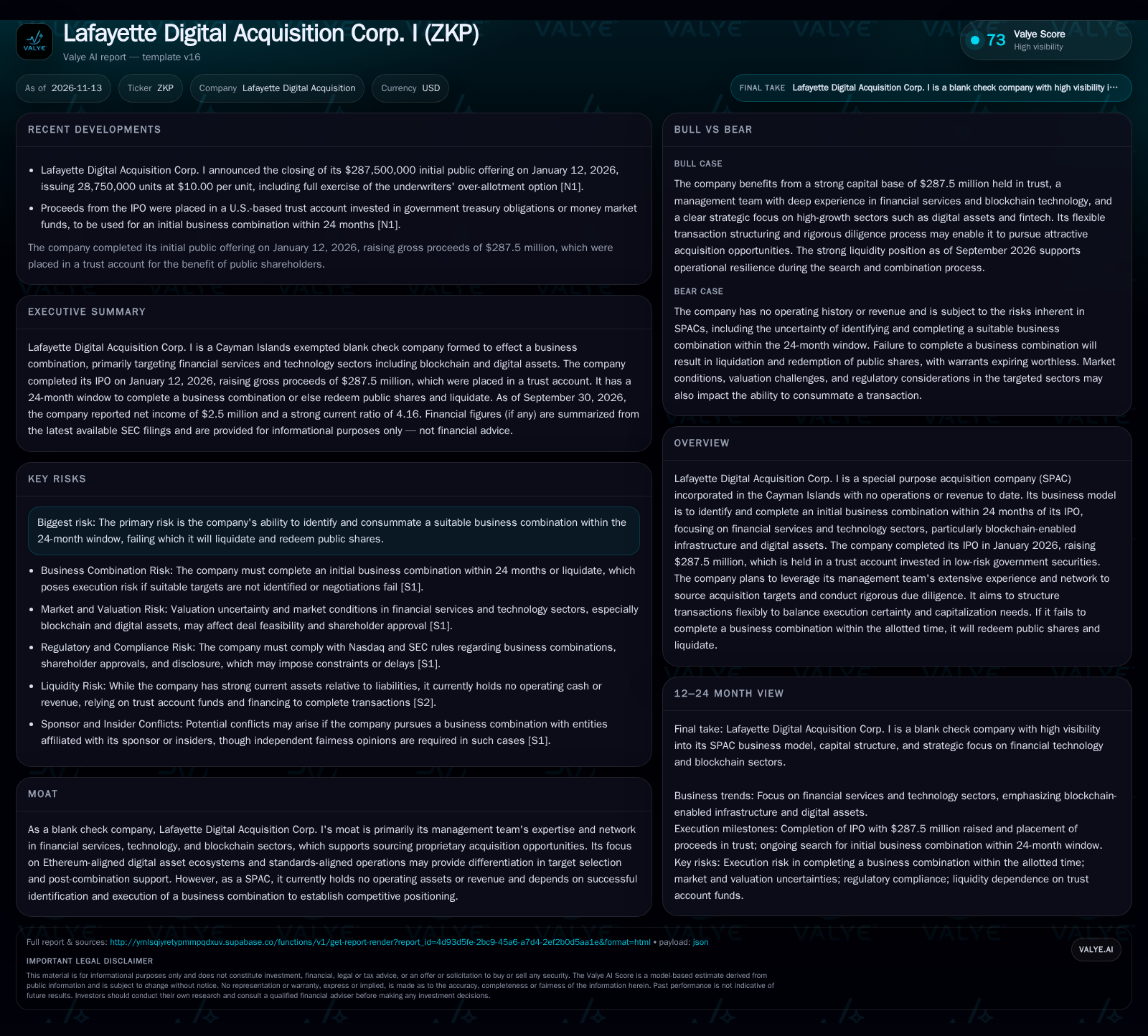
Lafayette Digital Acquisition I is a SPAC with no operating business, holding $287.5M in trust from its January 2026 IPO. The company targets a business combination in fintech, blockchain, or adjacent sectors within 24 months. Success depends on sourcing and executing a suitable deal before the window closes, amid variable market and regulatory dynamics. Failure to close a transaction triggers shareholder redemption and liquidation. The core thesis rests on the management team’s network, sector focus, and deal execution under time pressure. [S1] [S2] [N1]
Lafayette Digital Acquisition Corp. I embodies the classic special purpose acquisition company (SPAC) model: a blank check, a sector thesis, and a countdown clock. With $287.5 million in trust and a mandate to target high-growth fintech or blockchain assets, the company faces the dual challenge of finding a deal that meets its criteria and closing it before the 24-month deadline. Execution risk looms large, as does the unpredictable environment for digital asset and financial technology deals. The next year will be decisive in determining whether Lafayette Digital Acquisition I can translate its capital, network, and sector focus into lasting shareholder value—or whether it will join the ranks of SPACs that ultimately liquidate.
IPO Proceeds, Trust Structure, and the 24-Month Countdown
Lafayette Digital Acquisition Corp. I raised $287.5 million in gross proceeds through its January 2026 IPO, placing the entirety of this capital into a U.S.-based trust account invested in government securities or money market funds. This structure ensures that public shareholders’ funds are protected and available for redemption if a business combination is not completed. The SPAC has not engaged in any operating activities or generated revenue, as confirmed by the latest filings. Instead, its reported net income as of September 2026 is derived solely from interest earned on the trust assets. Critically, the company faces a hard 24-month deadline from the IPO date to close a qualifying transaction, after which it must return trust assets to shareholders and liquidate. [S1] [S2] [N1]
The trust structure not only safeguards shareholder capital but also imposes a rigid timeline that intensifies pressure on deal sourcing and execution. This temporal constraint can influence the SPAC’s strategic approach, potentially prompting management to prioritize speed over optimal target quality as the deadline nears. Additionally, the trust’s investment in low-risk government securities limits yield, which while preserving capital, may reduce the opportunity cost of holding funds idle. This dynamic underscores the importance of balancing capital preservation with the imperative to deploy funds into a value-accretive transaction within the fixed timeframe. Understanding how the trust structure shapes both risk tolerance and deal urgency is critical to assessing Lafayette’s prospects.
How Value Is Created (or Destroyed) in a SPAC: Capital, Incentives, and Dilution Dynamics
SPAC economics are defined by the interplay between initial capital, sponsor incentives, dilution mechanics, and the quality of the target acquisition. Lafayette’s $287.5 million trust provides a substantial pool for a merger or acquisition, but most of this capital is earmarked for the target rather than ongoing operations. The company itself generates no operating cash flow until after a deal closes. Sponsor economics typically include founder shares and private warrants, which can create misaligned incentives if a deal is pursued for sponsor benefit rather than long-term shareholder value. Public shareholders have the right to redeem shares for their pro-rata trust value if they dislike the deal, which can shrink the capital available for the combination and may require PIPE (private investment in public equity) financing or debt to fill the gap. Transaction expenses, due diligence, and ongoing public company costs (legal, compliance, accounting) are incremental cash drains that can erode value if a deal is delayed or fails.
Dilution dynamics in SPACs like Lafayette Digital Acquisition I also hinge on the interplay between sponsor promote structures and shareholder redemption behavior. Founder shares typically convert into common equity post-merger, potentially diluting public investors if redemption rates are high. This creates a delicate alignment challenge: sponsors benefit from completing a deal to realize their promote, but excessive dilution can undermine shareholder returns and market reception. Furthermore, the necessity of PIPE financing to bridge capital gaps caused by redemptions introduces additional complexity, as PIPE investors often negotiate preferential terms that may further dilute existing shareholders or constrain future capital flexibility. Effective management of these incentive and capital structure levers is essential to preserving value creation potential.
Deal Sourcing in a Crowded Fintech and Digital Asset SPAC Landscape
Lafayette Digital Acquisition I’s competitive positioning is shaped by its sector focus—blockchain infrastructure, fintech, digital assets, and financial software—and the depth of its management and sponsor network. The company aims to leverage relationships with founders and investors for proprietary or semi-proprietary deal flow. However, the SPAC market remains saturated, especially in fintech and digital assets, with numerous blank-check vehicles competing for a finite set of attractive targets. Many high-profile fintech and blockchain companies have become wary of SPAC mergers due to post-merger performance volatility and regulatory scrutiny. Traditional IPOs, direct listings, and late-stage private funding rounds offer alternative paths for these companies, increasing competition for Lafayette and potentially raising acquisition multiples. The company’s ability to differentiate itself may depend on its willingness to structure flexible transactions, offer post-merger support, or target under-the-radar assets with defensible technology or data advantages.
In a saturated SPAC environment, Lafayette’s ability to leverage its sponsor network for proprietary deal flow is a key differentiator but also a potential bottleneck. The quality and exclusivity of relationships with fintech and blockchain founders determine access to off-market opportunities that can avoid competitive bidding and valuation inflation. However, reliance on network-driven sourcing may limit the pipeline if those relationships are not sufficiently deep or if target companies prefer alternative exit routes amid regulatory uncertainty. Moreover, Lafayette’s sector focus requires nuanced expertise to identify targets with defensible technology moats and scalable business models, which are scarce in rapidly evolving fintech and blockchain landscapes. Success depends on combining network reach with rigorous target evaluation frameworks to mitigate the risk of overpaying or acquiring suboptimal assets.
A Proprietary, Scalable Fintech Target Unlocks Value for All Stakeholders
The most favorable outcome is a business combination with a high-growth, scalable fintech or blockchain company that meets Lafayette’s criteria: large addressable market, differentiated technology, attractive financial profile, and public-market readiness. In this scenario, the management’s network yields a proprietary or semi-proprietary deal, minimizing competitive bidding and acquisition premiums. The target’s fundamentals—recurring revenue, robust margins, scalable platform, and regulatory compliance—enable a smooth de-SPAC process, strong post-merger trading, and limited redemptions. PIPE financing, if required, is secured on favorable terms, and the combined entity is able to deploy new capital for growth. Confirmation would come from the announcement of a signed letter of intent with a credible target, low redemption rates at the merger vote, and positive trading momentum post-close. Falsification would be signaled by prolonged silence, high redemption rates, or failure to secure a suitable target as the deadline nears.
Deal Execution Pressure, Shareholder Redemptions, and the Realities of the SPAC Cycle
The most plausible outcome is that Lafayette Digital Acquisition I identifies a fintech or blockchain target but faces a complex negotiation process, with significant shareholder redemptions and the need for PIPE or alternative financing to complete the transaction. The deal may be structured to accommodate shifting market valuations, regulatory uncertainty, and residual sponsor incentives. Post-merger trading could be volatile, reflecting the broader challenges faced by de-SPACed companies in 2025-2026. Confirmation of this scenario would be an announced deal with significant redemption rates, possible transaction renegotiation, and the need for additional capital to replace redeemed shares. Falsification would be the announcement of a highly sought-after target with minimal redemptions and strong aftermarket support—or, conversely, a failure to announce any deal at all.
No Deal, Clock Expiry, and Forced Liquidation: The SPAC’s Existential Risk
The adverse scenario is that Lafayette fails to secure a suitable business combination within the 24-month window. This could result from a lack of attractive targets, failed negotiations, adverse market conditions, or insurmountable regulatory hurdles. In this case, the company is forced to redeem all public shares at the trust account value and liquidate, wiping out any sponsor equity and limiting public shareholders to a modest yield from trust interest. Confirmation would come from approaching the deadline with no deal announcement, explicit statements about failed negotiations, or regulatory filings indicating liquidation preparations. Falsification would be a credible deal announcement well ahead of the deadline with clear execution momentum.
Milestones That Will Determine Whether Lafayette Digital Acquisition I Delivers Shareholder Value
Announcement of a signed letter of intent or definitive agreement with a fintech, blockchain, or digital asset target.
Shareholder redemption rate at the merger vote—a high rate would signal weak confidence and reduce available capital.
PIPE financing secured to supplement trust proceeds, if disclosed, especially if redemptions are significant.
Regulatory approvals or commentary regarding the proposed transaction, especially in sensitive fintech or crypto segments.
Sponsor or insider participation in PIPE or backstop arrangements, if disclosed, as a signal of internal confidence.
Market reaction and trading performance of the combined company post-de-SPAC, if the transaction closes.
Ongoing updates on the number of months remaining in the SPAC’s completion window, and any shareholder-approved extensions.
Disclaimer: This is research-only, informational analysis and not investment advice. It may include AI-generated interpretation and general industry context. Always verify important details using primary sources.

Comments