
BT Brands’ Restaurant Spin-Off and UAV Merger: Dilution Effects and Strategic Transformation
BT Brands, Inc. faces a transformative juncture as it seeks to spin off its restaurant operations and merge with Aero Velocity, a UAV and drone-services provider. The move signals a dramatic sector pivot, compressing substantial dilution, new governance, and operational risk into a single transaction. Execution, integration, and the ability to manage cross-industry complexity now define the company's outlook.
BT Brands, Inc. is attempting a high-stakes strategic overhaul: spinning off its legacy restaurant assets and merging with a drone technology company. This would shift control to new shareholders, substantially dilute current owners, and expose the company to new sector risks and integration challenges. The transaction’s success, contingent on multiple approvals, will determine whether BT Brands can effectively reinvent itself.
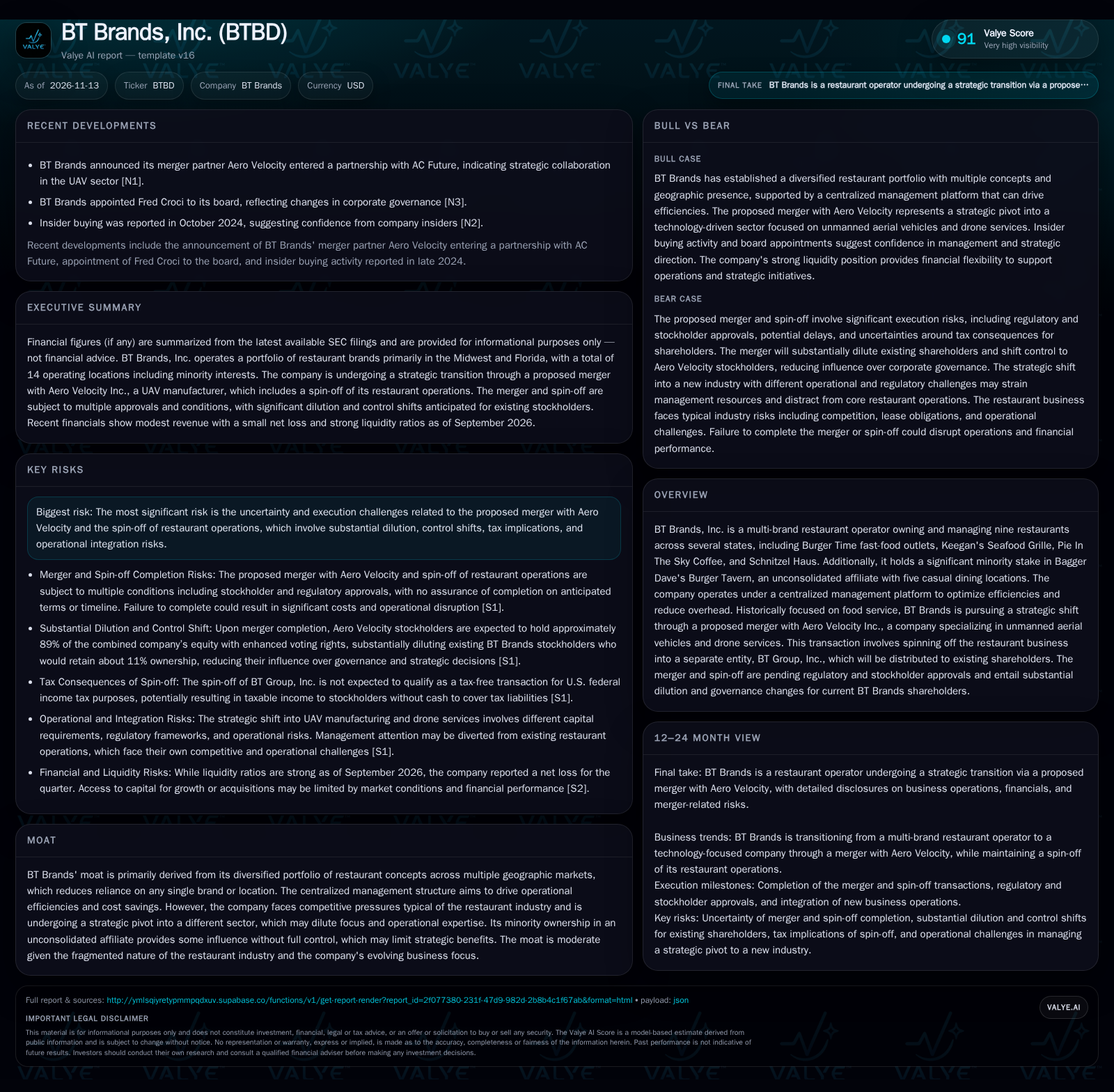
BT Brands, Inc. is at a pivotal crossroads, aiming to exit its traditional role as a regional multi-brand restaurant operator by merging with Aero Velocity, a manufacturer and service provider in the unmanned aerial vehicle (UAV) space. This two-part transaction will spin off BT Brands' restaurant operations to existing shareholders and reconstitute the parent as a drone technology company with new majority owners and governance. The deal represents both a bold pivot and a bet on management’s ability to execute a complex transition across unrelated industries—while simultaneously managing substantial dilution, tax complexities, and the risk that the deal may not close as planned.
Merger Details, Spin-Off Design, and Shareholder Consequences
The company reported cash and liquidity metrics for the period; these figures do not by themselves establish operating runway, investment capacity, financial flexibility, or financing capacity. [S2] The company is in the midst of a proposed merger with Aero Velocity, a UAV manufacturer and drone-services provider, which would spin off the restaurant operations into a new entity, BT Group, Inc. Shares in the spin-off will be distributed to existing holders, but the transaction is not expected to be tax-free for U.S. shareholders, potentially resulting in a cashless tax liability [S1]. Upon completion, Aero Velocity shareholders would control about 89% of the combined company’s equity and possess enhanced voting rights, leaving current BT Brands shareholders with only 11% [S1]. The deal’s closure is contingent on several approvals and may not occur as planned.
Assessing Economic Shifts: From Restaurant Cash Flow Stability to UAV Market Volatility
Historically, BT Brands’ economics have been driven by typical restaurant fundamentals: revenue generated through food and beverage sales, moderate gross margins subject to commodity and labor cost pressures, and a mix of owned and minority interest locations. The centralized management platform could, in principle, provide cost leverage and back-office efficiency, but the company has struggled to achieve scale-driven margin expansion, as reflected in modest revenues and a net loss for the recent quarter [S2].
The proposed merger would fundamentally alter the economic model. The remaining public entity would be dominated by Aero Velocity’s UAV business, which likely features very different economics: higher capital intensity, longer sales cycles, and potential reliance on large contracts or service agreements rather than high-frequency consumer transactions. Drone manufacturing and services may offer higher gross margins or recurring service revenue if commercialized successfully, but upfront R&D, regulatory compliance, and business development costs could be significant. The spin-off of the restaurant assets removes a low-growth but comparatively stable cash-flow base in favor of a high-uncertainty, potentially high-reward technology business. Dilution and loss of control further complicate the value proposition for existing shareholders.
Competitive Dynamics Across Restaurant and Drone Industries
BT Brands’ legacy restaurant business faced intense competition, with limited brand power and geographic scale to create meaningful barriers to entry. The company’s minor equity stake in Bagger Dave’s Burger Tavern offered some diversification but did not confer operational control or a material competitive edge [S1]. The centralized management structure may have provided modest cost advantages, yet the restaurant segment remained exposed to the cyclical and fragmented nature of food service.
Post-merger, the competitive landscape would shift dramatically. Aero Velocity operates in the UAV and Drones-as-a-Service market—a sector characterized by rapid innovation, regulatory flux, and competition from both established aerospace incumbents and agile technology startups. Success in this arena requires technological differentiation, regulatory navigation, and the ability to secure and retain large enterprise or government contracts. Without established brand equity or proven recurring-revenue streams, the combined company would enter a field where switching costs are low and customer loyalty is fragile. The challenge for the new entity will be to carve out a defensible niche amid better-capitalized and more experienced drone sector rivals.
Potential Gains from Strategic Overhaul and Market Expansion
If the merger and spin-off are completed efficiently, BT Brands’ shareholders would receive equity in both the spun-off restaurant business and the new UAV-focused entity. In a favorable scenario, Aero Velocity’s technology could establish a competitive foothold in a fast-growing segment—such as infrastructure inspection, logistics, or defense—securing multi-year contracts that drive high-margin, recurring service revenue. The capital base inherited from BT Brands, together with the expanded management and board (including recent additions such as Fred Croci [N3]), could enable rapid scaling and product development.
Confirmation of this scenario would require evidence of post-merger operational integration, successful commercialization of UAV offerings, and material contract wins or partnerships (such as the recent Aero Velocity-AC Future partnership [N1]). Sustained revenue growth, margin expansion, and positive cash flow from the drone business would be strong signals, as would regulatory approvals and early customer adoption in key target verticals.
Challenges in Managing a Complex Business Transition
The most plausible near-term outcome is a protracted, complex transaction process. Regulatory and shareholder approvals may delay or alter the terms of the merger and spin-off, and integration of two fundamentally different businesses could strain management bandwidth. For existing shareholders, the restaurant spin-off may provide a modest, independent cash-flow stream, but the new UAV entity will be capital intensive and likely unprofitable during its early stages. Dilution and governance changes will reduce legacy shareholders’ influence over strategic direction.
In this scenario, the restaurant spin-off struggles to achieve growth or margin expansion, while the UAV business faces long sales cycles, high R&D and compliance costs, and tough competition. The company’s financial performance remains volatile, with limited visibility on sustainable profitability. Evidence supporting this scenario would include delays in transaction closure, lack of major UAV contract announcements, continued operating losses, and minimal growth in either the spun-off restaurant or the new drone business.
Risks of Deal Failure and Post-Merger Operational Disruptions
The adverse scenario centers on deal failure or post-merger dysfunction. If the merger or spin-off is not completed—due to regulatory, shareholder, or operational barriers—BT Brands could incur significant transaction costs without realizing strategic benefits. The legacy restaurant business would remain saddled with industry headwinds, limited scale, and the distraction of a failed transaction. Alternatively, if the merger closes but operational integration falters, the combined company could face cash burn, failed product launches, or inability to win meaningful UAV contracts.
Shareholder value would be eroded by dilution, tax liabilities from the spin-off, and the absence of clear growth drivers in either business. This scenario would be confirmed by transaction abandonment, restated financials reflecting large one-time expenses, or early post-merger disclosures of integration setbacks, contract losses, or negative regulatory outcomes.
Critical Events Influencing BT Brands’ Strategic Shift
Completion status and closing terms of the Aero Velocity merger and BT Group spin-off, including regulatory and shareholder approval updates.
Tax treatment of the spin-off for U.S. shareholders, and any company guidance on potential tax liabilities or mitigation strategies.
Post-merger capital allocation plans and cash burn rates for the drone business, as disclosed in future filings or investor presentations.
Material contract announcements, especially in UAV services, government procurement, or strategic partnerships that drive revenue visibility.
Operating margin and cash flow trends in both the spun-off restaurant business and the remaining UAV entity, if disclosed.
Board composition and management continuity following the transaction, including integration of new directors such as Fred Croci.
Any restatement of financials or disclosure of one-time transaction-related expenses that impact equity value or future runway.
A useful metric would be customer concentration and retention rates in the UAV business to assess reliance on key accounts post-merger.
Disclaimer: This is research-only, informational analysis and not investment advice. It may include AI-generated interpretation and general industry context. Always verify important details using primary sources.

Comments