
Aeluma’s Shift from Photonics R&D to Market-Ready High-Value Sensing and Communications
Aeluma, Inc. is navigating the complex shift from research-driven photonic innovation to early-stage commercialization, leveraging proprietary compound semiconductor integration for next-generation sensing and communications markets. Despite a reported liquidity position and growing customer engagement, the company must convert promising technology and initial orders into sustainable, scalable revenue amid entrenched competition and manufacturing dependencies.
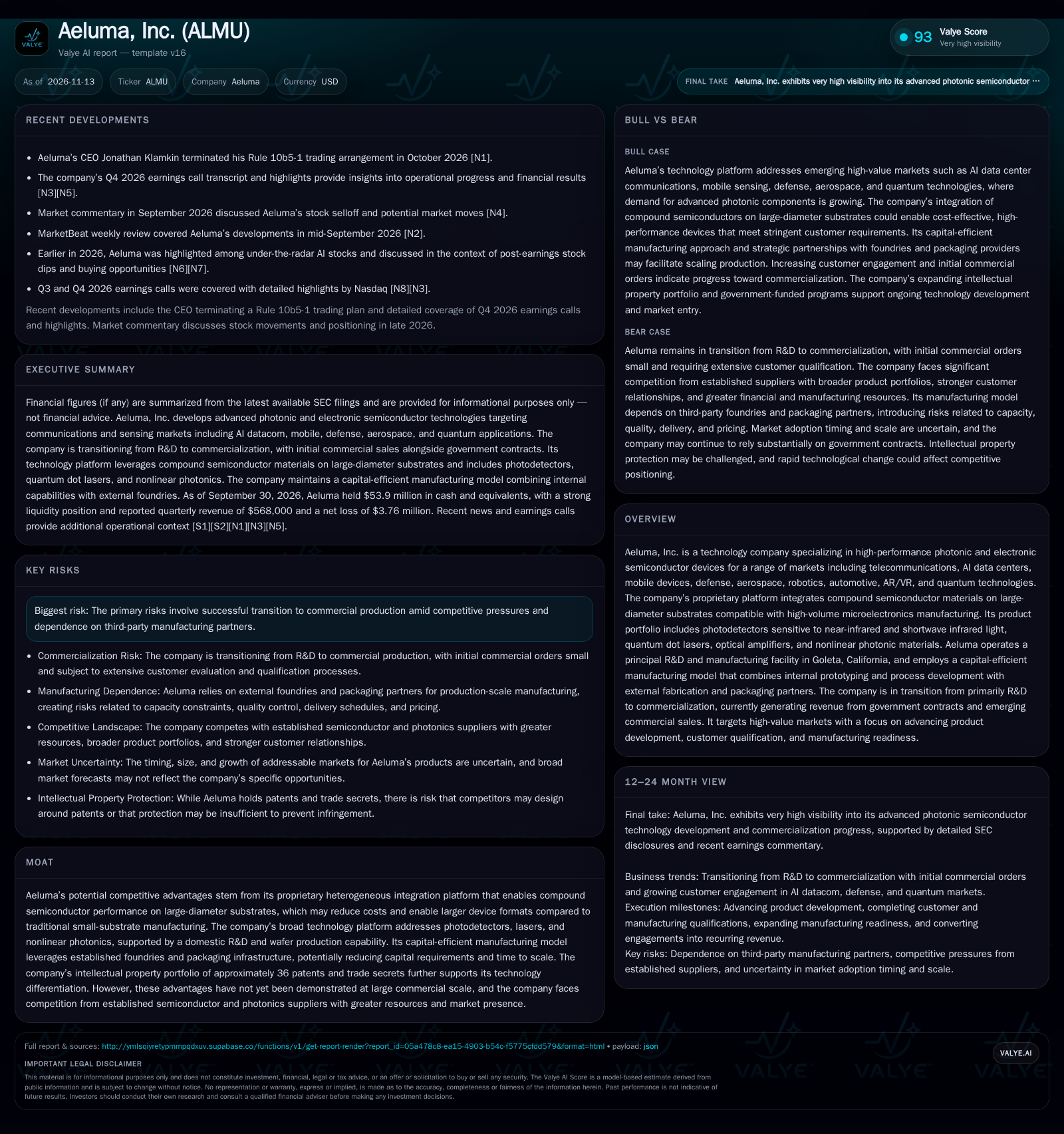
Aeluma, Inc. is moving from R&D to initial commercial sales in advanced photonic components for AI datacom, defense, and quantum applications. It combines proprietary compound semiconductor materials with high-volume manufacturing techniques, aiming for cost and performance advantages. Early commercial orders are small and require lengthy qualification, and the company faces stiff competition from established players. With $53.9 million in cash as of September 2026 and growing customer engagement, the core challenge is proving its technology can scale to meaningful, recurring revenue streams. [S1] [S2]
Aeluma, Inc. stands at a pivotal juncture: having spent years developing a proprietary platform that marries compound semiconductor performance with scalable, large-diameter substrates, the company is now pushing into commercial markets spanning AI data centers, defense, and quantum technologies. With a reported liquidity position and a pipeline of government contracts and early commercial orders, the company’s near-term prospects hinge on overcoming the protracted customer qualification cycles that typify advanced photonics and proving its technology’s value at scale. Achieving this transition could unlock high-value markets, but entrenched competition and execution risk remain central hurdles. [S1] [S2]
Recent Developments and Ongoing Hurdles in Aeluma’s Commercialization Journey
Aeluma, Inc. is in the midst of transitioning from a primarily R&D-focused operation to a company with real, albeit early-stage, commercial activity. As of September 30, 2026, the company reported $53.9 million in cash and equivalents, a current ratio above 26, and quarterly revenue of $568,000—still modest relative to its ambitions, and accompanied by a net loss of $3.76 million. [S2] The revenue base currently reflects a mix of government-funded R&D contracts and emerging, small-scale commercial sales, with initial orders requiring lengthy customer evaluation and qualification before any ramp to volume. [S1] Notably, Aeluma’s customer engagement increased throughout fiscal 2026, particularly in AI datacom, mobile, defense, and quantum segments. [S1] This uptick in activity signals that the company is making inroads with potential adopters, but the real test will be whether these engagements convert into recurring, production-scale revenue.
The Impact of Aeluma’s Manufacturing Approach on Profit Margins and Expansion
Aeluma’s business model is designed for capital efficiency: it combines internal materials production and prototyping with external partners (such as Tower Semiconductor and Sumitomo Chemical Advanced Technologies) for large-scale fabrication, packaging, and integration. [S1] This approach may minimize upfront capital expenditures and fixed costs compared to traditional vertically integrated semiconductor firms, but it introduces variable costs tied to external partner pricing and capacity. The company’s proprietary integration of compound semiconductors on large-diameter substrates could, if proven at scale, enable lower per-unit costs and improved yields versus legacy small-substrate approaches.
The current revenue mix—predominantly government contracts and small commercial orders—suggests that Aeluma is not yet benefiting from operating leverage. Gross margins are likely volatile and compressed at this stage, as early production is characterized by high fixed R&D and qualification costs with relatively little output. If the company can convert customer evaluations into volume orders, the economics could shift: higher throughput would allow fixed R&D and facility costs (such as its Goleta, California R&D and manufacturing site) to be spread over more units, improving margins and cash generation. However, scaling will require careful management of variable costs and successful negotiations with manufacturing partners to preserve any cost advantage.
Aeluma’s Competitive Stance Among Established and Emerging Photonics Players
Aeluma competes in a landscape dominated by established suppliers of CMOS image sensors, InGaAs-based sensors, compound semiconductor lasers, and large silicon photonics firms. [S1] These incumbents possess deep customer relationships, mature manufacturing processes, and the ability to supply in large volumes—factors that create considerable barriers to entry for a newcomer. In addition, emerging quantum photonics players are targeting many of the same high-value applications, raising the bar for both performance and integration.
Aeluma’s potential competitive edge lies in its proprietary integration platform, which may allow for higher-performance photonic components at lower cost by leveraging large-diameter substrates and scalable manufacturing infrastructure. The breadth of its technology portfolio (spanning photodetectors, quantum dot lasers, nonlinear photonics) and a U.S.-based R&D and wafer production capability could appeal to customers seeking domestic supply chains or differentiated device architectures. The company’s intellectual property portfolio—about 36 issued and pending patents—provides some defensibility, but has not yet translated into a clear market lead. Ultimately, the question is whether Aeluma’s technical differentiation and capital-efficient model can overcome the inertia and procurement risk aversion that favor incumbent suppliers.
Potential Pathways to Significant Revenue Growth
A favorable outcome for Aeluma would involve several reinforcing developments: successful qualification of its photodetectors, lasers, or nonlinear photonic devices by a major OEM or system integrator; follow-on volume orders that demonstrate market acceptance; and the ability to ramp manufacturing without eroding margins or hitting quality bottlenecks. The company’s capital-efficient model could enable rapid scaling if demand materializes, provided external partners can deliver capacity and quality as promised.
Confirmation of this scenario would come from a sharp increase in commercial revenue—especially from non-government sources—alongside announcements of multi-year supply agreements or recurring production orders. Additional signals could include new customer wins in AI datacom, defense, or quantum technologies, and public disclosures of design wins or integration into high-profile products. Evidence that would falsify this scenario includes persistent revenue stagnation, failure to secure volume orders after extended evaluations, or difficulty maintaining manufacturing quality and yields at scale.
Aeluma’s Stepwise Move from Pilot Programs to Broader Market Adoption
The most plausible near-term trajectory for Aeluma is a drawn-out conversion of customer engagements into small but growing commercial orders, punctuated by intermittent government contract wins. Revenue growth may remain lumpy as each new commercial win requires extensive qualification and customer validation, with volume ramps occurring more slowly than bullish projections might suggest. The company may continue to post net losses as R&D and business development expenses remain high relative to modest initial sales.
This base scenario would be confirmed by steady, incremental increases in commercial revenue, ongoing customer trials, and occasional announcements of new partnerships or pilot programs. Falsifying evidence would include a sudden drop-off in customer engagement, loss of key government contracts, or clear signs that technical differentiation is insufficient to win business against entrenched competitors.
Factors That Could Impede Aeluma’s Commercialization Momentum
Aeluma’s transition could falter if customers remain hesitant to commit to volume orders, either due to technical concerns, supply chain risk, or procurement inertia favoring incumbents. The reliance on external manufacturing partners could become a liability if capacity, cost, or quality issues emerge as the company seeks to scale.
Negative confirmation would include sustained low commercial revenues, the need for additional capital raises before meaningful sales ramp, or reports of quality, yield, or delivery issues with external partners. A loss of key technical personnel or failure to protect intellectual property could further erode the company’s competitive position.
Specific Indicators Reflecting Progress in Aeluma’s Market Entry
Commercial revenue growth by segment—especially from non-government customers—would directly test the company’s ability to move beyond small initial orders. [S2]
Number and size of production-scale orders or signed supply agreements would indicate whether customer qualifications are converting to recurring business. If disclosed, tracking this metric would be highly informative.
Customer concentration and diversity: monitoring whether revenue is spread across multiple large customers or remains reliant on government contracts would shed light on market traction and risk.
Updates on manufacturing partner capacity, pricing, and quality—either via commentary or disclosed issues—would clarify the scalability of the capital-efficient model.
Gross margin trends, if reported, could reveal whether the shift to commercial production is unlocking operating leverage or encountering cost headwinds.
IP litigation, patent grants, or evidence of competitors designing around Aeluma’s core patents would help assess the durability of any technology moat.
Attrition or additions among technical and business development leadership, as early-stage companies are vulnerable to key personnel risk.
Disclaimer: This is research-only, informational analysis and not investment advice. It may include AI-generated interpretation and general industry context. Always verify important details using primary sources.

Comments