
Sutro Biopharma’s Platform Ambitions: Can Precision ADCs Redefine Oncology Drug Development?
Sutro Biopharma is advancing its proprietary cell-free protein synthesis platforms to deliver next-generation, site-specific antibody drug conjugates (ADCs) targeting difficult-to-treat solid tumors. As its lead candidate STRO-004 enters Phase 1 trials and preclinical assets progress, Sutro’s heavy investment in R&D and reliance on strategic partnerships underscore both its disruptive potential and exposure to clinical and financial risk.
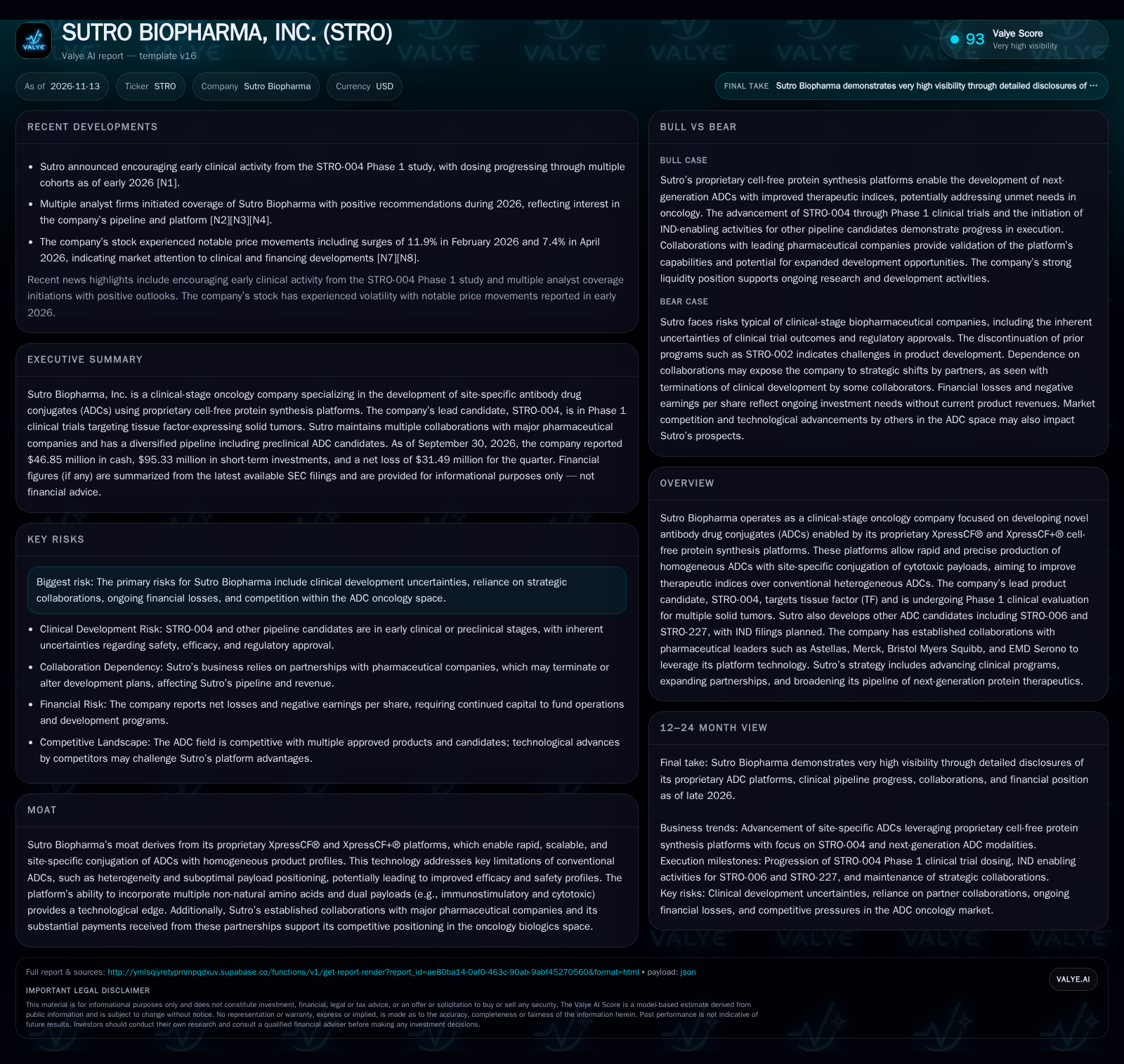
Sutro Biopharma’s XpressCF® technology aims to solve key limitations of conventional ADCs by enabling rapid, homogeneous, and site-specific conjugation—potentially improving efficacy and safety in oncology. With STRO-004 dosed in a Phase 1 trial and a pipeline of novel ADCs, Sutro leverages major pharma collaborations and a reported cash position. The company’s future hinges on clinical validation and sustained partner interest amid intense competition and ongoing losses. [S1] [S2]
Sutro Biopharma is betting that its cell-free protein synthesis platforms—XpressCF® and XpressCF+®—can deliver a new generation of antibody drug conjugates (ADCs) with the precision and flexibility needed to tackle stubborn cancer targets. The company’s technology promises rapid, scalable, and highly controlled ADC manufacturing, aiming to address both efficacy and safety limitations of conventional ADCs. With its lead program STRO-004 now in Phase 1 trials and a robust preclinical pipeline, Sutro’s progress is closely tied to clinical data, the durability of its pharma partnerships, and its ability to navigate the capital-intensive path of oncology drug development. [S1] [S2]
Recent Developments: Clinical Progress and Financial Foundations
Sutro Biopharma’s lead asset, STRO-004—a homogeneous ADC targeting tissue factor (TF)—entered Phase 1 clinical evaluation in November 2025, with dosing ongoing through early 2026. This open-label, multicenter trial is assessing safety, pharmacokinetics, and preliminary anti-tumor activity across multiple advanced solid tumor indications, including non-small cell lung, head and neck, cervical, colorectal, pancreatic, endometrial, and bladder cancers. The initiation and progression of this trial represent a critical inflection point, as it marks the company’s first wholly owned clinical-stage program following the discontinuation of STRO-002 in March 2025. [S1]
On the financial front, as of September 30, 2026, Sutro reported $46.85 million in cash, $95.33 million in short-term investments, and current assets of $159.5 million against current liabilities of $54.31 million, resulting in a current ratio of 2.94 and a cash ratio of 2.62. The company posted a net loss of $31.49 million for the quarter, underscoring the ongoing capital demands typical of clinical-stage biotech operations. [S2]
Cumulatively, Sutro has received approximately $1.016 billion in payments from pharma collaborations (including $79 million in equity investments) through the end of 2025, reflecting sustained partner engagement and external validation of its platform technology. [S1]
How Sutro’s Business Model Could Unlock Value in Oncology
Sutro’s core economic proposition is rooted in its proprietary XpressCF® and XpressCF+® cell-free protein synthesis platforms, which allow for rapid, scalable production of homogeneous, site-specific ADCs. This technical differentiation could translate into improved therapeutic indices—higher efficacy with reduced off-target toxicity—potentially enabling premium pricing and broader clinical adoption if translated into clinical benefit.
Revenue streams for Sutro remain heavily weighted toward collaboration and milestone payments rather than product sales—a common dynamic for clinical-stage biotech. The company’s ability to secure over $1 billion in cumulative payments from partners suggests commercial traction for its platform, but these revenues are episodic and contingent on continued partner interest and project milestones. If Sutro’s technology produces differentiated clinical results, the company could unlock high-margin royalty streams or opt for direct commercialization, but both scenarios require substantial further investment.
Cost structure is dominated by R&D spending, with fixed costs in platform maintenance and clinical development, while variable costs may rise with trial expansion or manufacturing scale-up. The cell-free system’s rapid turnaround (less than 24 hours for protein production versus 30–40 days for conventional methods) could enable flexible prototyping and reduce development timelines, but the true scale economies and gross margins will only be revealed with commercial-stage manufacturing.
Capital needs are significant. Despite a cash and short-term investment balance of $142.18 million as of Q3 2026, ongoing net losses and the capital intensity of late-stage clinical trials and potential commercial launch suggest Sutro will likely require additional funding within the next 12–24 months unless major milestones or new partnerships materialize. [S2]
Technological Edge and Competitive Pressures in the ADC Arena
The antibody drug conjugate (ADC) field is highly competitive, featuring multiple approved agents and numerous candidates from both established pharmaceutical companies and innovative biotech firms. Sutro’s main competitive advantage lies in its proprietary XpressCF® platforms, which enable rapid, site-specific, and homogeneous ADC production—including the incorporation of non-natural amino acids and dual-payload constructs. These capabilities address key industry pain points: product heterogeneity, suboptimal payload positioning, and limited payload diversity.
Sutro’s ongoing collaborations with major pharma players (Astellas, Merck, Bristol Myers Squibb, EMD Serono) provide both validation and a potential pipeline for future licensing or co-development opportunities. However, the ADC sector is marked by rapid technological evolution—competitors are exploring next-generation linkers, novel payloads, and improved antibody engineering. Large-cap pharma with commercial ADCs and deep pipelines remain formidable, and emerging biotech could leapfrog with alternative modalities such as bispecifics, targeted radiotherapies, or cell therapies.
Switching costs may be moderate for partners if Sutro’s platform does not deliver clear clinical or manufacturing advantages, especially given the transactional nature of many early-stage collaborations. The company’s ability to demonstrate clinical differentiation and maintain or expand strategic relationships will be critical to sustaining its position.
If Clinical Data Validate Platform Promise, Sutro Could Transform Oncology Pipelines
In a favorable scenario, STRO-004’s Phase 1 trial generates compelling safety and efficacy signals—such as durable tumor responses or a differentiated safety profile—across multiple solid tumor types. This would provide proof-of-concept for Sutro’s homogeneous, site-specific ADC approach and could catalyze accelerated development, either as a wholly owned program or via lucrative out-licensing deals.
Positive clinical data would likely strengthen existing partnerships and attract new collaborators eager to access Sutro’s flexible platform for novel ADC modalities—especially bispecific, immunostimulatory, or dual-payload constructs. Such momentum could unlock significant non-dilutive milestone payments, larger upfront deals, or opt-in royalties, reducing Sutro’s reliance on equity capital.
Evidence to confirm this scenario would include: rapid enrollment and expansion of the STRO-004 trial, publication of robust Phase 1 data at major oncology conferences, new or expanded partnerships with top-tier pharma, and early initiation of pivotal trials or registrational studies. Downstream, a successful launch or out-licensing of STRO-004 or other pipeline assets would validate the platform’s commercial potential.
Most Likely Outcome: Incremental Progress, Ongoing Losses, and Platform Validation in Stages
The most plausible trajectory for Sutro involves steady advancement of its lead and preclinical assets, with periodic data updates and milestone achievements. STRO-004 may progress through Phase 1 with acceptable safety and preliminary signs of activity, but, like many early ADC programs, may require optimization or face competitive pressure from other emerging therapies targeting tissue factor or overlapping indications.
Collaboration revenues are likely to remain a key source of non-dilutive funding, but new partnership terms may be less lucrative unless Sutro’s platform demonstrates clear clinical or technical superiority. The company will continue to invest heavily in R&D, resulting in persistent net losses and a likely need for additional capital within the next 12–18 months.
Evidence to confirm this base case would include: continued reporting of net losses, incremental clinical progress without major inflection points, moderate partnership activity, and pipeline advancement (e.g., IND filings for STRO-006 and STRO-227 as planned). The thesis would be challenged by significant delays, trial setbacks, or loss of key partnerships.
Clinical Setbacks or Partnership Attrition Could Accelerate Dilution and Strategic Risk
In an adverse outcome, STRO-004’s Phase 1 data could reveal dose-limiting toxicities, lack of efficacy, or other safety concerns, prompting trial suspension or program discontinuation. This would undermine the platform’s clinical credibility and could trigger a negative feedback loop: partners may deprioritize or terminate collaborations, reducing milestone revenue and increasing Sutro’s funding burden.
A scenario of partnership attrition or tepid interest would force Sutro to rely more heavily on external capital markets to fund operations and pipeline progression—at a time when negative clinical news could depress valuation and increase dilution risk. The discontinuation of STRO-002 in 2025 underscores the possibility of strategic pivots or failed programs.
Confirmation of this scenario would come from halted or terminated trials, public disclosure of adverse clinical events, reduction or loss of partner funding, or sudden, dilutive capital raises under unfavorable terms.
Factors That Will Decide Whether Sutro’s Platform Realizes Its Oncology Ambitions
Clinical trial enrollment rates, safety outcomes, and preliminary efficacy data for STRO-004 in Phase 1—particularly any evidence of tumor response or differentiated safety profile.
Progress on preclinical candidates: timely completion of IND-enabling studies for STRO-006 and successful IND filing for STRO-227 as planned.
Updates or expansions in strategic collaborations, especially new deals with large pharma or expanded scope/size of existing partnerships.
Milestone and royalty revenue recognized from collaborations versus historical levels, if disclosed, to test the platform’s ongoing commercial appeal.
R&D burn rate relative to cash and short-term investments, and any signals of impending capital raises or shifting funding strategy.
Publications or presentations at major oncology conferences that could validate technical or clinical claims.
Any announcements regarding manufacturing scale-up, CMC (chemistry, manufacturing, and controls) progress, or regulatory designations (e.g., Fast Track or Breakthrough Therapy) that could accelerate development.
Disclaimer: This is research-only, informational analysis and not investment advice. It may include AI-generated interpretation and general industry context. Always verify important details using primary sources.

Comments