
Bluejay Diagnostics: Approaching Clinical Milestones, but Capital and Regulatory Hurdles Remain
Bluejay Diagnostics is nearing a pivotal FDA submission for its Symphony IL-6 sepsis diagnostic, with recent trial progress and improved cash on hand. Yet, the company’s future depends on timely regulatory clearance, sustained access to capital, and the ability to convert clinical achievements into a viable commercial model.
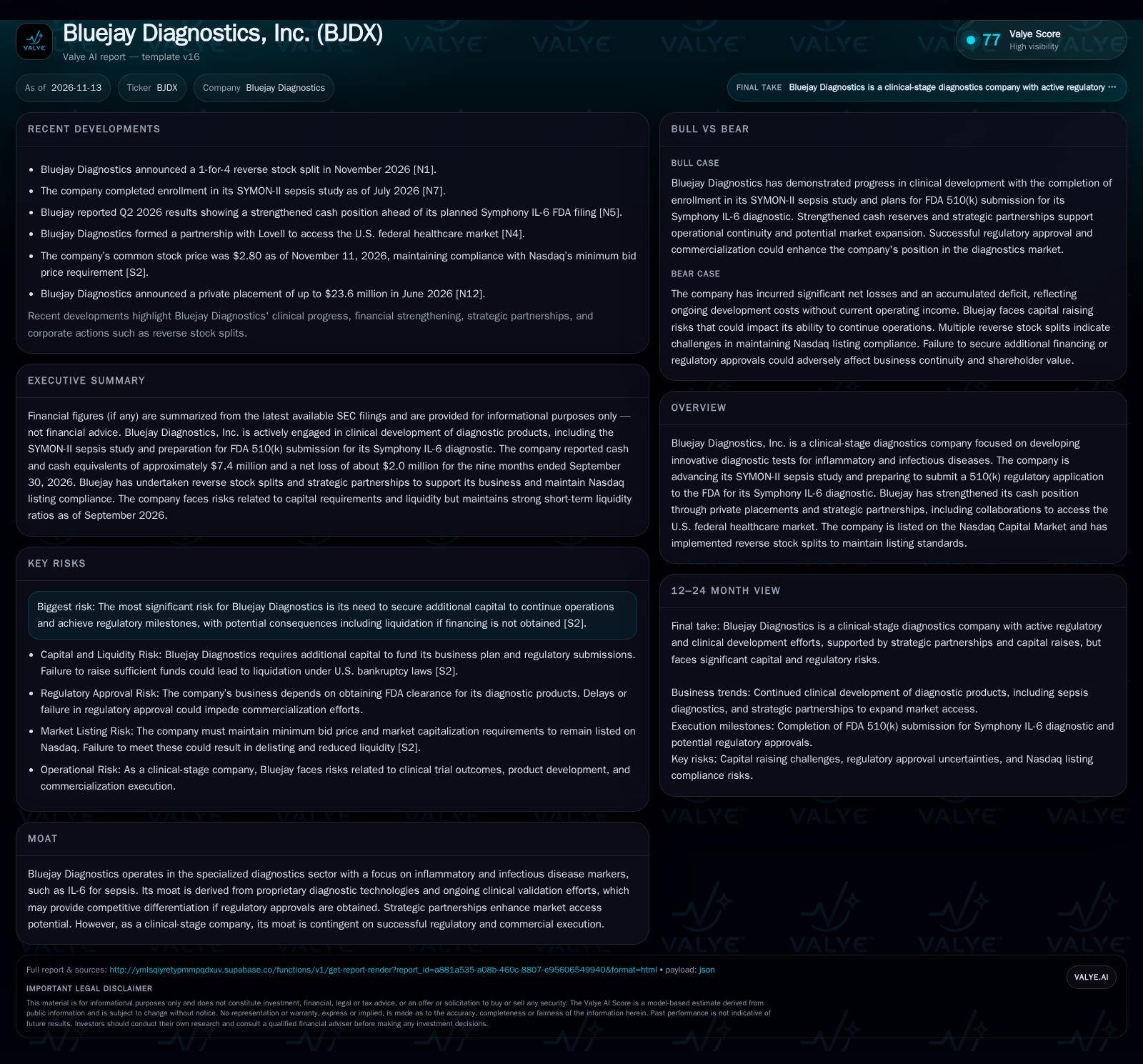
Bluejay Diagnostics has completed enrollment in its SYMON-II sepsis trial and is preparing for a 2027 FDA 510(k) submission for its Symphony IL-6 diagnostic. The company reported $7.4 million in cash as of September 2026, but continues to post net losses and faces a material need for additional funding. Its continued Nasdaq listing reflects successful reverse splits but underscores ongoing listing compliance pressure. The business model’s viability depends on regulatory approval, commercialization execution, and access to capital markets in a competitive diagnostics landscape. [S2] [N1] [N5] [N7]
Bluejay Diagnostics is at a critical juncture: the company has completed a key clinical trial for its Symphony IL-6 sepsis diagnostic and is preparing to submit for FDA 510(k) clearance in 2027. The recent 1-for-4 reverse split underscores ongoing listing compliance pressure and the company’s reliance on external funding. Success will depend on regulatory progress, market uptake, and the ability to sustain its financial runway amid a competitive diagnostics sector. [S2] [N1] [N5] [N7]
Clinical Progress and Funding Status Define Today’s Risk-Reward
Bluejay Diagnostics has completed enrollment in its pivotal SYMON-II sepsis study as of July 2026, positioning the company to file a 510(k) submission for its Symphony IL-6 diagnostic in the first half of 2027 [N7] [S2]. This milestone marks a transition from trial execution to regulatory engagement, a key inflection point for clinical-stage diagnostics firms.
The company reported $7.4 million in cash and equivalents as of September 30, 2026, reflecting a strengthened but finite liquidity position [S2] [N5]. Despite this, Bluejay posted a net loss of approximately $2.0 million for the first nine months of 2026 and an accumulated deficit of about $47.7 million since inception, highlighting the ongoing burn characteristic of pre-commercial diagnostics ventures [S2].
A 1-for-4 reverse stock split in November 2026 enabled Bluejay to maintain Nasdaq listing compliance, with the stock trading at $2.80 as of November 11, 2026 [N1] [S2]. This move, while technically successful, signals persistent pressure to meet minimum price requirements and underscores the reliance on capital markets for continued operation.
Beyond the immediate cash position and net losses, a deeper analysis of Bluejay's operational burn rate relative to its cash reserves would provide insight into its financial runway. If the company’s monthly cash outflows remain steady or increase due to scaling preparations, the current liquidity could support operations for a limited period, necessitating timely capital raises. Conversely, if operational efficiencies or cost reductions are implemented, the burn rate might moderate, extending the runway. Monitoring these dynamics is crucial, as the timing and terms of future financing will directly influence shareholder dilution and strategic flexibility.
Potential Revenue Model Hinges on Regulatory and Commercial Execution
Bluejay’s business model is predicated on bringing proprietary diagnostics—specifically for inflammatory and infectious diseases like sepsis—to market. If Symphony IL-6 secures FDA clearance, the company could generate revenue from direct diagnostic sales, licensing, or partnerships with healthcare providers and distributors. However, the commercial mechanics, such as pricing, contract structure (e.g., per-test vs. platform sales), and reimbursement pathways, have not been disclosed, making near-term revenue projections highly speculative.
The economics of diagnostics often involve high upfront fixed costs (R&D, clinical trials, regulatory filings) followed by variable production and distribution expenses. Once regulatory approval is achieved, operating leverage could emerge: incremental test volumes may contribute disproportionately to profitability if fixed costs are already absorbed. However, the company’s consistent net losses and the need for further capital raises suggest negative operating leverage until commercialization is achieved [S2].
Capital requirements remain significant. [S2] This dynamic exposes Bluejay to dilution risk, unfavorable financing terms, or—if capital markets tighten—potential operational curtailment or liquidation.
Differentiation in a Crowded Diagnostics Landscape
Bluejay aims to carve out a niche in the diagnostics sector by focusing on rapid, actionable tests for sepsis and inflammatory conditions—areas of high unmet medical need. Its proprietary IL-6 diagnostic could offer clinical value if it demonstrates superior sensitivity, specificity, or workflow integration compared to incumbent solutions.
The diagnostics market is highly competitive, with established players offering broad test menus and distribution networks, as well as innovative startups targeting the same biomarkers. Barriers to entry include regulatory approval, clinical validation, and provider adoption, but switching costs for hospitals and labs may be moderate if workflow disruption is minimal and reimbursement is secured.
Strategic partnerships—such as those for accessing the U.S. federal healthcare market—could enhance distribution and credibility, but the ultimate competitive advantage will depend on clinical validation, regulatory success, and the ability to secure favorable reimbursement and adoption. Without clear, sustained differentiation, Bluejay may face pricing pressure or slow uptake from risk-averse healthcare buyers.
Regulatory Approval Triggers Commercial Ramp and Funding Optionality
The most favorable outcome for Bluejay would be timely FDA 510(k) clearance for Symphony IL-6, followed by strong clinical adoption driven by compelling trial data and successful reimbursement negotiations. In this scenario, hospital systems and labs could integrate the test into sepsis protocols, driving recurring sales and potential platform adoption.
Confirmation of this scenario would require: (1) positive regulatory feedback and clearance; (2) evidence of early commercial traction through contracts, purchase orders, or channel partnerships; (3) successful reimbursement coding and payment rates; and (4) the ability to raise capital at improved terms, reducing dilution risk.
Falsification would occur if the FDA delays or denies the application, if trial data are not compelling, or if early market feedback indicates limited interest or reimbursement barriers.
Execution Delays and Capital Constraints Prolong Uncertainty
The most plausible path is that Bluejay proceeds with its FDA submission in 2027, but faces typical regulatory review timelines and potential information requests. Commercialization, if approved, could be gradual as the company works to secure reimbursement, educate providers, and build distribution.
This scenario would be confirmed by regulatory milestones (e.g., acceptance and review of the 510(k)), periodic capital raises to extend runway, and incremental partnership or pilot program announcements. However, continued net losses and further dilution are likely until meaningful revenue materializes.
Falsification would be signaled by a failure to file the 510(k) on time, inability to raise capital, or material negative regulatory feedback.
Funding Shortfalls or Regulatory Setbacks Force Strategic Retrenchment
A credible downside sequence involves either a regulatory setback—such as an FDA rejection or onerous additional data requirements—or a failure to secure sufficient funding. In this case, Bluejay could be forced to curtail development, pursue asset sales or partnerships from a position of weakness, or face the risk of delisting and liquidation.
Evidence for this scenario would include negative regulatory news, missed FDA submission timelines, failed or highly dilutive financing attempts, or a stock price drop below the Nasdaq minimum, triggering delisting risk.
If the company is unable to maintain operations or meet listing requirements, the value for existing shareholders could be severely impaired.
Milestones That Will Determine Whether Bluejay’s Clinical Progress Can Translate to Commercial Success
Actual timing and outcome of the Symphony IL-6 FDA 510(k) submission and subsequent regulatory review.
Updates on additional capital raises, including terms, amount, and resulting dilution.
Evidence of commercial traction, such as purchase orders, contracts, or strategic distribution partnerships—especially with U.S. hospital systems or federal healthcare entities.
Disclosures regarding pricing, reimbursement status, and payer acceptance for Symphony IL-6, if available.
Quarterly burn rate and updated cash runway projections, if disclosed, to assess operational sustainability.
Progress on reimbursement coding, payer negotiations, and integration into clinical care guidelines.
Any further Nasdaq compliance actions, including reverse splits or warnings, that could impact liquidity and investor confidence.
Disclaimer: This is research-only, informational analysis and not investment advice. It may include AI-generated interpretation and general industry context. Always verify important details using primary sources.

Comments