
Motorsport Games: Franchise Concentration Drives Profitability, But Exposes Structural Fragility
A narrow focus on the Le Mans Ultimate franchise has enabled Motorsport Games to achieve its first profit and maintain reported liquidity position, but dependency on a handful of customers and persistent internal control issues raise questions about the durability and scalability of its business model.
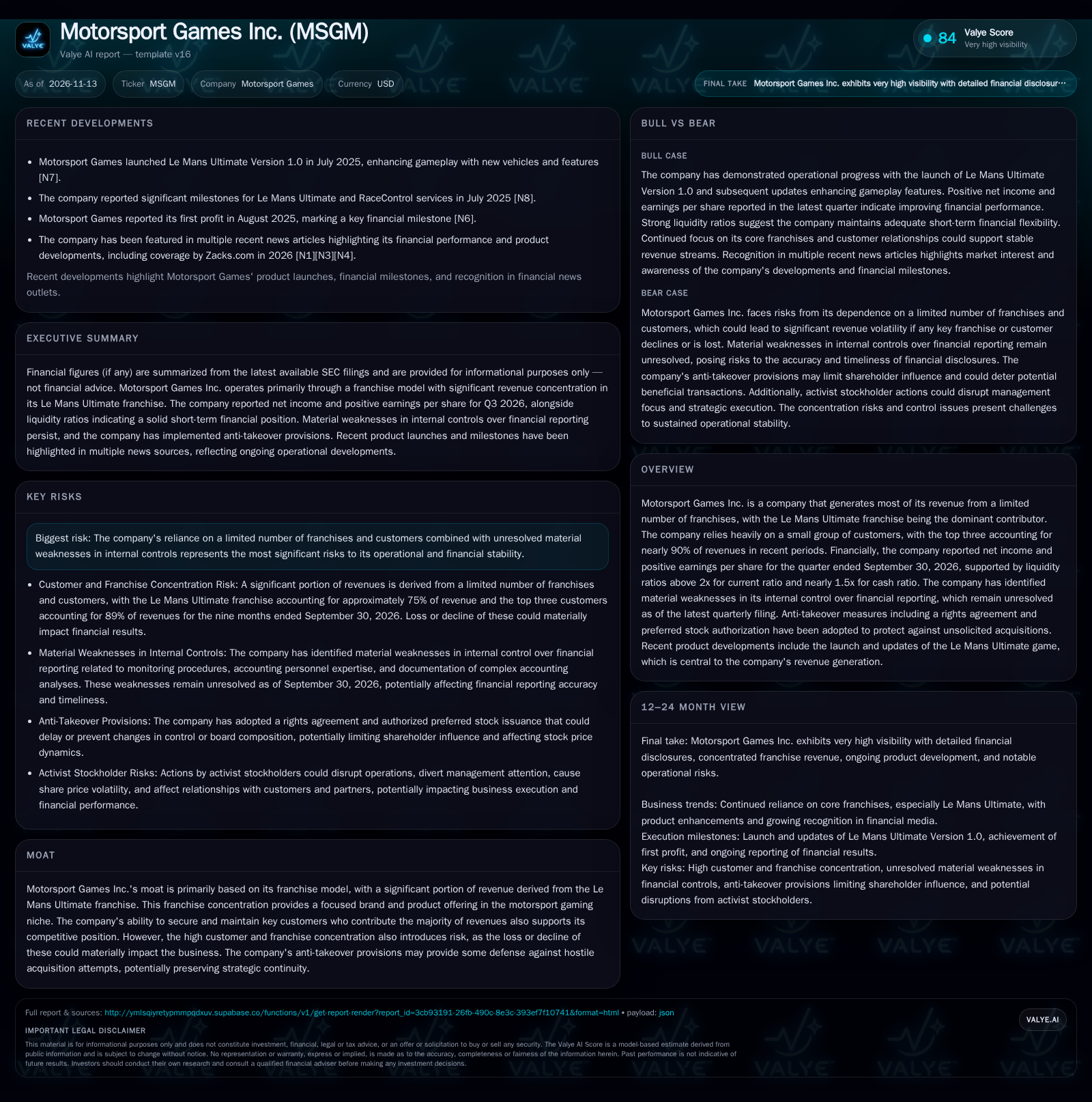
Motorsport Games’ financial turnaround is anchored by the Le Mans Ultimate franchise, which now accounts for 75% of revenue and underpins recent profitability. However, the company’s reliance on just three customers for 89% of revenues and unresolved material weaknesses in internal controls leave it vulnerable to franchise or partner disruption. The business model’s inherent concentration risk will likely define both the upside and downside scenarios in the coming quarters. [S2]
Motorsport Games Inc. has engineered a turnaround by tightly focusing on its Le Mans Ultimate franchise, which now delivers three-quarters of its revenue and has propelled the company to its first reported profits. While recent launches and product enhancements have driven financial improvement and earned media attention, the company’s fortunes are tethered to a narrow set of customers and exposed to unresolved internal control weaknesses. As management seeks to sustain operational momentum, the underlying structure—highly concentrated and potentially brittle—will be tested by both market and governance challenges.
Profitability Returns, But Revenue and Customer Base Remain Highly Concentrated
For the nine months ended September 30, 2026, Motorsport Games derived approximately 75% of its total revenue from the Le Mans Ultimate franchise, underscoring a strategy built on deep focus rather than breadth. The company’s top three customers collectively contributed 89% of total revenues during this period, reflecting a business model with high customer concentration risk. Financially, Motorsport Games reported net income of $328,388 and basic earnings per share of $0.07 for Q3 2026, marking its second consecutive quarter of profitability. Reported liquidity metrics include $5.38 million in cash and a current ratio of 2.16, but material weaknesses in internal control over financial reporting remain unresolved, including deficiencies in monitoring and documentation of complex accounting analyses. [S2]
The concentration of revenue in a limited number of customers and a single franchise inherently increases operational risk, making Motorsport Games particularly sensitive to shifts in customer demand or franchise appeal. This dependency may constrain the company’s negotiating leverage, as losing or displeasing one major customer could disproportionately impact financial performance. Additionally, the unresolved internal control deficiencies suggest potential challenges in accurate financial reporting and risk management, which could affect investor confidence and the company’s ability to respond swiftly to market changes. A robust remediation plan for these control weaknesses would be critical to sustaining trust and operational stability.
Franchise-Centric Model: Revenue Streams and Cost Structure Dynamics
Motorsport Games’ economics are anchored in a franchise model, where licensing agreements and ongoing content updates for Le Mans Ultimate form the core revenue stream. Revenue likely comes from a mix of direct game sales, downloadable content (DLC), and potentially online services such as RaceControl, though the precise commercial mechanics are not specified. The heavy reliance on a single franchise and a handful of customers suggests limited pricing power and little diversification, making profitability sensitive to the lifecycle and popularity of Le Mans Ultimate.
Operating leverage is plausible: once the core game is developed, incremental content updates and digital distribution can expand margins if user engagement remains high. However, fixed costs in game development and licensing—particularly for motorsport IP—can be substantial, and the company may face lumpy revenue recognition tied to major launches or customer renewals. The company reported cash and liquidity metrics for the period; these figures do not by themselves establish operating runway, investment capacity, financial flexibility, or financing capacity.
Given the franchise-centric revenue model, Motorsport Games’ cost structure likely exhibits significant fixed costs related to game development, licensing fees, and platform maintenance, with variable costs tied to marketing and customer support. This cost composition implies that scaling revenue through user base expansion or additional content releases could improve profitability via operating leverage. However, the timing and magnitude of content launches may cause revenue volatility, complicating cash flow predictability. Furthermore, the company’s limited pricing power, due to dependency on a few customers and competitive pressures, may constrain margin expansion, necessitating careful cost management and innovation in monetization strategies to sustain profitability.
Niche Focus Versus Platform Scale: Where Motorsport Games Stands
Motorsport Games occupies a specialized niche within the racing simulation segment, leveraging the Le Mans Ultimate brand for differentiation. This focus may provide a defensible market position among motorsport enthusiasts, but it also caps addressable market size compared to broader racing franchises from larger competitors. The company’s moat is tied to licensing relationships and its ability to deliver authentic, regularly updated content tied to marquee events.
However, the lack of diversification and high customer concentration leave Motorsport Games exposed to shifts in franchise popularity or the negotiating power of key partners. Major platform holders, large gaming publishers, or alternative racing titles could act as substitutes or competitive threats, especially if they secure similar licensing deals or invest in more robust online ecosystems. The company’s anti-takeover provisions may deter hostile acquisition attempts but could also reduce its strategic flexibility in a consolidating industry.
Motorsport Games’ niche positioning within the racing simulation market offers both advantages and vulnerabilities. While a focused franchise like Le Mans Ultimate can foster strong brand loyalty and specialized expertise, it also limits the company’s ability to capture broader market segments or pivot quickly in response to changing consumer preferences. Competitors with diversified portfolios or larger scale may leverage cross-franchise synergies, broader distribution channels, and greater marketing resources to erode Motorsport Games’ market share. The company’s reliance on licensing agreements further exposes it to renegotiation risks or potential loss of rights, which could be exacerbated by competitors securing exclusive deals or investing heavily in emerging technologies such as virtual reality racing experiences.
If Le Mans Ultimate Sustains Engagement and Expands Its Ecosystem
A bullish scenario would see Le Mans Ultimate maintaining or increasing its share of the motorsport gaming audience, with regular content releases, positive community reception, and robust engagement on RaceControl or similar online platforms. This could drive higher digital sales, recurring DLC revenue, and potentially attract new licensing or sponsorship partners. The company’s demonstrated ability to achieve profitability suggests that, with steady franchise performance, operating leverage could meaningfully boost margins.
Evidence supporting this scenario would include consistent or growing revenue and user metrics for Le Mans Ultimate, successful launches of new content or features, and signs of customer diversification—such as new contracts or expanded distribution partnerships. Falsification would come from declining franchise revenue, negative user engagement trends, or the loss of a top customer.
Sustained Profitability, But Structural Risks Cap Upside
The most plausible outcome is that Motorsport Games maintains modest profitability anchored by Le Mans Ultimate, but without meaningful diversification or expansion, revenue growth remains limited and volatility stays high. Customer and franchise concentration continue to define the risk profile, with periodic updates and community events sustaining user interest but not generating breakout growth.
This scenario would be confirmed by continued net income, stable cash balances, and regular product updates, but little evidence of material new franchises, customer diversification, or significant margin expansion. Any improvement in internal controls—if disclosed—would also support greater confidence in the durability of reported results.
Franchise or Customer Loss Triggers Revenue Shock
The most acute risk remains the potential loss or material decline of the Le Mans Ultimate franchise or a top customer. Given that 75% of revenue is tied to one franchise and 89% to three customers, any disruption—whether from licensing disputes, competitive launches, or customer churn—could result in rapid revenue and profitability deterioration.
This scenario would be confirmed by a drop in reported revenues, negative net income, or disclosures of terminated or non-renewed contracts. Additional evidence would include user attrition, negative press regarding franchise performance, or worsening internal control findings that undermine confidence in reported financials.
Milestones That Could Validate or Challenge the Motorsport Games Thesis
Performance of Le Mans Ultimate: Quarterly and annual revenue contributions, active user metrics, and engagement trends for the franchise—if disclosed—would directly test the sustainability of the core business.
Customer Concentration: Any change in the proportion of revenue from the top three customers, or announcements of new significant partners or contracts, would signal progress on diversification.
New Franchise or Product Launches: Evidence of development or launch of additional franchises beyond Le Mans Ultimate would indicate a shift toward business model resilience.
Internal Control Remediation: Updates on the resolution of material weaknesses in financial reporting would address a key risk to reporting quality and operational oversight.
Liquidity and Cash Flow Trends: Monitoring cash balances, operating cash flow, and any new financing or capital raise activity will help assess potential financial flexibility.
Franchise Licensing or Renewal Events: Announcements regarding the renewal, extension, or loss of key licensing agreements could materially impact future revenue.
Activist or Governance Developments: Board changes, activist investor actions, or modifications to anti-takeover provisions could affect strategic direction and risk profile.
Disclaimer: This is research-only, informational analysis and not investment advice. It may include AI-generated interpretation and general industry context. Always verify important details using primary sources.

Comments