
Gulf Coast Ultra Deep Royalty Trust: Awaiting Well Results in a Single-Asset, High-Risk Model
With its only income source shut in, Gulf Coast Ultra Deep Royalty Trust’s future hinges on the uncertain outcome of a newly drilled deep well in South Louisiana. The Trust’s lack of operational control, exposure to commodity and regulatory volatility, and single-asset concentration create a binary thesis around production resumption.
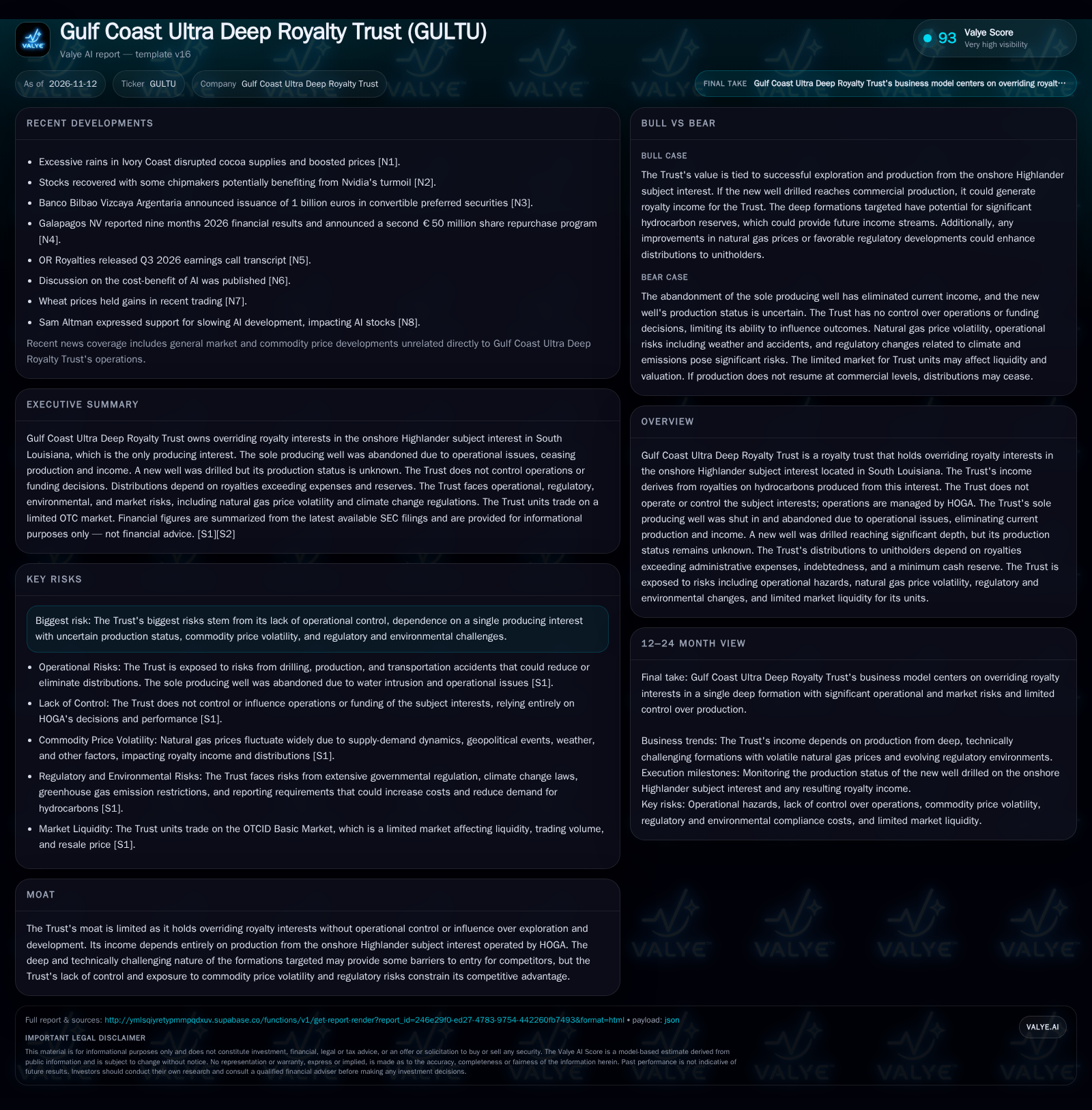
Gulf Coast Ultra Deep Royalty Trust currently generates no income after abandoning its sole producing well. The fate of a new, ultra-deep well—whose production status remains unknown—will determine whether royalty distributions resume. The Trust’s economics are highly sensitive to operational outcomes, natural gas prices, and regulatory changes, compounded by its inability to influence operations or diversify risk. [S1]
Gulf Coast Ultra Deep Royalty Trust stands at a pivotal juncture following the abandonment of its only income-generating well in South Louisiana. The Trust’s future now depends entirely on the outcome of a newly drilled, ultra-deep well—whose commercial viability and production status remain unknown. As a passive royalty vehicle with no operational control, the Trust is exposed to operational, commodity price, and regulatory risks, making its near-term outlook highly binary. Success or failure in bringing the new well online could determine whether unitholders see any future distributions.
Production Halt and a New Well Create a Make-or-Break Moment
Gulf Coast Ultra Deep Royalty Trust’s sole producing well on the onshore Highlander subject interest was shut in and abandoned due to operational issues and water intrusion, eliminating all current royalty income. A new, technically complex well was spudded on January 30, 2025, reaching a total depth of 30,862 feet by February 17, 2026, but its production status remains unreported. The Trust’s distributions to unitholders are now suspended unless and until this new well yields commercial production sufficient to cover administrative costs, indebtedness, and a minimum required cash reserve of $302,500 as of December 31, 2025. The Trust itself has no control or influence over operations, which are entirely managed by HOGA. [S1]
How Royalties, Costs, and Price Volatility Shape the Trust’s Earnings Potential
The Trust’s business model is structurally simple but economically fragile: it receives a fixed percentage of gross hydrocarbon revenue (overriding royalty interest) from the onshore Highlander subject interest, after deduction of administrative expenses and maintenance of a minimum cash reserve. There are no direct operating expenses or capital expenditures for the Trust, but it is entirely dependent on the net cash flow from production managed by HOGA.
The economics are acutely sensitive to production volume, natural gas pricing, and timing of any revenue resumption. With no current output, fixed administrative expenses persist, meaning the Trust is presently cash-flow negative. If the new well proves productive, the Trust would benefit from high operating leverage: incremental royalty revenue flows through to unitholders after modest administrative costs. However, because the Trust cannot influence development pace, operational efficiency, or capital allocation, its fate is tied to HOGA’s actions and market conditions.
Commodity price volatility further compounds this fragility. Even if production resumes, sharp declines in natural gas prices could erode or eliminate distributable income, while cost inflation or new regulatory requirements could increase the minimum threshold for breakeven distributions.
The Trust's reliance on a fixed overriding royalty interest means its revenue stream is inherently passive and lacks flexibility. This structure can magnify the impact of any production interruptions or declines, as the Trust cannot adjust its operational approach to mitigate losses. Moreover, the absence of capital expenditure obligations shields the Trust from direct financial burdens but also precludes it from influencing development strategies that might enhance recovery or extend the asset's productive life. Consequently, the Trust's cash flow is a direct function of the operator's efficiency and external market forces, underscoring the importance of monitoring operator performance metrics and broader commodity cycles.
Single-Asset Exposure and No Operational Levers Limit Defensibility
The Trust’s competitive position is unusually weak by design. Unlike operators or diversified royalty vehicles, Gulf Coast Ultra Deep Royalty Trust has exposure to only one producing asset, and it holds no rights to direct, accelerate, or optimize operations. Its only potential moat is the technical challenge and capital intensity of the deep formations targeted, which may deter new entrants from directly competing for the same resource base—but does not shield the Trust from execution risk or operator decisions.
There are no direct competitors for the overriding royalty stream from this specific asset, but the Trust’s units must compete with broader energy royalty vehicles, master limited partnerships, and income-focused alternatives that may offer more diversified or stable payouts. The limited OTC market further reduces liquidity, making the Trust less attractive for investors requiring flexibility or scale.
The Trust's single-asset concentration amplifies its exposure to idiosyncratic risks, including geological uncertainties, mechanical failures, and operator-specific decisions. Unlike diversified royalty portfolios that can offset underperformance in one asset with gains in others, this Trust's fortunes are tightly coupled to the success of a single well. This lack of diversification increases the volatility of expected cash flows and may deter risk-averse investors. Additionally, the Trust's inability to influence operational decisions limits its capacity to respond proactively to challenges, placing it at a strategic disadvantage relative to entities with operational control or broader asset bases.
From a market perspective, the Trust's reported liquidity position on the OTC market restricts price discovery and may exacerbate valuation discounts during periods of uncertainty or distress. Investors seeking exposure to energy royalties often favor instruments with transparent pricing and active secondary markets, which provide exit flexibility and reduce transaction costs. The Trust's niche positioning and market constraints may therefore limit its appeal to institutional investors or those requiring portfolio liquidity, potentially resulting in higher required returns to compensate for these risks and market frictions.
If the New Well Flows: Potential for Royalty Resumption and Upside Surprise
A favorable scenario is contingent on the new Highlander well achieving commercial production at meaningful flow rates. If HOGA brings the well online and production volumes are sufficient to generate royalty income above administrative costs and required reserves, the Trust could resume distributions. Given the depth and technical challenge of the formation, a successful well might yield substantial reserves, potentially supporting multi-year payouts—especially if natural gas prices remain supportive.
Upside could be amplified by a recovery in natural gas prices or by regulatory clarity that reduces cost or compliance uncertainty. Confirmation would come through formal notification from the Trust regarding commercial production commencement, reported royalty receipts, and re-initiation of distributions to unitholders. Sustained high payout ratios and disclosure of reserve estimates would further validate the upside thesis.
Waiting Game: Uncertainty Persists Pending Well Results and Market Conditions
The most plausible scenario is a period of continued uncertainty. The new well may require prolonged testing, remediation, or even workovers before its potential is known. Administrative expenses will continue to erode the Trust’s cash reserves in the interim. If the well eventually produces, initial flows could be modest or variable, resulting in sporadic or partial distributions.
Confirmation of this scenario would come from delays or limited communication about production status, ongoing suspension of distributions, and continued reliance on existing cash reserves. Alternatively, a modest initial production profile or muted price environment could limit the Trust’s ability to generate meaningful or sustainable income, resulting in low or irregular payouts.
Another Dry Hole or Prolonged Shut-In: Path to Zero Distributions
The adverse scenario materializes if the new well fails to achieve commercial production—whether due to technical failure, poor reservoir quality, or ongoing operational setbacks. In this case, the Trust would remain without royalty income, and administrative expenses would steadily deplete its cash reserves. Ultimately, the Trust could be forced to suspend all distributions indefinitely, with units trading as a pure option on a future, uncertain operational turnaround.
This outcome could be confirmed by explicit disclosure of unsuccessful well results, abandonment notices, or further write-downs of trust assets. Ongoing regulatory or cost headwinds, or a collapse in natural gas prices, could compound the downside, making eventual recovery even less probable.
What Will Determine Whether Gulf Coast Ultra Deep Royalty Trust Delivers Value?
Formal disclosure of the new Highlander well’s production status and initial flow rates, if available.
Timing and magnitude of any royalty receipts reported by the Trust following the new well’s completion.
Re-initiation, suspension, or permanent cessation of distributions to unitholders.
Updates on the Trust’s cash reserve levels and administrative expense burn rate.
Natural gas price trends and volatility, which directly affect potential royalty income.
Any regulatory changes or environmental compliance costs impacting the economics of the subject interest.
Operational updates or additional capital/development plans communicated by HOGA (if disclosed).
Disclaimer: This is research-only, informational analysis and not investment advice. It may include AI-generated interpretation and general industry context. Always verify important details using primary sources.

Comments