
Mexco Energy: Disciplined Balance Sheet and Focused Control in Small-Cap Oil & Gas
The company’s ability to convert reserve value and manage sector volatility will determine long-term shareholder outcomes.
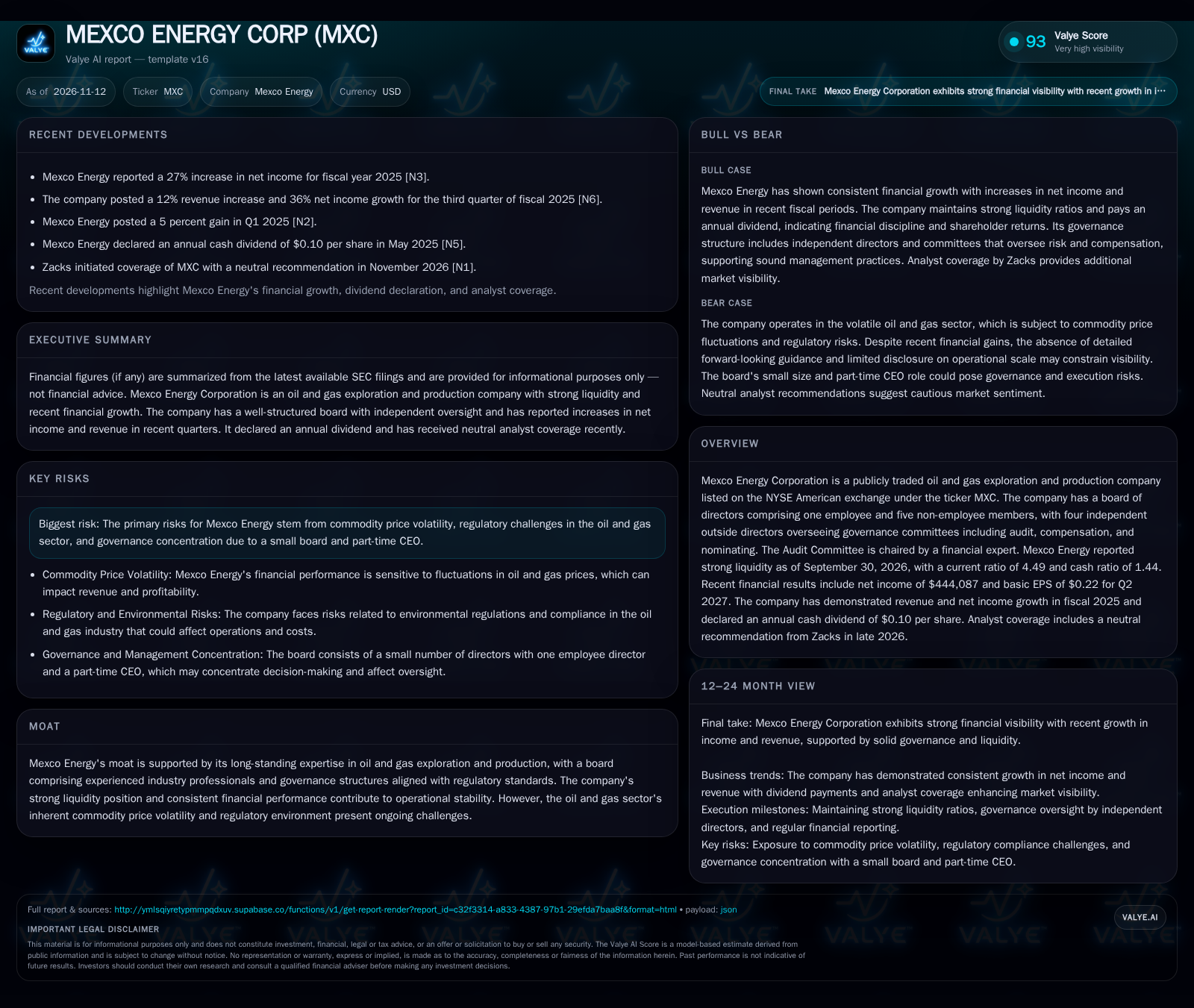
Mexco Energy reported a cash balance of $903,819 and a current ratio of 4.49 as of September 30, 2026, reflecting notable liquidity for its operational scale. The company posted net income of $444,087 for the quarter and maintains a governance structure with a majority independent board, though its CEO and largest shareholder wields significant influence. With a neutral analyst view and an annual dividend declared in 2025, Mexco faces the classic risks of commodity exposure and scale limitations, balanced against prudent financial management and a proven reserve base. [S2] [N1] [N5]
Mexco Energy stands out among small-cap oil and gas companies for its disciplined balance sheet and continued earnings growth, even as it operates in a sector notorious for volatility and capital intensity. Yet, the company’s future will be shaped by its ability to translate reserve value into sustainable cash flow and navigate the structural risks of commodity price swings, regulatory demands, and a governance model marked by concentrated control.
Operational Discipline Reflected in Recent Liquidity and Earnings
As of September 30, 2026, Mexco Energy reported cash and cash equivalents of $903,819 and current assets of $2.82 million against current liabilities of $628,727, resulting in a current ratio of 4.49 and a cash ratio of 1.44 [S2]. The company reported cash and liquidity metrics for the period; these figures do not by themselves establish operating runway, investment capacity, financial flexibility, or financing capacity. The company posted net income of $444,087 ($0.22 per share) for the quarter, continuing a recent trend of profit growth, including a 27% net income increase for fiscal 2025 and a 36% jump in Q3 2025 [S2] [N3] [N6]. In May 2025, Mexco declared an annual cash dividend of $0.10 per share, underscoring its commitment to shareholder returns [N5]. The board structure features a majority of independent directors, yet CEO and chairman Nicholas C. Taylor controls approximately 46% of outstanding shares, centralizing governance and strategic direction [S1].
Value Extraction Strategies in Smaller-Scale Oil & Gas Ventures
Mexco Energy’s core business is the acquisition, exploration, development, and production of oil and natural gas properties in the United States. Revenue is driven primarily by the sale of produced hydrocarbons, with realized pricing a function of prevailing regional spot markets. Unlike larger E&P companies with diversified asset bases and hedging programs, small-caps like Mexco tend to have higher exposure to price volatility and less leverage to economies of scale.
The company’s reserve base was estimated at 1.437 million barrels of oil equivalent (MMBOE) as of March 31, 2026, with a present value of $21 million discounted at 10% per annum, split roughly evenly between oil and gas [S1]. This reserve mix exposes Mexco to both oil and gas price cycles, and future value realization depends on disciplined capital allocation, cost control, and successful conversion of reserves into production. Fixed costs—such as lease operating expenses, regulatory compliance, and overhead—can weigh heavily on profitability for smaller operators, while variable costs scale with production. The company’s ability to maintain profitability during downturns often hinges on prudent capital spending, selective drilling, and a flexible cost structure.
Given its size, Mexco is likely to fund new projects through a combination of operating cash flow and, if needed, targeted equity or debt issuance.
The capital allocation decisions Mexco makes are critical given the cyclical nature of the oil and gas sector. In particular, the timing and scale of exploration and development investments must align with commodity price cycles to optimize returns. If Mexco can selectively invest during periods of favorable pricing while maintaining a conservative financial posture during downturns, it may enhance its ability to sustain operations without excessive dilution or leverage. Additionally, operational efficiency gains—such as improved drilling techniques or cost reductions in production—would further support margin stability. The interplay between reserve life, production rates, and capital expenditure pacing is a key dynamic that will influence Mexco’s long-term cash flow profile and valuation.
Competitive Dynamics and Constraints in Small-Cap E&P
Mexco operates in a highly competitive sector dominated by larger, integrated oil and gas companies, as well as a broad spectrum of independent E&P firms. Its competitive position is defined by its focus on U.S. properties, lean cost structure, and experienced board with sector expertise [S1]. The company’s small scale can be both a strength and a weakness: it enables nimble decision-making and lower overhead, but limits access to premium acreage, capital markets, and large-scale development opportunities.
Peer competition is intense, with rivals ranging from other small-cap E&Ps to private operators and larger independents. Substitution risk is inherent, as buyers (midstream, refiners, or marketers) can source hydrocarbons from a wide array of producers. In the longer term, structural headwinds from the energy transition and potential demand shifts could pressure realized prices and access to capital.
Potential counterforces to Mexco’s competitive position include commodity price swings, regulatory tightening, and industry consolidation. The company’s governance structure, with significant insider ownership, may support strategic consistency but could also reduce responsiveness to external pressures or minority shareholder interests.
Mexco’s competitive positioning is also influenced by its ability to leverage local knowledge and operational agility. Smaller operators can sometimes capitalize on niche opportunities or underdeveloped fields that larger companies overlook due to scale or strategic focus. However, this advantage is conditional on maintaining access to capital and technical expertise, which can be constrained in smaller firms. Furthermore, the company’s governance concentration may allow for swift strategic pivots but could also limit external input that might identify emerging risks or opportunities. In an industry increasingly shaped by environmental, social, and governance (ESG) considerations, smaller players like Mexco must balance operational flexibility with evolving stakeholder expectations, which may affect access to capital and market reputation over time.
Reserve Value Potential in a Favorable Commodity Context
In a constructive scenario, Mexco leverages its disciplined balance sheet and operational efficiency to ramp production during periods of elevated oil and gas prices.
Disclosure of new drilling successes, accretive property acquisitions, or expanded reserve estimates would also signal effective capital deployment. A narrowing of the valuation gap with larger peers or a shift to more bullish analyst coverage would further validate the upside.
In scenarios where commodity prices rise sustainably, Mexco’s ability to convert reserves into increased production could generate disproportionate cash flow growth relative to its size. This would be particularly true if the company can avoid overextending its balance sheet while selectively investing in high-return projects. The potential for accretive acquisitions or partnerships could also enhance scale and operational footprint, improving cost structures and market visibility. However, realizing this upside depends on maintaining operational execution excellence and navigating the timing of capital deployment to avoid the pitfalls of overexpansion common in commodity cycles.
Maintaining Steady Growth Through Prudent Operations
The most plausible trajectory is that Mexco continues to operate conservatively, maintaining reported liquidity position and posting steady but unspectacular earnings in line with recent results. Governance remains concentrated, but the board’s independence and experience provide a check on major strategic missteps.
This scenario would be confirmed by continued positive net income, stable or gradually increasing production, and maintenance of high liquidity ratios. Analyst coverage likely remains neutral, with valuation tracking sector averages. Absence of major acquisitions or transformative projects would support the base case, as would consistent disclosure of reserve and production metrics.
Exposure to Price Volatility and Scale-Related Risks
A negative scenario emerges if oil and gas prices decline sharply or remain depressed for a sustained period. Given its size, Mexco has limited ability to hedge or absorb prolonged revenue shocks. Regulatory changes or an operational setback (such as a dry hole or environmental incident) could amplify downside risk.
Signs that this scenario is unfolding would include a rapid deterioration in net income, shrinking production, reduction or suspension of the dividend, or a need to raise dilutive equity or take on high-cost debt. Governance risks could become more pronounced if concentrated control impedes swift adaptation or if minority shareholder concerns escalate.
Key Milestones Influencing Mexco Energy’s Long-Term Value
Quarterly and annual production volumes: Consistent growth or sharp declines will be an early signal of operational momentum or stress.
Reserve replacement ratio and updates to proved reserves: A useful metric would be whether the company is adding new reserves at a pace matching or exceeding production depletion.
Net income and operating margins: Sustained profitability, especially during commodity downturns, would confirm cost discipline and resilience.
Governance events, such as board changes or shifts in insider ownership: Would help test whether concentrated control remains stable or if minority interests gain more influence.
Disclosure of new drilling projects, acquisitions, or divestitures: These actions would indicate strategic direction and capital allocation discipline.
Disclaimer: This is research-only, informational analysis and not investment advice. It may include AI-generated interpretation and general industry context. Always verify important details using primary sources.

Comments