
Tamboran Resources: Pre-Revenue Oil & Gas Play Bolstered by reported cash position and New Leadership
However, the company remains highly exposed to sector execution risks and will need to demonstrate tangible progress toward production to justify current market optimism and analyst support.
However, the company remains highly exposed to sector execution risks and will need to demonstrate tangible progress toward production to justify current market optimism and analyst support. [S2] [N5] [N8]
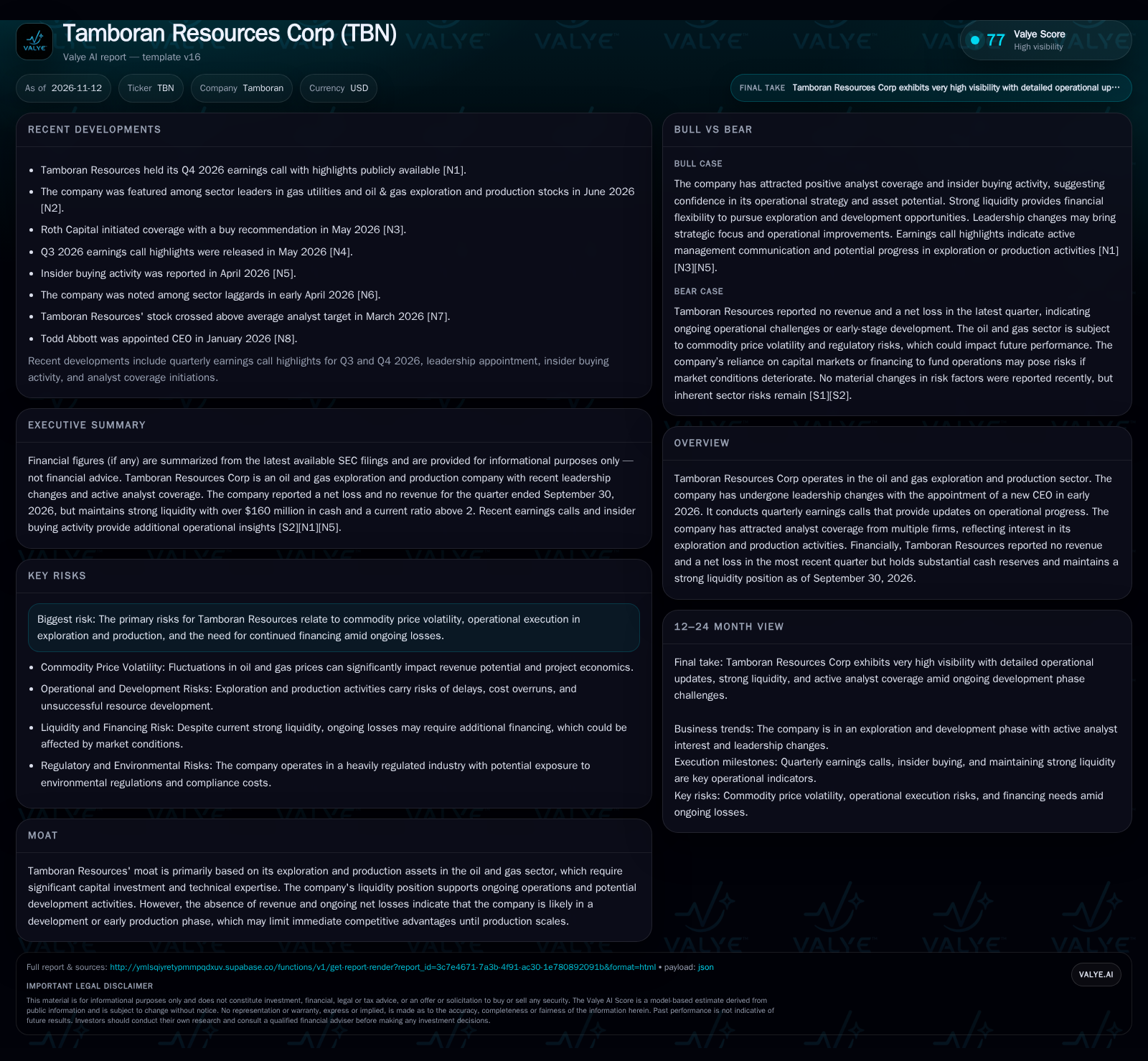
Tamboran Resources Corp exemplifies both the promise and the peril of early-stage oil and gas exploration and production (E&P). With a $160.1 million cash reserve and a current ratio above 2, the company is financially positioned to pursue ambitious development plans. Yet, as of Q3 2026, Tamboran remains pre-revenue, posting a net loss of $12.1 million for the quarter.Insider transaction activity was reported in the cited source; this activity does not by itself establish insider confidence. Still, the company’s valuation and analyst optimism ultimately hinge on its ability to convert exploration assets into producing wells, while weathering sector volatility and capital-intensive development cycles. [S2] [N5] [N8]
Tamboran’s Liquidity, Leadership, and Market Dynamics at a Critical Juncture
Tamboran Resources reported zero revenue and a net loss of $12.1 million for the quarter ended September 30, 2026, highlighting its ongoing status as an exploration-phase oil and gas company. These figures underscore significant liquidity available for further exploration, drilling, and operational ramp-up. [S2]
A major leadership change occurred with the appointment of Todd Abbott as CEO in January 2026, which may presage strategic or operational pivots.Insider transaction activity was reported in the cited source; this activity does not by itself establish insider confidence. The company has also attracted favorable analyst coverage (including buy and overweight ratings) and its stock recently crossed above average analyst target prices, reflecting positive market sentiment despite the lack of revenue. [N8] [N5] [N3] [N7]
The absence of material changes in risk factors and the ongoing net losses point to a business still in the capital-intensive build-out phase, with execution risk tied directly to moving assets from exploration to production. [S1] [S2]
Economic Considerations from Exploration Budgeting to Cash Flow Generation
In this model, capital expenditures are front-loaded and operating leverage only materializes if—and when—production begins. Until then, fixed costs and exploration outlays drive ongoing net losses, as seen in the Q3 2026 results. [S2]
However, the duration of this runway is contingent on the pace of spending, success in delineating commercially viable reserves, and the timeline for transitioning to revenue-generating operations. Should Tamboran succeed in bringing wells online, the economics could shift dramatically: high-margin sales (depending on commodity prices), improved cash flow, and potential for positive operating leverage as fixed costs are absorbed over growing output.
Conversely, if exploration results disappoint or development is delayed, Tamboran may face further dilution or the need to tap capital markets at less favorable terms. The sector’s inherent volatility—driven by commodity prices and regulatory factors—adds another layer of uncertainty to the economic equation.
Asset Quality, Capital Availability, and Execution as Competitive Differentiators
Tamboran’s competitive positioning in the oil and gas E&P sector will largely depend on the quality and scale of its underlying resource base, its ability to efficiently convert prospects into proven reserves, and the cost structure it can ultimately achieve. In the pre-production phase, barriers to entry are high in terms of capital and technical expertise, but so too is the risk of stranded assets.
Well-capitalized incumbents, regional operators, and private equity-backed explorers form the relevant peer set—many of whom are also chasing high-potential acreage and seeking to de-risk assets for eventual monetization or partnership. Technological advances in drilling and completion can confer an edge, but can also be rapidly commoditized. Access to capital is a crucial differentiator: Tamboran’s current liquidity is a strength, but only insofar as it translates into successful execution.
Substitutes for conventional oil and gas—such as renewables or LNG imports—may cap long-term upside if regulatory or market dynamics shift. The near-term competitive question is whether Tamboran can move quickly enough to establish a cost-competitive, scalable production base before capital runs thin or sector sentiment turns.
Potential Gains from Advancing Exploration to Production
The bull case for Tamboran hinges on a favorable sequence: successful drilling and appraisal results, timely conversion of resources into producing reserves, and the onset of commercial production within its current liquidity window. Positive operational milestones—such as well test results, reserve upgrades, or early offtake agreements—would support this scenario.
If the company can demonstrate a clear path to cash flow without major cost overruns or delays, the market could reward it with improved valuation multiples, easier access to additional capital, and the potential for strategic partnerships or asset sales.Insider transaction activity was reported in the cited source; this activity does not by itself establish insider confidence. [N5] [N3]
What would confirm this scenario? Announcements of successful well completions, initial production rates, and tangible progress on reserve certification would provide evidence. Conversely, a lack of such milestones or ongoing delays would undermine the upside case.
Anticipated Developments Reflecting Industry Realities and Timing Challenges
The most plausible path for Tamboran involves incremental operational progress interspersed with the typical hurdles of early-stage E&P: permitting delays, cost inflation, and variable drilling outcomes.
Under this scenario, Tamboran may achieve some initial successes—such as exploratory wells or resource upgrades—but will likely need to raise additional capital before full-scale production is achieved. The transition from exploration to development is rarely linear, and investor sentiment may oscillate with each operational update.
Confirmation would come from steady operational milestones, manageable cash burn, and clear communication around timelines and funding needs. Falsification would be indicated by persistent delays, cost overruns, or disappointing resource results leading to downward revisions in analyst coverage or valuation.
Consequences of Exploration Setbacks: Capital Strain and Dilution Concerns
The bear case emerges if Tamboran’s exploration efforts fail to deliver commercial results within its liquidity window. Under this scenario, continued net losses and the absence of revenue force the company to seek additional financing, potentially at dilutive terms or under distressed conditions.
Sector volatility—such as a sharp drop in oil and gas prices or adverse regulatory changes—could exacerbate funding challenges and erode asset values. If operational setbacks mount, the company could face write-downs or struggle to attract partners, leading to a downward spiral of dilution and diminished strategic options.
Evidence for this scenario would include persistent negative operational updates, accelerated cash burn, unsuccessful capital raises, or a marked deterioration in analyst sentiment and stock price. The absence of material milestones or a shift in risk disclosures would further support the downside thesis.
Key Milestones Guiding Tamboran’s Shift Toward Production
Operational progress: Announcements of successful well completions, flow test results, or resource upgrades would directly impact the investment thesis.
Cash burn andreported liquidity position: Quarterly updates on cash outflows and remaining liquidity will indicate how much time Tamboran has to achieve key milestones before needing to raise additional capital.
Transition to revenue: The first instance of recognized production revenue would mark a critical inflection point.
Development timeline clarity: Updated guidance on project timelines, permitting, and expected production start dates would help gauge feasibility.
Cost discipline: Disclosure of actual versus budgeted capital expenditures (if provided) would test management’s ability to control spending.
Insider transaction activity was reported in the cited source; this activity does not by itself establish insider confidence.
Sector and commodity price trends: External oil and gas price movements and regulatory shifts will shape both the opportunity set and risk profile.
Reserve certification: Independent reserve audits or upgrades would substantiate asset value and future cash flow potential.
Disclaimer: This is research-only, informational analysis and not investment advice. It may include AI-generated interpretation and general industry context. Always verify important details using primary sources.

Comments