
LGL Group: Portfolio Expansion, Deep Liquidity, and the Strategic Challenge of Blending Niche Manufacturing with Opportunistic Merchant Investing
LGL Group’s distinctive mix of precision electronics manufacturing and merchant investment activity offers both diversification and complexity.
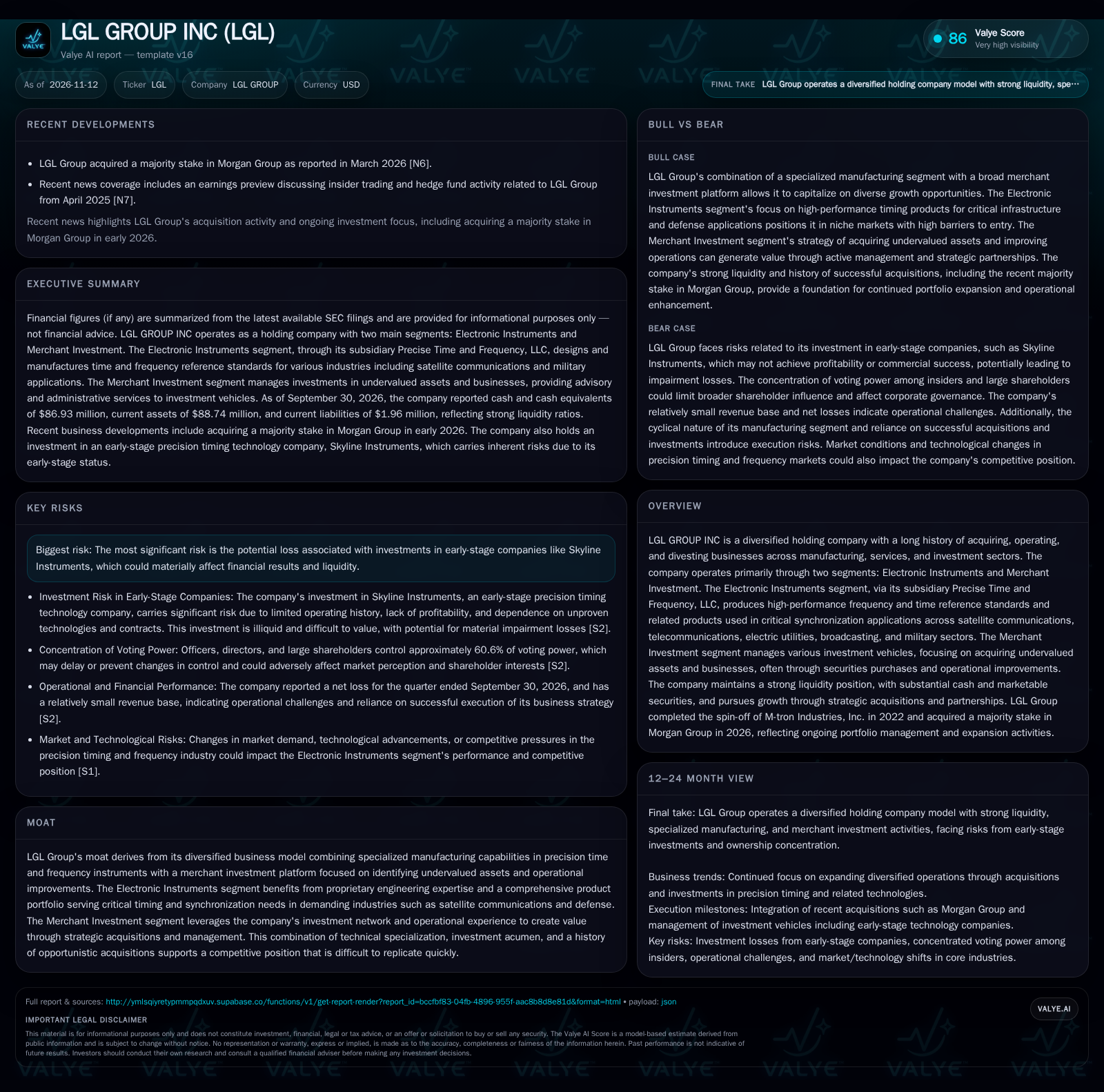
LGL Group operates as a diversified holding company with two core segments: Electronic Instruments, centered on critical timing products for sectors like satellite communications and defense, and Merchant Investment, focused on deploying capital into undervalued assets and businesses. As of September 30, 2026, LGL reported $86.93 million in cash and equivalents, a current ratio above 45, and a recent majority acquisition of Morgan Group. The company continues to invest in early-stage technologies, such as a stake in Skyline Instruments, but faces ongoing challenges tied to small-scale manufacturing economics, investment risk, and concentrated insider control. Future value creation depends on successful integration of acquisitions, realization of investment gains, and the ability to convert order backlog into profitable growth. [S2] [N6]
LGL Group stands out as a micro-cap holding company blending specialized electronic manufacturing with a flexible, opportunistic merchant investment platform. Its strategy is defined by both discipline and breadth: deploying a substantial cash war chest across a mix of operating businesses and investment vehicles, while continuing to pursue niche engineering markets through its Precise Time and Frequency subsidiary.
Recent Moves: Liquidity, Acquisitions, and Early-Stage Bets Reshape LGL’s Opportunity Set
As of September 30, 2026, LGL Group held $86.93 million in cash and cash equivalents, plus $41,000 in short-term investments, with current liabilities of only $1.96 million—yielding a current ratio above 45 and a cash ratio above 44. This extraordinary liquidity is central to the company’s strategic flexibility but also amplifies pressure to deploy capital productively. Revenue for the quarter was $1.46 million, with a modest net loss of $45,000, signaling that operating businesses remain small relative to the capital base. [S2]
In March 2026, LGL acquired a majority stake in Morgan Group, further diversifying its portfolio and signaling continued commitment to platform expansion through acquisition. [N6]
Investment in early-stage technology continues, most notably with an $850,000 commitment to Skyline Instruments—a company developing precision timing and GPS-denied sensing technologies. This move reflects LGL’s willingness to take on high-risk, high-reward positions within its Merchant Investment segment. [S2]
Officers, directors, and large shareholders collectively control about 60.6% of voting power, indicating a tightly held governance structure that may impact both agility and minority shareholder influence. [S2]
How LGL’s Hybrid Model Could Translate Cash into Earnings—and Where Friction Emerges
LGL’s business model is a blend of capital-light merchant investing and capital-intensive niche manufacturing. The Electronic Instruments segment, via Precise Time and Frequency (PTF), sells highly specialized products—such as quartz frequency standards and network time protocol servers—into critical applications for satellite communications, electric utilities, and defense. These are typically low-volume, high-mix markets characterized by demanding reliability requirements and long product lifecycles. Pricing power can exist due to technical differentiation, but absolute volume is limited, which constrains the segment’s ability to generate material operating leverage. The economics here are likely to be marked by high gross margins but low scalability, with engineering and R&D costs needing to be tightly managed against modest sales bases.
The Merchant Investment segment functions more like an opportunistic private equity or merchant bank, deploying capital into undervalued assets and businesses—sometimes via minority stakes, sometimes through control positions. Returns depend on a mix of realized investment gains, dividends, or operational improvements in acquired companies. This segment’s economics are inherently lumpy and require patience: periods of low activity or unrealized gains can make headline profitability volatile. The $850,000 investment in Skyline Instruments, for example, may generate exceptional returns if the technology succeeds, but equally could result in total loss or long-term illiquidity. The segment’s funding needs are modest relative to the cash available, but the challenge is consistently sourcing attractive opportunities and successfully executing value-creation plans.
LGL’s massive liquidity relative to operating scale means the company faces negative cash drag unless it can deploy capital at attractive risk-adjusted returns. The question is whether the combination of slow-growing niche manufacturing and sporadic investment wins can reliably outpace this drag and deliver compounding value to shareholders.
Specialization vs. Scale: LGL’s Niche Strengths and the Pressures from Larger, More Focused Players
LGL’s Electronic Instruments segment operates in highly specialized markets where technical expertise, reliability, and long-standing customer relationships are valuable. PTF’s products serve mission-critical roles in satellite communications and defense, sectors that value performance and continuity over pure price. This creates some switching friction and may support premium pricing, but these markets are also targeted by larger, better-resourced companies with broader product portfolios and deeper R&D budgets.
Instruments for timing and synchronization are subject to technological change—from alternative timing solutions (e.g., atomic clocks, chip-scale timing modules, or software-based synchronization) to the increasing integration of timing functions into broader communications or control systems. LGL’s ability to stay ahead of such shifts depends on continued engineering investment and the agility to respond to customer needs.
On the investment side, LGL competes with a wide field of private equity, family offices, and strategic buyers for undervalued assets—many of which may have access to lower-cost capital or sector-specific expertise. LGL’s advantage may reside in its willingness to take on complexity or early-stage risk (as with Skyline Instruments), but this also raises the risk profile. The tightly held voting structure could allow for swift, opportunistic moves, but may also limit external discipline or oversight.
If Capital Deployment and Portfolio Synergies Outpace Risks, LGL Could Unlock Compounding Value
A favorable scenario unfolds if LGL efficiently deploys its large cash balance into accretive acquisitions and investments that deliver outsized returns. Success here would require a combination of: (1) profitable integration of Morgan Group and other future acquisitions, (2) realization of value from high-risk bets like Skyline Instruments, and (3) steady, perhaps even modest, growth in the Electronic Instruments segment driven by increased backlog conversion and expanding demand for precision timing in communications and defense.
Evidence that would confirm this scenario includes: a sustained increase in consolidated revenue and operating profits, successful exits or marked-to-market gains in the Merchant Investment portfolio, and visible expansion in the Electronic Instruments order book. News of new customer wins, contract expansions, or industry partnerships for PTF would further support the case.
Falsification would come from continued stagnation in segment revenues, impairment losses on investments, or failure to integrate newly acquired entities into a coherent, value-generating platform.
Practical Realities: Low-Scale Operations and Lumpy Investment Returns Define LGL’s Trajectory
The most plausible outcome is that LGL continues to operate as a small, cash-rich holding company with periodic success in both operating and investment activities, but without achieving transformative scale or sustained earnings growth. The Electronic Instruments segment remains niche, providing stable but limited cash flow, while the Merchant Investment segment generates occasional but unpredictable gains or losses.
This scenario would be confirmed by continued modest quarterly revenues, low-to-flat operating profits, and sporadic news of new investments or small exits. The company’s large cash position persists, but capital deployment remains gradual and returns lumpy. Integration of Morgan Group occurs without major disruption, but also without dramatic value creation or synergy realization.
Falsification would require either a sharp uptick in recurring revenue/profitability—suggesting a step-change in the business model—or a major impairment event that materially reduces the company’s liquidity or equity value.
Portfolio Risks Materialize: Investment Losses, Operating Drag, and Governance Friction Threaten Value
A negative chain of events would see LGL’s early-stage and opportunistic investments, such as Skyline Instruments, fail to deliver, resulting in impairment losses and a reduction of the company’s capital base. If the Electronic Instruments segment faces technological displacement or loses key customers, operating losses could widen and erode any contribution to group-level economics.
Governance risks could also come to the fore: the high insider voting concentration might lead to capital allocation decisions that do not maximize minority shareholder value, or create perception issues that suppress the stock’s trading multiple. If acquisition integration missteps occur (e.g., Morgan Group), this could further drain resources and management focus.
Confirmation of this scenario would include material investment write-downs, persistent net losses, declining cash balances without offsetting value creation, and/or public shareholder dissent regarding governance or capital deployment.
Testing the LGL Thesis: Concrete Developments That Will Shape Future Value
Progress in realizing revenue and operating profit from Morgan Group and how its integration impacts group-level results.
Conversion of Precise Time and Frequency’s order backlog into recognized revenue and evidence of growing demand in core end markets—satellite communications, defense, and utilities.
Material changes in the size or performance of the Merchant Investment portfolio, including exits, impairments, or marked-to-market gains/losses.
Updates on the development milestones, customer traction, or commercial contracts for Skyline Instruments, as these will determine the payoff potential of the high-risk investment.
Any major new acquisitions, minority investments, or divestitures that alter the balance of the operating vs. investment segments.
Shifts in insider or concentrated shareholder control—such as sales, governance changes, or activist involvement—that could impact capital allocation or strategic direction.
Disclosure, if any, of segment-level margins, customer concentration, or recurring revenue metrics, which would clarify the underlying business quality and risk.
Changes in the competitive environment for precision timing and synchronization products, particularly new entrants or disruptive technology trends.
Disclaimer: This is research-only, informational analysis and not investment advice. It may include AI-generated interpretation and general industry context. Always verify important details using primary sources.

Comments