
Oramed’s Strategic Pivot: From Oral Insulin Technology to Portfolio-Driven Value Creation
Oramed Pharmaceuticals has shifted its focus from direct development of oral insulin to a portfolio model centered on technology transfers, equity stakes, and strategic alliances. With the transfer of its POD™ technology to OraTech and major investments in Lifeward and Alpha Tau, Oramed’s future now hinges on the clinical, regulatory, and commercial outcomes of its partners and assets—raising new questions about its potential upside, risk profile, and the durability of its business model.
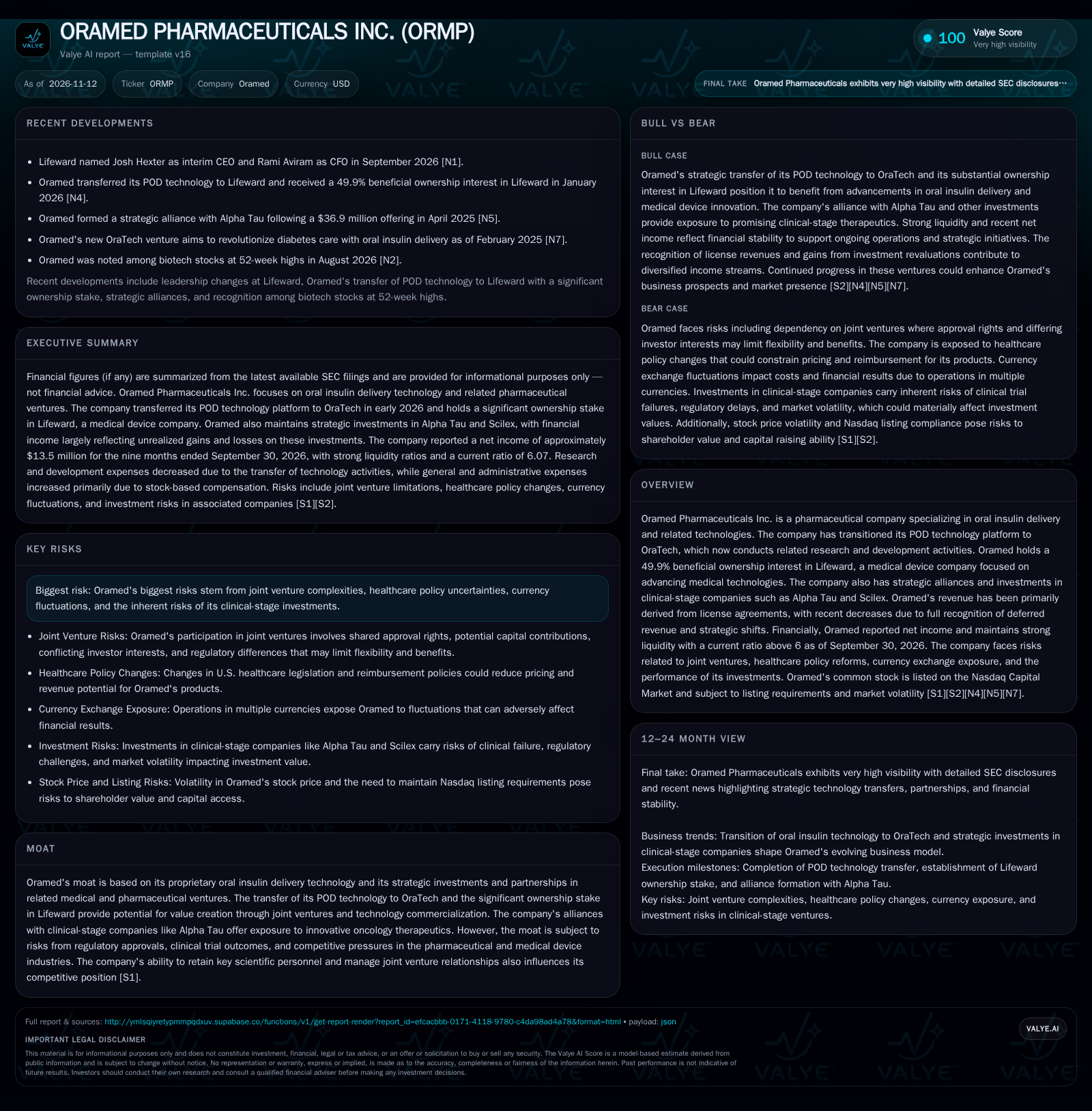
Oramed’s core oral insulin technology is now developed by its OraTech venture and Lifeward, in which Oramed holds a near-50% stake. The company’s income is increasingly tied to investment performance and license agreements, while R&D costs have dropped sharply after the tech transfer. Strategic alliances with Alpha Tau and Scilex diversify exposure but add clinical-stage risk. The company maintains a reported balance sheet position, but future value depends on milestone progress and the success of its portfolio companies [S2] [N4] [N5] [N7].
Oramed Pharmaceuticals has fundamentally restructured its business model: rather than directly developing and commercializing its oral insulin technology, it now seeks value through technology transfers, strategic alliances, and equity stakes in partner companies. The company’s POD™ technology is now under development by OraTech and Lifeward—ventures in which Oramed is a major stakeholder, but not the operational lead. Meanwhile, investments in clinical-stage companies like Alpha Tau and Scilex add both upside potential and exposure to biotech risk. With R&D costs down, general expenses up, and income increasingly dependent on external milestones, Oramed’s risk-reward profile has shifted from operational execution to portfolio management and investment timing.
Recent Restructuring and Portfolio Moves Reshape Oramed’s Opportunity Set
Several developments in 2025–2026 have transformed Oramed’s business model and value drivers. The most pivotal was the transfer of its POD™ oral insulin technology to OraTech in March 2026 and to Lifeward earlier that year, with Oramed securing a 49.9% beneficial ownership in Lifeward as a result [S2] [N4] [N7]. This move sharply reduced R&D expenses but shifted Oramed’s future earnings potential to the success of these ventures.
Additionally, Oramed formed a strategic alliance with Alpha Tau, a clinical-stage oncology company, after Alpha Tau’s $36.9 million offering in April 2025 [N5]. The company also holds secured notes and warrants in Scilex, with repayment risk attached [S1].
Financially, as of September 30, 2026, Oramed reported $15.2 million in cash, $0.58 million in short-term investments, current assets of $57.4 million, and current liabilities of $9.4 million, resulting in a current ratio of 6.07 and a cash ratio of 1.68 [S2]. Net income for the first nine months of 2026 was $13.5 million, but this is heavily influenced by investment gains and license revenue recognition, not recurring product sales [S2].
These shifts mean that Oramed’s future value depends less on its own R&D execution and more on the clinical, regulatory, and commercial outcomes achieved by its portfolio companies, particularly OraTech, Lifeward, and Alpha Tau.
How Oramed Now Makes Money: Licensing, Equity Stakes, and Portfolio Income
Oramed’s economics have transitioned from a traditional biotech model—driven by direct R&D and eventual product sales—to a portfolio approach built around technology licensing, equity participation, and strategic investments. Following the transfer of the POD™ platform, Oramed’s direct R&D costs have fallen, but so has its direct control over future commercialization and revenue timing [S2].
The company’s income streams now include: (1) license fees and milestone payments (such as from the HTIT and Medicox agreements), (2) mark-to-market changes and potential exits from holdings in Lifeward, Alpha Tau, and Scilex, and (3) possible future royalties or product revenue if and when partners achieve commercialization. However, revenue from license agreements has declined as deferred revenue was fully recognized and as new out-licensing deals have not replaced this income [S2].
Variable costs are now largely tied to corporate overhead and investment management, while fixed costs are driven by administrative and compliance expenses. The economics are characterized by high operating leverage if portfolio companies succeed, but limited recurring cash flow and greater dependency on external milestones. Capital needs are moderate in the near-term given lower R&D spending, but any follow-on investments or support for portfolio companies could require additional funding, depending on joint venture terms and market opportunities.
Assessing Oramed’s Position: Proprietary Tech, Strategic Stakes, and Exposure to Portfolio Risks
Oramed’s competitive edge historically derived from its proprietary oral insulin delivery technology. Now, its moat is more diffuse—anchored in its equity stakes, licensing relationships, and alliances across diabetes, oncology, and medical devices [S1] [S2].
The transfer of the POD™ platform to OraTech and Lifeward gives Oramed indirect exposure to potential first-mover or best-in-class status in oral insulin, if these ventures succeed. However, it also means Oramed is now dependent on its partners’ execution, regulatory navigation, and commercialization strategies. In oncology, the alliance with Alpha Tau offers upside if clinical milestones are met, but Oramed’s influence is limited by its minority investor position.
Relevant competitors now span: (1) direct oral insulin developers, (2) established diabetes device and therapy companies, (3) oncology biotechs, and (4) other investment-driven biotech holding companies. Oramed’s advantage is diversification across multiple high-risk, high-reward assets, but this also exposes it to the volatility and binary outcomes typical of clinical-stage biotech investments. The lack of direct operational control over its core technology may limit its ability to defend or expand its economic moat if competitors make faster or more successful progress.
Portfolio Success Could Unlock Nonlinear Value if Milestones Are Achieved
The most favorable scenario for Oramed is that its portfolio companies—OraTech, Lifeward, and Alpha Tau—demonstrate convincing clinical efficacy, secure regulatory approvals, and achieve commercial traction. If the oral insulin technology is validated in pivotal trials and adopted as a new diabetes standard, Oramed’s equity stakes and licensing rights could yield outsized returns relative to its current capital base.
Evidence that would confirm this scenario includes: (1) positive, peer-reviewed clinical data from OraTech and Lifeward, (2) regulatory filings or approvals for oral insulin products, (3) Alpha Tau advancing to late-stage clinical or regulatory milestones, and (4) new licensing or partnership deals that validate the platform’s commercial potential.
Investment-Driven Income with Lumpy Results and Uncertain Recurrence
The most plausible middle path is that Oramed’s portfolio generates intermittent investment gains and milestone payments, but without a transformative clinical or commercial breakthrough in the near term. Revenue recognition remains subdued as prior license fees have been fully realized and new deals are not immediately forthcoming [S2].
R&D expenses stay low, with general and administrative expenses elevated due to stock-based compensation and salary growth. Cash burn is moderate, and the company preserves its liquidity cushion, but future funding needs could arise if portfolio companies require capital or if Oramed seeks to expand its holdings.
In this scenario, Oramed’s share price and income statements remain volatile—subject to the fortunes of its portfolio companies, market conditions, and biotech sector sentiment. Validation or falsification of this scenario would come from the absence of major clinical or regulatory wins, limited new licensing activity, and continued reliance on investment revaluations rather than recurring operational cash flow.
Portfolio Setbacks, Clinical Failures, and Erosion of Investment Value
If OraTech, Lifeward, or Alpha Tau encounter clinical setbacks, regulatory rejections, or commercial failures, Oramed’s equity stakes and investment income could be significantly impaired. The lack of recurring product revenue means that negative trial outcomes or partner failures would directly erode Oramed’s value and may force asset write-downs [S2].
Further risk arises from joint venture governance limitations—if Oramed cannot influence strategic decisions or is required to make capital contributions under unfavorable terms. Scilex default risk could crystallize, leading to losses on notes and warrants. Regulatory shifts or reimbursement pressures could further compress potential upside from any successful products.
Downside evidence would include: (1) public disclosure of clinical failures or regulatory setbacks, (2) impairment charges against investment holdings, (3) forced or dilutive capital raises to support portfolio companies, or (4) a breach of Nasdaq minimum listing requirements due to share price declines [S1] [S2].
Milestones and Metrics That Will Determine Oramed’s Next Chapter
Progress updates and peer-reviewed clinical results from OraTech and Lifeward regarding oral insulin efficacy and safety would help test the value-creation thesis.
Regulatory submissions, approvals, or rejections for oral insulin or related products would serve as inflection points for Oramed’s portfolio value.
Clinical trial milestones, partnership announcements, or liquidity events at Alpha Tau and Scilex would directly impact Oramed’s investment income and balance sheet.
Any new licensing deals, joint ventures, or technology transfer agreements that expand Oramed’s recurring revenue base would clarify the sustainability of its business model.
Changes in general and administrative expense trends—especially stock-based compensation—would provide insight into cost discipline and management alignment.
Cash burn rate, capital commitment disclosures, and any follow-on investments required for portfolio companies would indicate funding needs and risk of dilution.
Compliance with Nasdaq listing requirements, including minimum bid price and market cap thresholds, would flag capital market access and downside risk.
A useful metric would be the timing and amount of realized versus unrealized gains from investment holdings, as this will affect the volatility and predictability of future earnings.
Disclaimer: This is research-only, informational analysis and not investment advice. It may include AI-generated interpretation and general industry context. Always verify important details using primary sources.

Comments