
Southland Holdings: Navigating Debt, Surety Reliance, and the Realities of Capital-Intensive Construction
With revenue down sharply and liabilities exceeding assets, Southland Holdings faces a precarious balance between operational continuity and stringent covenant compliance.
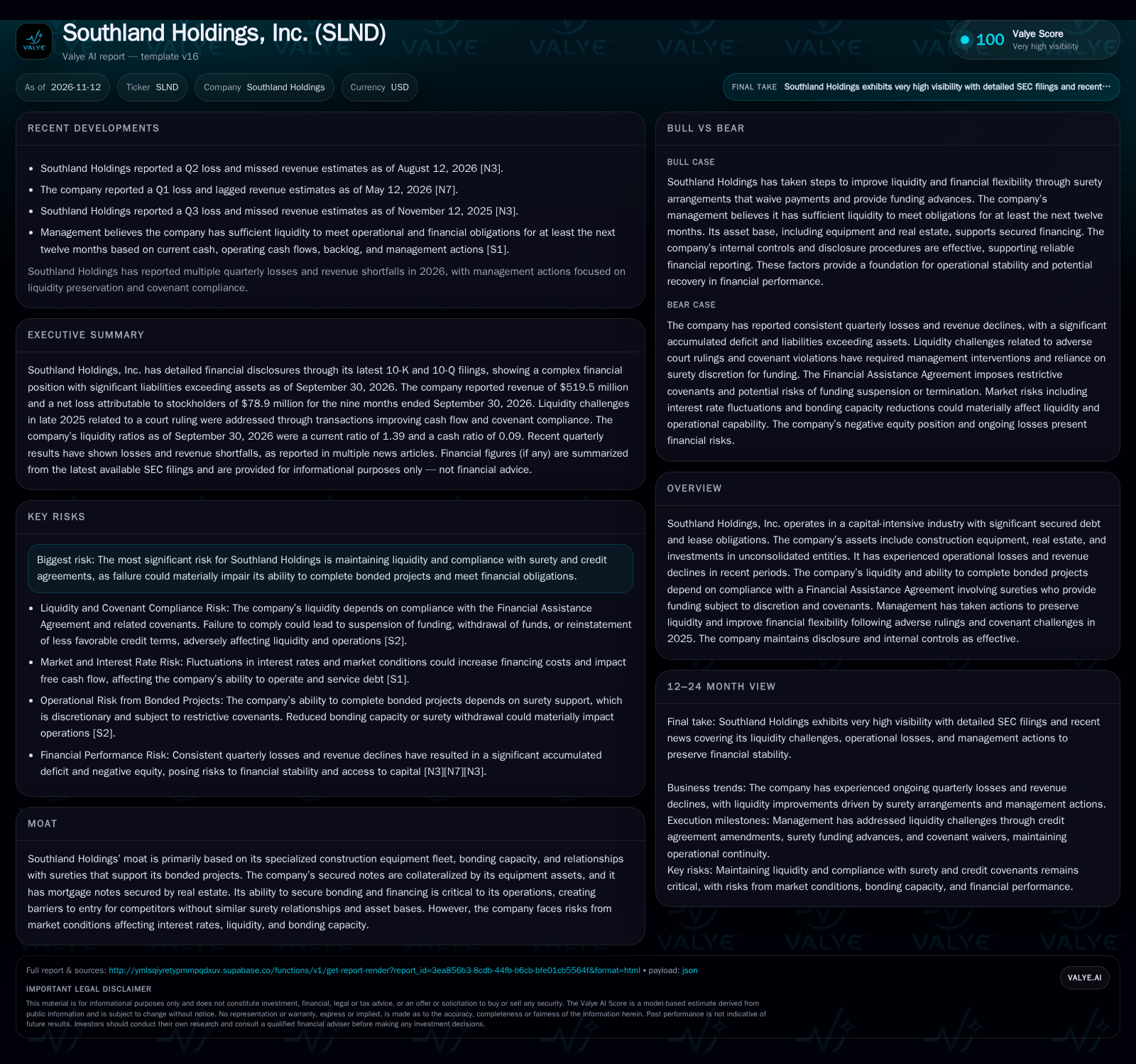
Southland Holdings, Inc. reported a continued net loss and a steep year-over-year revenue decline for the first nine months of 2026, with total liabilities outstripping assets by over $200 million as of September 30, 2026. The company’s ability to operate hinges on compliance with a Financial Assistance Agreement, where sureties have significant discretion over further funding. The next phase will test whether improved controls and cash management can restore profitability or if structural headwinds persist. [S2]
Southland Holdings, Inc., a capital-intensive construction company, finds itself at a critical juncture. Despite management’s recent success in securing short-term liquidity through surety arrangements and cost-saving maneuvers, the company operates with a substantial equity deficit and ongoing operational losses. Its future is tightly bound to the terms and continued forbearance of its surety partners, whose discretionary funding is both a lifeline and a source of risk. As Southland attempts to stabilize amid declining revenues, the durability of its business model—and its ability to withstand external shocks—will be tested in the coming quarters. [S2] [S1]
Recent Financial Strains and the Impact of Surety Interventions
The last twelve months have brought both acute challenges and partial relief for Southland Holdings. Revenue fell sharply to $519.5 million for the first nine months of 2026, compared to $668.2 million in the prior-year period, signaling either project delays, reduced backlog conversion, or competitive pressure. Net losses persisted at $78.9 million, only modestly improved from the previous year. Critically, the balance sheet remains under strain: as of September 30, 2026, liabilities outpaced assets by $220 million, and the company’s long-term debt stands at $386.5 million, largely secured by equipment and real estate. In late 2025, an adverse court ruling triggered covenant breaches and threatened liquidity, but management secured waivers and surety support that generated $30.2 million in cash savings for the following year. These interventions have allowed Southland to continue operations, but the underlying exposure to covenant and funding risk remains significant. [S2] [S1]
How Southland’s Capital-Intensive Model Shapes Its Economics
Southland’s core business requires substantial upfront investment in specialized construction equipment and real estate, resulting in high fixed costs and significant leverage. Revenue is typically earned through large-scale, often bonded, infrastructure projects, where payment schedules are milestone-driven and working capital requirements are lumpy. Gross margins in such industries are susceptible to project execution risk, weather disruptions, and change orders, leading to high earnings volatility.
The company’s financing structure, with $386.5 million in secured debt and a reliance on surety-backed bonding, highlights its dependence on both asset-backed lending and external confidence in its risk controls. Because construction project cash flows can be unpredictable, liquidity management becomes crucial—particularly when project setbacks or legal disputes arise. Operating leverage can provide upside if backlog conversion and execution improve, but it also magnifies losses when revenue contracts, as seen in the recent results. Unless Southland can drive higher utilization of its asset base and secure more profitable project awards, the current negative equity position will continue to weigh on its economics. [S2]
The capital-intensive nature of Southland’s operations also imposes a critical timing risk. Given the long project cycles and milestone-based payments, the company must carefully manage cash flow timing to avoid liquidity shortfalls that could disrupt ongoing work. This timing risk is exacerbated when projects encounter delays or disputes, potentially leading to extended periods without cash inflows while fixed costs continue to accrue. In such an environment, the ability to forecast cash flow accurately and maintain flexible financing arrangements becomes a key determinant of operational resilience. Moreover, the company’s asset-heavy model limits its agility to rapidly scale down operations without incurring significant write-downs or losses on specialized equipment.
Another important dimension is the interplay between asset utilization and capital expenditure. To sustain or grow revenue, Southland must maintain high utilization rates of its equipment fleet, which requires ongoing investment in maintenance and upgrades. However, with constrained liquidity and a negative equity position, allocating capital efficiently becomes a balancing act between preserving existing asset productivity and avoiding overextension. If the company delays necessary capital expenditures, it risks eroding its competitive advantage and increasing operational downtime. Conversely, excessive capital spending without corresponding revenue growth could deepen financial strain, underscoring the importance of disciplined investment aligned with realistic project pipelines.
Barriers and Vulnerabilities in the Heavy Construction Arena
Southland’s competitive position is built on its fleet of specialized equipment, experience with complex bonded projects, and established relationships with sureties—factors that create entry barriers for less-capitalized or less-experienced rivals. In the U.S. infrastructure market, the ability to secure bonding and meet rigorous prequalification standards is a prerequisite for winning large contracts, giving Southland a potential edge over new entrants.
However, these same factors are double-edged: dependence on surety support and restrictive covenants means any erosion of confidence from sureties or lenders could rapidly curtail Southland’s ability to bid for and execute new work. Competitor categories include other mid-to-large construction firms with strong surety relationships, diversified engineering and construction conglomerates, and, to a lesser extent, specialty subcontractors. The risk of substitution is limited by the scale and complexity of projects Southland pursues, but competitive pricing pressure and cyclical demand for infrastructure spending remain persistent threats.
What a Self-Reinforcing Recovery Would Require
A favorable scenario for Southland would involve a combination of improved project execution, stabilization (or growth) in public infrastructure spending, and successful compliance with all surety and lending covenants. If the company can convert its backlog into revenue at healthy margins, operating leverage could drive a return to profitability. Continued support from sureties would allow Southland to bid for new, higher-margin projects, while cost controls implemented in response to prior liquidity crises could enhance free cash flow.
Evidence that would confirm this scenario includes a return to year-over-year revenue growth, positive net income, and a reduction in the equity deficit. Additional markers would be the renewal or expansion of bonding capacity, fewer covenant waivers required, and growing cash balances without further asset sales or extraordinary support. Conversely, if revenue continues to decline or margin improvement fails to materialize, the recovery thesis would be undermined.
Stabilization Hinges on Execution and External Forbearance
The most plausible near-term outcome is a period of fragile operational stability, where Southland continues to execute its existing backlog and maintains compliance with the Financial Assistance Agreement through ongoing management vigilance. Revenue may remain flat or contract modestly, with losses narrowing only if cost controls are sustained and project execution risk is contained.
Confirmation of this scenario would come from stable or slightly improving current ratios, a plateauing of net losses, and continued disclosures of covenant compliance without new adverse events. If Southland is forced to seek additional waivers, faces unexpected project setbacks, or must liquidate assets to fund operations, this would suggest the base case is deteriorating toward a more adverse outcome.
Funding Disruption or Project Shock Could Force Restructuring
A negative scenario would be triggered if Southland fails to comply with the Financial Assistance Agreement or if sureties lose confidence and withdraw support, leading to a suspension of funding for bonded projects. This could result from further adverse legal rulings, significant project losses, or broader deterioration in infrastructure demand. In this case, Southland may face a liquidity crisis that forces asset sales, debt restructuring, or even insolvency proceedings.
Evidence supporting this scenario would include sharp reductions in backlog, disclosure of funding suspensions, inability to meet near-term obligations, or the announcement of asset divestitures at distressed prices. If management signals difficulties in renewing bonding capacity or if material covenant breaches recur without timely waivers, the risk of a forced restructuring would increase materially.
Milestones That Will Determine Whether Southland Can Rebuild
Quarterly revenue growth or stabilization, as a sign of backlog conversion and project execution improving.
Net income trends and whether operating losses continue to narrow or reverse into profitability.
Status of compliance with the Financial Assistance Agreement and any new or recurring covenant waivers.
Changes in the company’s cash and current ratios, signaling shifts in liquidity management.
Surety and lender disclosures regarding the renewal or reduction of bonding capacity.
Material project awards, contract wins, or cancellations that affect future revenue visibility.
Any significant asset sales, debt refinancing, or restructuring announcements.
Public infrastructure spending trends and government funding for the types of projects Southland targets.
Disclaimer: This is research-only, informational analysis and not investment advice. It may include AI-generated interpretation and general industry context. Always verify important details using primary sources.

Comments