
Xenetic Biosciences: NETosis Pipeline Ambition, Platform Progress, and the Realities of Capital-Intensive Biotech Development
Xenetic Biosciences is advancing a NET-focused therapeutic pipeline through collaborations, preclinical innovation, and an acquisition strategy, but faces persistent losses, undisclosed cash levels, and the capital demands of clinical-stage biotech. The company's future pivots on successful execution and the translation of platform promise into clinical and commercial milestones.
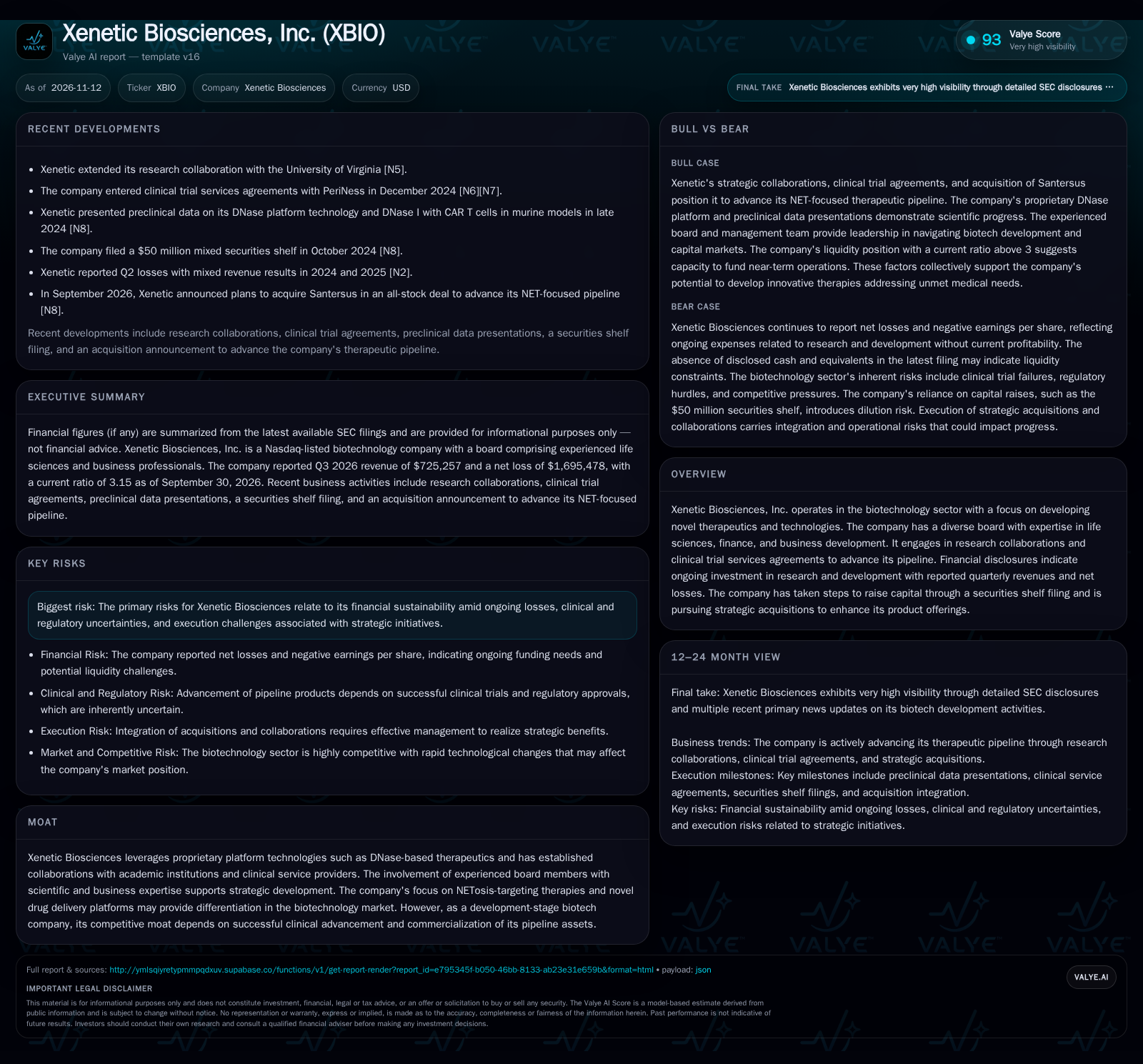
Xenetic Biosciences reported Q3 2026 revenue of $725,257 and a net loss of $1.7 million, with a current ratio of 3.15 but no disclosed cash balance. Recent milestones include extending a University of Virginia research collaboration, entering clinical trial agreements, presenting preclinical DNase data, and announcing the all-stock acquisition of Santersus to expand its NETosis pipeline. The company's ability to convert platform science and partnerships into clinical progress and funding will determine whether it can move beyond early-stage biotech risk.
Xenetic Biosciences sits at an inflection point typical of development-stage biotech: scientific promise, incremental pipeline progress, and strategic deal-making are weighed against ongoing losses, uncertain liquidity, and the relentless capital needs of translational medicine. With recent moves to deepen its NETosis-targeting platform—via an all-stock acquisition, research collaborations, and preclinical milestone disclosures—the company is positioning itself for a leap in value, yet must still demonstrate the ability to convert early-stage innovation into clinical validation and sustainable funding. The next 12-24 months will test whether Xenetic can bridge this gap or remain in the high-risk zone endemic to early-stage therapeutics.
Recent Results and Strategic Moves Define the Current Landscape
Xenetic Biosciences reported Q3 2026 revenue of $725,257 and a net loss of $1,695,478, highlighting the ongoing investment required for biopharma R&D and the typical lack of profitability at this stage [S2]. The company’s current ratio stood at 3.15 as of September 30, 2026, but notably, it did not disclose a cash or equivalents balance—raising questions about near-term liquidity despite a seemingly healthy ratio [S2].
Recent operational milestones include an extended research collaboration with the University of Virginia and the execution of clinical trial services agreements with PeriNess in December 2024, both aimed at advancing Xenetic’s therapeutic pipeline [N5] [N6] [N7]. The company also presented preclinical data on its DNase platform and announced a $50 million mixed securities shelf, signaling intent to access additional capital markets. In September 2026, Xenetic announced an all-stock acquisition of Santersus to expand its position in NETosis-targeting therapeutics. Collectively, these developments reflect a company actively pursuing scientific progress and pipeline expansion while managing the capital realities of early-stage biotech.
Translational Science Meets Capital Intensity: The Economic Engine of Pipeline Biotech
Xenetic’s economic model is emblematic of pre-commercial biotech: limited near-term revenue (primarily from research, collaborations, or early-stage licensing), high R&D expense, and a persistent net loss as the company invests in pipeline advancement [S2]. The $725,257 Q3 2026 revenue does not represent a commercial product franchise, but likely reflects milestone payments or research services, which are nonrecurring and volatile at this stage.
The company’s platform focus—targeting NETosis and leveraging DNase technology—suggests a future in which value will be realized through out-licensing, milestone payments, or eventual product commercialization if clinical success is achieved. However, the lack of disclosed cash and the reliance on a $50 million shelf registration highlight the need for ongoing capital raises, with attendant dilution risk for shareholders [S2].
Fixed costs are dominated by R&D and G&A, while variable costs remain low until clinical programs scale. If a candidate advances to late-stage trials or commercial launch, operating leverage could improve dramatically, but until then, funding requirements are significant and unpredictable. Acquisition of Santersus, if completed, could add both potential assets and integration expenses, further increasing capital needs.
Platform Differentiation and Academic Ties: Navigating a Crowded Therapeutic Landscape
Xenetic’s competitive hopes rest on its proprietary DNase-based platform and its focus on NETosis, a biological process increasingly implicated in a range of inflammatory and oncologic diseases. This scientific niche could provide differentiation if clinical data support efficacy and safety where competitors have struggled or failed.
The company’s collaborations with academic partners like the University of Virginia and agreements with clinical trial service providers may accelerate development and lend credibility, but these relationships are not exclusive barriers to entry [N5] [N6] [N7]. Large pharmaceutical companies and better-capitalized biotechs are also pursuing NETosis-related targets, and the pace of innovation in immunology and inflammation means that the window for first-mover or best-in-class status can be brief.
A Nobel laureate on the board underscores the depth of scientific leadership, yet commercial advantage will ultimately depend on the ability to translate platform science into differentiated clinical outcomes and intellectual property that is defensible against both branded and generic competitors.
Pipeline Progress and Strategic Leverage Could Unlock Value
The most favorable scenario for Xenetic is one where the DNase platform yields clear, positive clinical data in NETosis-driven indications, validating the mechanism and attracting either licensing partners or acquirers. The integration of Santersus could provide complementary assets or technology, expanding the addressable market and pipeline breadth.
Evidence confirming this scenario would include the initiation and rapid enrollment of clinical trials, publication of robust efficacy and safety data, non-dilutive funding from partnerships or grants, and successful integration of acquired assets. A material up-front or milestone payment from a larger pharma partner, or an equity investment on favorable terms, would further support the upside thesis.
Signs that would falsify this scenario include delayed or inconclusive clinical data, inability to secure external funding, or integration challenges post-acquisition that distract from core pipeline execution.
Incremental Progress Amid Ongoing Losses and Financing Cycles
The most plausible near-term trajectory is one where Xenetic continues to make incremental pipeline progress—advancing preclinical programs, initiating early-phase trials, and expanding collaborations—while managing persistent net losses and ongoing capital needs. The company would likely draw on its shelf registration in the absence of major partnering deals, resulting in periodic dilution [S2].
In this scenario, the company demonstrates scientific momentum but remains exposed to typical biotech risks: clinical setbacks, regulatory delays, competition, and the vagaries of capital markets. Confirmation would come from steady news flow of pipeline milestones, moderate increases in R&D spend, and additional collaboration or service agreements. Falsification would occur if clinical progress stalls, the company is unable to raise funds, or if asset integration fails to deliver anticipated pipeline synergies.
Liquidity Constraints and Clinical Setbacks Could Force Strategic Retrenchment
The principal risk for Xenetic is a confluence of liquidity constraints and clinical setbacks.
If clinical trials are delayed, fail to recruit, or generate negative data, and if the Santersus acquisition proves distracting or value-destructive, Xenetic could be forced to curtail development programs, seek emergency financing on punitive terms, or pursue strategic alternatives such as asset sales or a merger under duress.
Signs confirming this scenario would include missed milestones, abrupt reductions in R&D spend, layoffs, material going-concern language in filings, or highly dilutive financings. Falsification would require clear evidence of capital inflows or unexpectedly positive clinical results.
Milestones and Developments That Will Determine Xenetic’s Trajectory
Progression of lead DNase-based candidates into and through clinical trials—initiation dates, enrollment rates, and data readouts (if disclosed) would help test the thesis.
Details and terms of the Santersus acquisition—specifically, whether the deal closes as planned, and how the pipeline and technology are integrated and prioritized.
Frequency and size of capital raises or non-dilutive funding events, including grants, partnerships, or licensing deals.
Updates on research collaborations, such as milestone achievements or expansion of academic and clinical partnerships.
Board and management changes, especially related to scientific leadership or business development expertise.
Regulatory feedback or clinical trial design news that could accelerate or delay pipeline progress.
Intellectual property developments, including new patent grants or challenges, that affect platform defensibility.
Disclaimer: This is research-only, informational analysis and not investment advice. It may include AI-generated interpretation and general industry context. Always verify important details using primary sources.

Comments