
Boost Run Inc.: Navigating Liquidity Constraints and Market Attention Without a Clear Business Model
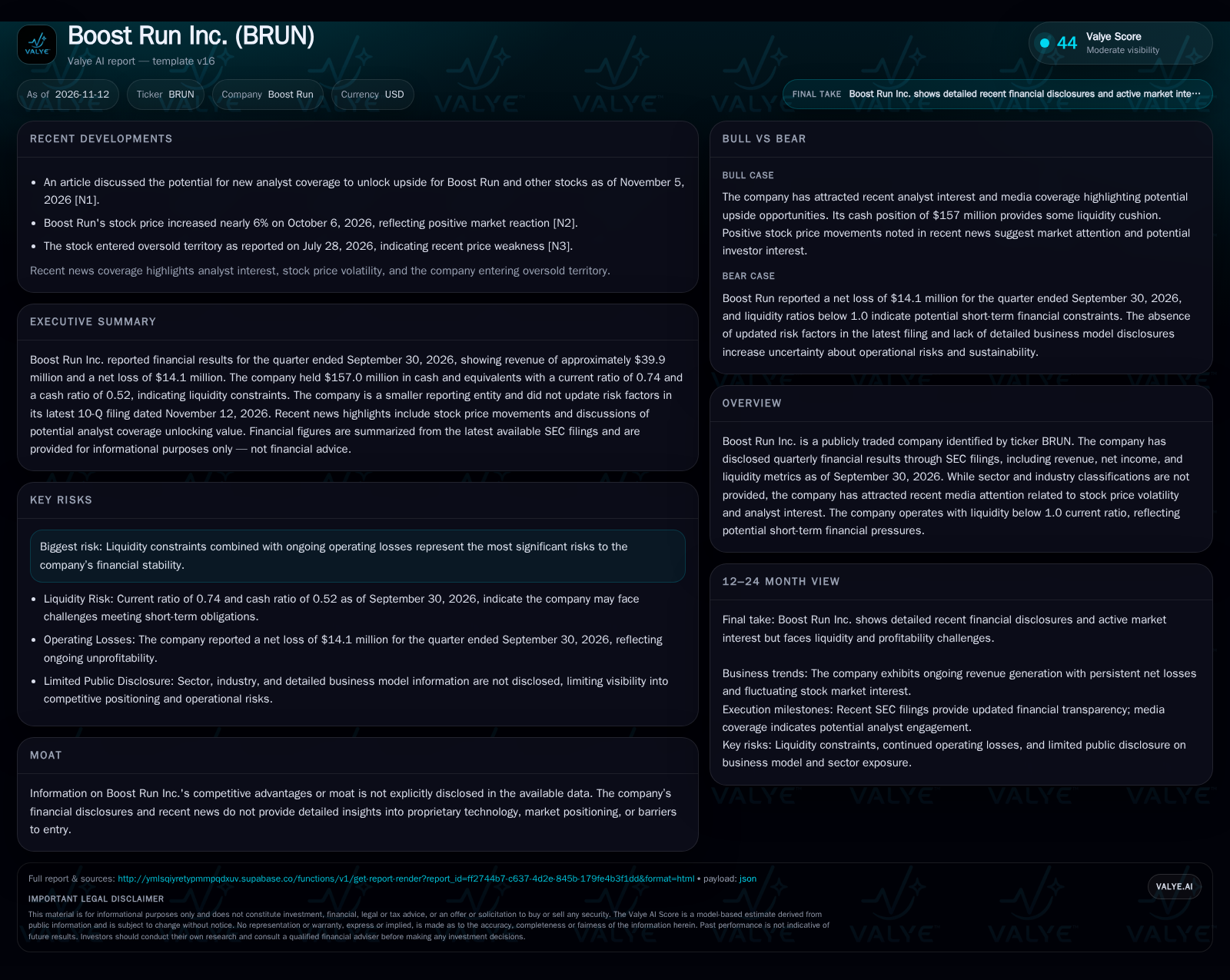
Boost Run Inc. reports notable revenue but remains unprofitable, with liquidity ratios below 1.0 and limited public disclosure on its business model or sector. Short-term financial pressures and a lack of transparency cloud the outlook, even as recent stock price movements and analyst interest suggest market attention.
Boost Run Inc. generated $39.9 million in quarterly revenue but posted a $14.1 million net loss and faces a current ratio of just 0.74, raising near-term liquidity concerns. Despite these challenges, recent stock price volatility and analyst interest have brought the company into the spotlight, yet operational transparency and long-term sustainability remain open questions. [S1] [N2] [N3]
Boost Run Inc. stands out for its recent revenue of $39.9 million in the latest quarter, but persistent net losses and liquidity ratios well below 1.0 raise significant questions about short-term financial health. With scant public disclosure about its business model, sector, or operational drivers, investors are left to interpret the company’s prospects through the lens of market volatility and speculative analyst interest. [S1] [N2] [N3]
Liquidity Pressures and Market Attention Define the Present Landscape
Boost Run Inc. reported $39.9 million in revenue and a $14.1 million net loss for the quarter ending September 30, 2026. On the balance sheet, cash and cash equivalents stood at $157.0 million, against current liabilities of $304.6 million, resulting in a current ratio of 0.74 and a cash ratio of 0.52. These figures indicate that the company does not have enough short-term assets to cover its short-term liabilities, a classic sign of liquidity pressure. [S1]
Despite these financial constraints, Boost Run’s stock experienced a nearly 6% price increase in early October 2026, following a period where it was flagged as oversold in July 2026. Recent news coverage highlights analyst interest and investor attention, suggesting that market participants are speculating on potential catalysts even as operational disclosures remain thin. [N2] [N3]
Revenue Generation Without Profitability: Examining the Economics
With $39.9 million in quarterly revenue but a $14.1 million net loss, Boost Run is clearly generating sales but is not achieving profitability. The absence of sector, product, or customer details means the revenue mix—whether recurring, project-based, hardware, software, or service—is unknown. If the company’s revenue is concentrated in low-margin or capital-intensive segments, that could explain persistent losses and liquidity strain. Alternatively, high customer acquisition costs or heavy R&D investment could also be driving negative earnings.
The company’s current asset base is insufficient to cover its short-term liabilities, which may force reliance on external financing or asset sales if operating cash flow remains negative. Without more detail, it is difficult to assess fixed versus variable cost structure, operating leverage, or the capital intensity of the business. If Boost Run operates in a software or platform model, one would expect higher potential operating leverage and margin expansion with scale. Conversely, a hardware or services-heavy model could mean structurally thinner margins and higher working capital needs.
A deeper understanding of the revenue composition would enable more precise modeling of profitability trajectories. For example, if a significant portion of revenue derives from subscription or recurring services, the company might benefit from predictable cash flows and lower volatility, which could support longer-term investments despite current losses. The company reported cash and liquidity metrics for the period; these figures do not by themselves establish operating runway, investment capacity, financial flexibility, or financing capacity. Moreover, the interplay between customer acquisition costs and lifetime value is critical; a high upfront cost could justify initial losses if customer retention and upsell opportunities are strong, but absent such dynamics, sustained losses could indicate structural issues.
Opaque Market Position Clouds Competitive Assessment
There is no explicit disclosure of Boost Run’s industry, sector, or competitive landscape. This opacity makes it impossible to directly benchmark the company against peers or determine whether it enjoys any sustainable advantages. If the company operates in a crowded, commodity-driven sector, pricing power and retention could be weak, amplifying financial pressure. Conversely, if it has proprietary technology or a sticky customer base, there could be untapped upside.
Without evidence of a moat—such as network effects, intellectual property, or high switching costs—the risk is that Boost Run is competing on price or struggling to differentiate itself. The absence of customer concentration or contract disclosures further obscures whether revenue is stable and recurring or cyclical and vulnerable to competitive encroachment.
The competitive landscape’s opacity also complicates assessment of potential barriers to entry or competitive dynamics. If Boost Run operates in a sector characterized by rapid innovation cycles, maintaining technological relevance could require continuous and substantial R&D spending, which may pressure margins and liquidity. Alternatively, if the market is fragmented with many small players, the company might leverage scale or integration to build a competitive moat over time. However, without clarity on customer stickiness or switching costs, it is difficult to ascertain whether the company can defend market share or command pricing power, both essential for improving financial health.
Catalyst-Driven Re-Rating Hinges on Improved Disclosure and Execution
The most favorable scenario for Boost Run is that recent analyst interest and stock price momentum translate into broader market coverage, improved liquidity, and a re-rating of the company’s valuation. If the company issues detailed disclosures clarifying its business model, sector, and growth strategy, this transparency could attract institutional investors and strategic partners.
Such a scenario would be confirmed by new filings outlining customer relationships, product lines, or technology differentiators, and by evidence of narrowing net losses or positive operating cash flow. A successful capital raise or refinancing—if needed—on non-dilutive terms would further support this upside case. Conversely, continued opacity or lack of operational improvement would falsify the scenario.
Sustained Cash Burn and Uncertainty with Periodic Market Volatility
The most plausible near-term path is one of continued revenue generation but ongoing operating losses and liquidity constraints. In this scenario, Boost Run remains a speculative vehicle, with valuation driven by market sentiment, news catalysts, and the occasional analyst report rather than by fundamental operational progress.
This scenario is confirmed if quarterly filings continue to show net losses, liquidity ratios below 1.0, and little improvement in disclosure or transparency. If the company is forced to raise capital at unfavorable terms or pursue asset sales, it would further validate the base case. Evidence that would falsify this scenario includes a sudden improvement in profitability, a material increase in recurring revenue, or the emergence of a clear, sustainable business model.
Liquidity Shortfall Triggers Forced Restructuring or Dilution
The adverse scenario is that persistent net losses and sub-1.0 liquidity ratios culminate in a cash crunch. If Boost Run is unable to refinance short-term obligations or raise new capital, it may be forced into asset sales, restructuring, or highly dilutive equity offerings. In the worst case, creditors could exert pressure, leading to distressed outcomes or bankruptcy proceedings.
This scenario would be confirmed by a rapid decline in cash balances, new disclosures of covenant breaches or going concern warnings, and the announcement of emergency financing at punitive terms. The risk is heightened if the company’s business model is capital intensive or if customer demand proves volatile and unsticky.
Milestones and Disclosures That Could Shift the Boost Run Thesis
Quarterly cash flow from operations—if disclosed—would help determine whether the company is approaching break-even or burning cash at an accelerating rate.
Any new SEC filings or press releases that clarify the company’s sector, core products, or customer base would materially improve visibility.
Disclosure of contract terms, customer concentration, or revenue breakdown (recurring vs. one-time) would test the stability of the topline.
Announcements regarding new financing, credit facility renewals, or equity raises would indicate management’s access to capital and dilution risk.
Material changes in current ratio or cash ratio in future filings would be a leading indicator of improving or worsening liquidity.
Evidence of margin expansion, cost controls, or restructuring efforts would signal management’s ability to address persistent losses.
If analyst initiation or coverage reports are published, the nature and depth of their research could reveal previously undisclosed business drivers or risks.
Disclaimer: This is research-only, informational analysis and not investment advice. It may include AI-generated interpretation and general industry context. Always verify important details using primary sources.

Comments