
IEH Corp: Specialized Hyperboloid Connectors, Growing Backlog, and Scaling Dynamics in Niche Markets
IEH Corp’s significant backlog expansion and continued product innovation reflect strong demand in defense and aerospace, but the company’s future hinges on managing customer concentration, supply chain volatility, and irregular order cycles. The durability of its moat will be tested as it seeks to convert backlog into predictable revenue while navigating capital and operational constraints.
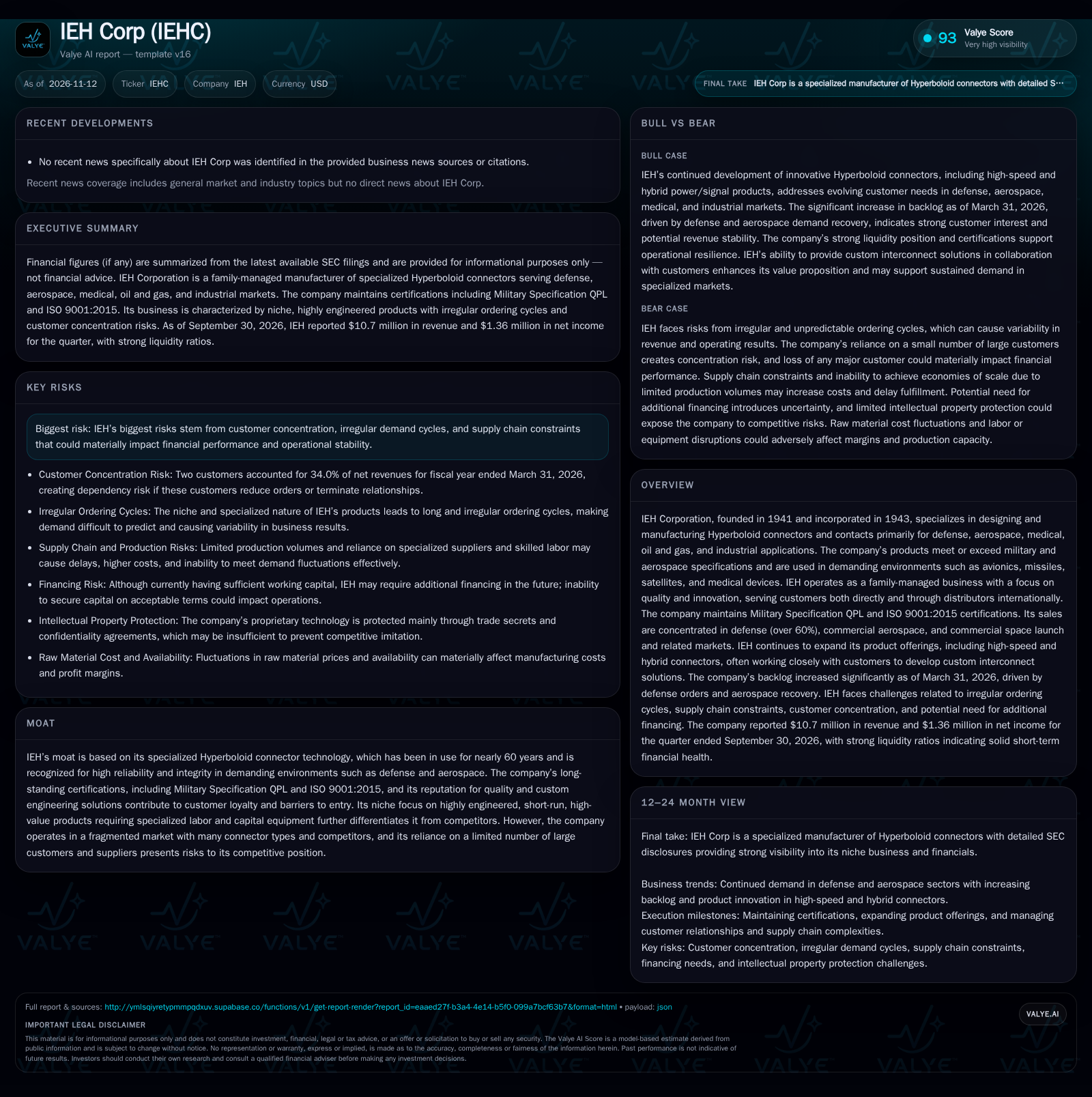
IEH Corp’s $27.8M backlog—more than double the prior year—signals robust demand in defense and aerospace, supported by $10.7M in quarterly revenue and solid profitability. However, heavy reliance on a few major customers, unpredictable ordering cycles, and potential supply chain bottlenecks introduce volatility. The business model depends on highly engineered, short-run products with limited economies of scale, making execution and capital management critical as the company seeks to turn backlog into sustained growth and margin stability. [S2]
IEH Corp sits at the intersection of high-reliability electronics and mission-critical markets, manufacturing Hyperboloid connectors for defense, aerospace, and industrial applications. Its recent surge in order backlog points to renewed demand from core sectors, but the company’s fortunes remain tied to a handful of large customers and the unpredictable rhythms of project-based procurement. As IEH invests in new connector technologies and custom solutions, its ability to convert backlog into consistent revenue while weathering supply chain and capital pressures will determine whether it can scale beyond its niche and deliver stable long-term value.
Backlog Growth, Customer Concentration, and Near-Term Financial Resilience
As of March 31, 2026, IEH reported a backlog of $27.8 million—more than double the $12.4 million in the prior year—primarily reflecting increased defense orders and a rebound in commercial aerospace activity. This surge in backlog suggests strong near-term demand visibility, at least within the context of IEH’s typical 12- to 24-week order fulfillment window. For the quarter ended September 30, 2026, IEH posted $10.7 million in revenue and $1.36 million in net income, with a current ratio of 6.34 and a cash ratio of 2.25, indicating a reported liquidity position. However, customer concentration remains acute: two customers accounted for 34% of net revenues in FY26, representing a structural risk if either reduces orders or shifts suppliers. [S1] [S2]
Custom High-Reliability Connectors as a Margin Driver with Scale Constraints
IEH’s economics are shaped by its focus on highly engineered, short-run Hyperboloid connectors—components that command premium pricing due to rigorous performance requirements in defense, aerospace, and medical applications. The company’s mix is heavily weighted toward defense (over 60% of sales) and commercial aerospace, exposing it to program-driven, often lumpy procurement cycles. Pricing power is supported by the need for reliability, qualification standards (such as MIL-DTL-55302), and the collaborative design process with OEM customers, but IEH’s limited production volumes restrict its ability to achieve economies of scale. Variable costs, particularly raw materials and skilled labor, are significant; fluctuations in material prices or labor availability can compress margins. The capital intensity is moderate—IEH relies on specialized equipment and processes—but the need for ongoing investment in product development and quality certifications is persistent. While the current liquidity snapshot is strong, the business model’s inherent cyclicality and exposure to large project wins or losses mean that cash flow can swing sharply, and future financing may be required to support growth or innovation if operating cash flow proves insufficient.
Fragmented Market Landscape Featuring Entry Barriers and Substitution Risks
IEH’s moat rests on decades of field-proven Hyperboloid technology, long-standing customer relationships, and certifications that set a high bar for new entrants in defense and aerospace connectors. The company’s reputation for quality, custom engineering, and ability to co-develop solutions with OEMs creates switching frictions, especially for mission-critical applications. However, the broader interconnect market is fragmented, with numerous competitors offering alternative connector types, and larger players may have greater scale advantages or broader product portfolios. IEH’s limited intellectual property protection—relying mainly on trade secrets and proprietary processes rather than patents—could make it vulnerable to imitation if competitors can replicate its designs or processes. Substitution risk also exists: advances in connector technology, changes in system architectures, or shifts to wireless solutions could, over time, erode demand for traditional physical connectors in some applications. That said, the rigorous testing and qualification cycles in defense and aerospace typically slow the pace of substitution, preserving incumbency for proven vendors.
Potential Revenue Growth from Backlog Conversion and High-Speed Product Expansion
A favorable outcome for IEH would be the successful conversion of its enlarged $27.8 million backlog into revenue at stable or improving margins, supported by timely fulfillment and continued recovery in commercial aerospace. The expansion of its product line into high-speed and hybrid power/signal connectors could open new addressable markets or deepen share within existing accounts, particularly if these products are adopted as design-ins for next-generation defense and avionics platforms. Confirmation would come from sequential revenue growth, stable or rising gross margins, and evidence that new product lines are gaining traction—such as disclosed design wins or customer endorsements. Further, if IEH can diversify its customer base and reduce concentration, it would support a more resilient revenue profile. Falsification would occur if backlog conversion is delayed (e.g., due to supply chain bottlenecks or customer postponements), new products fail to gain adoption, or if customer concentration intensifies.
Most Probable Outcome: Continued Demand Amid Market Fluctuations
The most plausible near-term scenario is that IEH continues to benefit from robust defense demand and recovering aerospace orders, translating its backlog into revenue with periodic lumpiness. Margins may remain solid but are likely to fluctuate in response to raw material costs, labor availability, and the timing of large project deliveries. Customer concentration persists, with the company’s fortunes closely tied to procurement cycles at a handful of major accounts. The irregularity of order flow and ongoing supply chain risks mean that quarter-to-quarter results may remain volatile, even if long-term demand trends are favorable. Confirmation would come from relatively stable quarterly revenues around current levels, continued backlog replenishment, and no major customer losses. Falsification would be signaled by sustained revenue declines, margin erosion due to cost inflation or delays, or a sharp increase in order cancellations.
Risks to Growth from Customer Attrition or Supply Chain Interruptions
A negative scenario unfolds if IEH loses one of its two largest customers, which together account for more than a third of revenue. Such a loss could create a revenue gap that is difficult to fill quickly given the company’s niche focus and long sales cycles. Alternatively, significant supply chain disruptions—such as shortages of specialized raw materials or prioritization of larger orders by key suppliers—could delay order fulfillment, increase costs, and erode margins. Additionally, if program cycles in defense or aerospace slow, or if a major customer postpones or cancels orders, the company’s backlog could shrink or become less reliable as an indicator of future revenue. Confirmation would come from sharp drops in reported revenue, a declining backlog, or management disclosures of lost customers, order cancellations, or prolonged fulfillment delays. Falsification would require evidence of stable or rising sales and backlog despite external shocks.
Key Elements Influencing IEH’s Capacity for Scalable, Sustainable Expansion
Sequential changes in order backlog—growth, stability, or contraction—will indicate whether current demand momentum persists or fades.
Revenue diversification by customer: a reduction in the share of sales to the top two customers would signal progress in mitigating concentration risk.
Adoption rates and revenue contribution from new high-speed and hybrid connector products, if disclosed, would test the effectiveness of recent innovation efforts.
Quarterly gross and operating margin trends, especially in the face of raw material or labor cost volatility, will reveal pricing power and cost control.
Lead times and on-time delivery rates, if disclosed, would indicate the company’s ability to manage supply chain constraints and fulfill backlog.
Any announced or disclosed customer losses, order cancellations, or major postponements would provide early warning of downside scenarios.
Capital expenditure levels and R&D investment, if disclosed, will shed light on the company’s capacity to innovate and maintain certifications in a competitive marketplace.
Evidence of new OEM design wins or expanded distributor relationships would support the thesis of addressable market expansion.
Disclaimer: This is research-only, informational analysis and not investment advice. It may include AI-generated interpretation and general industry context. Always verify important details using primary sources.

Comments