
Travelzoo’s Membership Shift: Can a Premium Model and New Experiences Offset Liquidity and Platform Risks?
Travelzoo’s pivot to a paid membership model and the planned addition of Metaverse experiences mark a high-stakes attempt to defend relevance and revenue in a fiercely competitive, platform-dependent travel deals market.
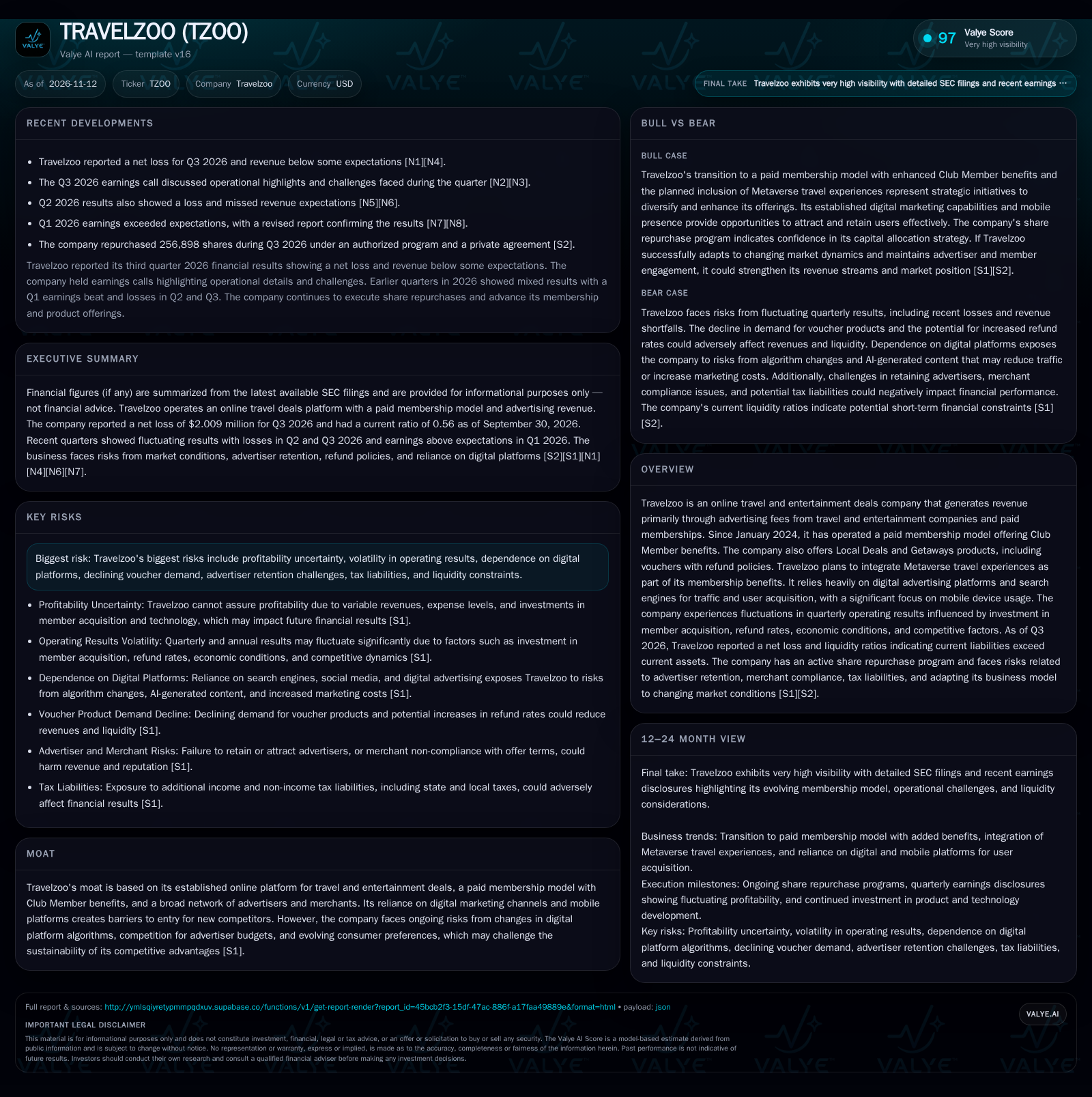
Travelzoo’s move to a paid membership model with added Club Member benefits and future Metaverse travel experiences is an ambitious play to diversify revenue and deepen user engagement. The company remains heavily reliant on digital platforms for traffic and faces declining demand for its voucher products, making the success of its new membership-driven strategy critical to its future [S1] [S2] [N1] [N4] [N6] [N7].
Travelzoo is at a strategic crossroads as it works to reinvent its online travel deals platform through a paid membership model and the promise of Metaverse travel experiences. While these initiatives could unlock new sources of revenue and user engagement, recent financial results paint a picture of a business under pressure: net losses, declining demand for core voucher products, and short-term liquidity ratios that signal little margin for error. The company’s future now hinges on whether its membership-centric approach can generate enough value and retention to offset competitive threats, digital platform dependency, and the risk of further financial strain.
Recent Results, Membership Rollout, and Financial Constraints: What’s Changed for Travelzoo
Travelzoo’s most material current developments center on its accelerated shift to a paid membership model, with Club Member benefits introduced since January 2024 and further expansion via planned Metaverse travel experiences in 2026 [S1]. This move is designed to create a more defensible, recurring revenue stream and differentiate the platform amid commoditization pressures in online travel deals.
However, Q3 2026 brought a net loss of $2.009 million and a basic/diluted EPS of -$0.20, continuing a trend of underwhelming quarterly results after a stronger Q1 [S2] [N1] [N4] [N6] [N7]. [S2]
Share repurchases totaling 256,898 shares in Q3 2026 may signal management’s view of undervaluation, but the ongoing losses limit the runway for buybacks and suggest a need for operational turnaround [S2].
Finally, demand for Travelzoo’s legacy voucher products continues to decline, putting added pressure on the success of its new membership strategy [S1].
How Travelzoo’s Model Makes (or Loses) Money: Membership, Advertising, and the Economics of Platform Reliance
Travelzoo’s revenue model is built on two main pillars: advertising fees paid by travel and entertainment providers seeking exposure to the company’s audience, and paid memberships that offer users access to exclusive deals and, soon, digital experiences [S1]. The advertising stream is volume-driven and cyclical, depending on advertiser budgets and the perceived quality and demographics of Travelzoo’s user base. Membership revenue, in contrast, could provide more predictability if adoption and retention rates are strong.
The shift to paid memberships introduces new economic dynamics: every incremental member potentially brings recurring revenue, but also raises the stakes for user acquisition cost (UAC) and retention. If membership benefits—such as exclusive deals, flexible refund policies, and planned Metaverse experiences—are compelling, the company may see lower churn and higher average revenue per user (ARPU). Conversely, if benefits are insufficient or easily replicated, churn could remain high, eroding the revenue base.
Travelzoo’s cost structure includes significant variable components—advertising spend to drive user acquisition, and the cost of refunding vouchers (with a typical 14-day refund window)—as well as fixed costs for technology, content, and personnel. Operating leverage is plausible if membership revenue scales faster than fixed costs, but losses in recent quarters suggest that current scale is insufficient to cover the cost base [S2].
Defending Differentiation: Can Exclusive Memberships and Metaverse Perks Withstand Platform and Peer Competition?
Travelzoo operates in a crowded digital landscape, competing against large online travel agencies (OTAs), deal aggregators, and direct supplier deals. Its legacy moat was built on a curated, trusted deals platform with a loyal email subscriber base and advertiser relationships. However, the rise of platform-driven discovery (search, social, mobile) and the spread of AI-generated content have eroded barriers to entry, making it easier for both established and niche players to reach consumers at scale [S1].
The move to a paid membership model is a direct response to these pressures. In theory, membership (especially with unique benefits like planned Metaverse experiences) could increase switching costs, increase user stickiness, and improve advertiser targeting. Yet, success depends on the exclusivity and perceived value of these benefits. If competitors replicate or out-innovate Travelzoo—by offering similar deals, better user experience, or deeper supplier integration—the company’s advantage may prove transient.
Travelzoo’s heavy dependence on digital platforms for traffic and user acquisition is a structural vulnerability: changes in search or social algorithms, or a surge in AI-generated travel content, could quickly reduce visibility and increase marketing costs [S1]. Unlike larger OTAs, Travelzoo may lack the scale to absorb these shocks or negotiate preferential platform terms.
If Memberships and Experiences Unlock Retention: Pathways to Sustainable Growth
The most favorable scenario for Travelzoo rests on the successful scaling of its membership model. If the company can demonstrate a compelling value proposition—through a curated set of deals, flexible refund policies, and truly differentiated Metaverse travel experiences—it could drive higher membership conversions, lower churn, and increase ARPU from both users and advertisers.
A positive feedback loop could emerge: as membership grows, advertisers may see more value in targeting a premium, engaged audience, leading to higher advertising fees and better deal inventory. This, in turn, could attract even more members, further strengthening the platform’s economics.
Confirmation of this scenario would require evidence of accelerating paid membership growth, improving retention/churn rates, and stabilization or growth in advertising revenue per member. Early adoption of Metaverse experiences as a member benefit, with positive user feedback and engagement, would further strengthen the thesis. A return to profitability and improvements in liquidity ratios would provide tangible proof of the model’s viability.
Realistic Outcomes: Incremental Membership Uptake Amid Ongoing Margin Pressure
The most plausible near-term outcome is a gradual ramp-up in paid memberships, offset by continued headwinds in legacy voucher products and persistent margin pressure. Travelzoo may see modest membership growth as early adopters test the new benefits, but retention and ARPU could remain volatile as users weigh the value of paid access against free alternatives and competitor offerings.
Advertising revenue is likely to fluctuate in line with broader travel and entertainment sector budgets and Travelzoo’s ability to market its audience as premium. Voucher demand may continue to decline, further eroding a once-stable revenue stream.
Operating results will likely remain lumpy, with periods of progress interrupted by setbacks tied to user acquisition costs, refund rates, and digital platform changes. The company may need to moderate share repurchases and focus on cash conservation unless operational performance improves. Confirmation of this scenario would come from stable but unspectacular membership growth, flat or declining voucher revenue, and continued low liquidity ratios, with periodic losses offset by cost discipline.
Membership Model Fails to Gain Traction—Liquidity and Platform Risks Compound
If Travelzoo’s membership model fails to resonate—due to insufficient differentiation, weak perceived value, or aggressive competitive responses—the company could see high churn, stagnant or declining membership revenue, and continued erosion of advertising fees. As voucher product demand wanes, the revenue base could shrink further, and fixed costs may become increasingly burdensome.
Heavy dependence on digital platforms could exacerbate the problem: if algorithm changes or AI-generated content significantly reduce organic traffic, user acquisition costs might spike, making paid marketing uneconomical. Advertiser and merchant attrition could follow, further weakening the platform’s appeal.
Confirmation would come from falling membership counts, persistent or widening losses, negative operating cash flow, and worsening liquidity metrics.
Milestones That Will Reveal Whether Travelzoo’s Membership Bet Pays Off
Quarterly paid membership growth and retention/churn rates, if disclosed, to gauge adoption and stickiness of the new model.
Average revenue per user (ARPU) for both members and advertisers, as a signal of pricing power and engagement.
Advertising revenue trends per member or per thousand users, to test whether the membership base attracts premium advertiser demand.
Gross margin and operating margin evolution, to assess whether scale is translating into improved unit economics.
Cash flow from operations and changes in cash/current ratios, as leading indicators of potential financial flexibility and runway.
User acquisition cost (UAC) and payback period for new members, if disclosed, to measure marketing efficiency.
Engagement and feedback metrics for Metaverse travel experiences, once launched, as a test of product differentiation.
Refund rates on voucher products, to monitor ongoing risk to revenue and liquidity from legacy offerings.
Disclaimer: This is research-only, informational analysis and not investment advice. It may include AI-generated interpretation and general industry context. Always verify important details using primary sources.

Comments