
Rumble Inc.: Scaling a Creator-Driven Video Platform into AI Infrastructure—Promise, Pressures, and Pivotal Proof Points
Rumble leverages rapid user growth, diversified monetization, and a bold AI infrastructure push, but faces entrenched competitors, capital demands, and execution risks. The next phase will test whether its unique positioning and integrated ecosystem can convert visibility into sustainable economics.
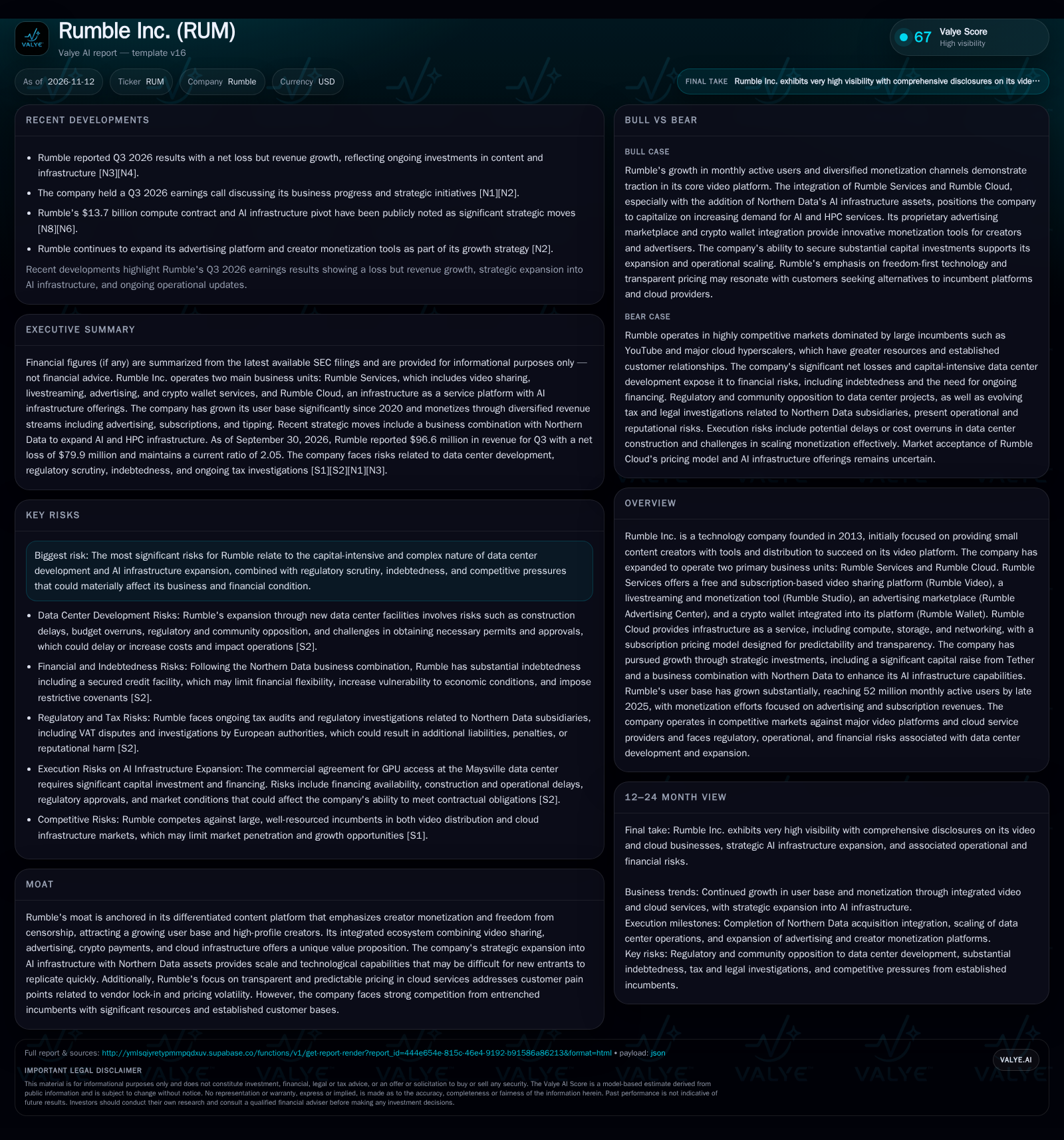
Rumble reported Q3 2026 revenue of $96.6 million and a net loss of $79.9 million, reflecting heavy investment in video, advertising, and cloud infrastructure. Its 52 million monthly active users and strategic expansion into AI and HPC through the Northern Data combination underpin growth ambitions. Success depends on converting audience scale and infrastructure assets into durable, high-margin revenue amid fierce competition, regulatory scrutiny, and the challenge of monetizing creator-centric platforms at scale. [S2] [N3] [N4]
Rumble Inc. has evolved from a niche creator video platform into a multi-pronged digital media and infrastructure company, aiming to challenge tech giants across video, cloud, and AI markets. With 52 million monthly active users and a growing suite of monetization tools, Rumble has attracted strategic capital and acquired substantial AI infrastructure assets. Yet, the company's deepening net losses, regulatory and operational hurdles, and the realities of competing with entrenched incumbents make its next chapter a test of whether audience scale and platform differentiation can be parlayed into durable economics. The coming quarters will reveal whether Rumble's integrated approach can overcome execution and market risks—or whether the model stalls under the weight of its own ambition. [S1] [S2] [N3]
Recent Performance and Strategic Moves: Where Rumble Stands Now
Rumble reported $96.6 million in revenue for Q3 2026, with a net loss of $79.9 million, reflecting an aggressive investment phase in both its core video platform and infrastructure expansion. The company’s user base has reached 52 million monthly active users as of late 2025, demonstrating significant audience traction. Recent strategic actions include a business combination with Northern Data, aimed at bolstering Rumble’s AI and HPC infrastructure capabilities, and a substantial capital raise from Tether to support these ambitions. Despite top-line growth, the company’s persistent losses highlight the capital intensity of scaling both content and data center operations. Rumble also faces regulatory and tax investigations, particularly tied to Northern Data subsidiaries and ongoing data center development, which could impact both operations and reputation. [S2] [N3] [N4]
How Rumble’s Monetization Model Could Move from Audience to Profits
Rumble’s business model is built around two primary engines: Rumble Services (video, livestreaming, advertising, crypto wallet) and Rumble Cloud (infrastructure as a service, including AI/HPC capabilities). Revenue is generated through a mix of advertising, subscription fees, and creator-driven tipping, while cloud services are offered on a subscription basis aimed at predictable, transparent pricing. This dual-pronged approach allows Rumble to tap both consumer and enterprise markets, but each segment presents distinct economic profiles.
In video and creator services, variable costs scale with content acquisition, creator payouts, and platform moderation, while fixed costs include platform development and infrastructure. Advertising margins can be high if scale and targeting improve, but Rumble competes for ad dollars with much larger platforms. Subscription and tipping revenue may offer steadier margins but are sensitive to churn and creator retention.
The cloud and AI infrastructure segment is capital-intensive, requiring upfront investment in data centers, hardware, and regulatory compliance. Operating leverage could be significant if utilization rises, but underutilized capacity or cost overruns could weigh on margins. The integration with Northern Data brings both potential scale and heightened financial risk, especially given new indebtedness and the complexity of AI infrastructure management. The ultimate economic outcome hinges on Rumble’s ability to drive high utilization across both video and cloud assets, achieve sufficient pricing power, and contain operating and capital costs.
Challenging Incumbents: Can Rumble’s Ecosystem Withstand Market Entrenchment?
Rumble faces entrenched competition in both its core segments. In video sharing and livestreaming, it competes directly with YouTube, Twitch, and other large-scale platforms that benefit from established creator networks, massive advertiser relationships, and deep technical moats. These incumbents possess superior resources for content licensing, platform development, and global distribution, making it difficult for challengers to win sustained share without significant differentiation.
In cloud infrastructure and AI/HPC, Rumble enters a domain dominated by hyperscalers such as Amazon Web Services, Microsoft Azure, and Google Cloud. These players possess not only scale but also a broad portfolio of AI tools, integrated developer ecosystems, and long-term enterprise contracts. Rumble’s focus on transparent pricing and freedom from perceived censorship may resonate with particular customer segments, but the challenge is translating this into large-scale enterprise adoption and sticky, recurring revenue.
Potential advantages for Rumble include its integrated ecosystem—combining creator monetization, advertising, crypto payments, and cloud. This could appeal to customers seeking alternatives to mainstream platforms, especially if they value platform neutrality or predictable costs. However, the test is whether this differentiation is sufficiently compelling to overcome switching frictions, customer inertia, and the superior network effects of incumbents.
If Scale Meets Monetization: Pathways to Operating Leverage and Market Share Gains
A favorable scenario for Rumble would see continued robust growth in monthly active users, deepening engagement, and improved monetization rates per user. If advertising demand on the platform accelerates—perhaps due to brand safety concerns elsewhere, or unique audience access—ad pricing and fill rates could rise. Simultaneously, successful adoption of subscriptions, tipping, and crypto wallet features could diversify revenue, reduce churn, and strengthen creator loyalty.
On the infrastructure side, if Rumble’s integration with Northern Data proceeds smoothly, and its AI/HPC offerings attract meaningful enterprise or AI-native customers, operating leverage could emerge as data center utilization ramps. Transparent, predictable pricing may win share from hyperscaler customers frustrated by cost uncertainty. The combination of audience scale, creator monetization, and new enterprise cloud contracts could push the business toward break-even or profitability.
Evidence that would confirm this scenario includes accelerating revenue growth outpacing operating expense increases, rising gross margins, new high-profile customer wins in cloud/AI, increased ARPU (average revenue per user) across both business units, and positive updates on regulatory/tax matters. Conversely, stalling user growth, flat ARPU, or persistent underutilization of data center assets would falsify it.
What Sustained Investment and Mixed Monetization Could Mean for Rumble’s Trajectory
The most plausible trajectory is one of continued user and revenue growth, but with a persistent gap between top-line expansion and profitability. Rumble may continue to invest heavily in platform features, content acquisition, and data center infrastructure, driving near-term losses. Monetization per user could improve gradually—particularly if advertising and subscription efforts gain traction—but likely lags the pace needed to offset rising costs.
In the cloud segment, customer acquisition may be slow as Rumble builds credibility and track record in a market accustomed to hyperscaler reliability and breadth. Regulatory and tax investigations could introduce periodic volatility or require management bandwidth, but may not fundamentally derail operations unless liabilities escalate. The company’s ability to sustain capital investment—through further raises or improved cash flow—will be a key watchpoint.
Confirmation of this scenario would involve steady, but not accelerating, user and revenue growth; gradual margin improvement; and ongoing, but narrowing, net losses. Evidence to the contrary would include sharp reversals in user metrics, major regulatory setbacks, or an inability to fund continued investment.
Where Execution or Market Acceptance Falters: Risks of Value Erosion
Adverse outcomes could materialize if Rumble’s investments fail to yield sufficient utilization or monetization. In video, user growth could plateau or reverse if creators or audiences migrate to larger platforms, or if content moderation or community issues arise. Advertisers may hesitate to scale budgets if targeting or brand safety concerns persist. Subscription and tipping revenue could disappoint if churn rises or creator incentives wane.
On the cloud side, data center construction delays, cost overruns, or regulatory/community opposition could inflate capital needs and delay revenue realization. If AI and HPC customers do not materialize at scale, Rumble could be left with expensive, underutilized assets. Indebtedness from the Northern Data combination may amplify financial strain, especially if operating losses persist or new capital becomes difficult to access.
Evidence confirming this scenario would include flat or declining user metrics, negative operating leverage (expenses rising faster than revenue), large impairments or write-downs of infrastructure assets, adverse regulatory/tax outcomes, or signs of financial distress (e.g., covenant breaches, emergency financings).
Milestones and Metrics That Will Define Rumble’s Next Phase
Monthly active user growth and engagement levels, particularly year-over-year changes and time spent per user, will be critical to assessing platform momentum.
Advertising revenue growth and ad fill rates; a useful metric would be ARPU segmented by ad-supported versus subscription users, if disclosed.
Adoption and retention rates for subscription and tipping features; churn or cohort retention data would help test monetization depth.
Utilization rates for newly acquired AI/HPC infrastructure; updates on contracted versus available capacity would clarify operating leverage.
Progress on regulatory and tax investigations, particularly any disclosed contingent liabilities or fines tied to Northern Data subsidiaries.
Capital expenditure and data center development timelines, including updates on construction milestones, permitting, and budget adherence.
Gross margin and operating expense trends relative to revenue growth, indicating whether investments are translating into scalable economics.
Any additional capital raises or changes in debt covenants, which would signal financial resilience or emerging funding pressures.
Disclaimer: This is research-only, informational analysis and not investment advice. It may include AI-generated interpretation and general industry context. Always verify important details using primary sources.

Comments