
Artesian Resources: Dividend Stability, Regulatory Realities, and the Economics of a Regional Water Utility
While defensibility is underpinned by regulated monopoly status and steady demand, investor returns hinge on the company’s ability to manage capital allocation, regulatory negotiations, and evolving sector pressures.
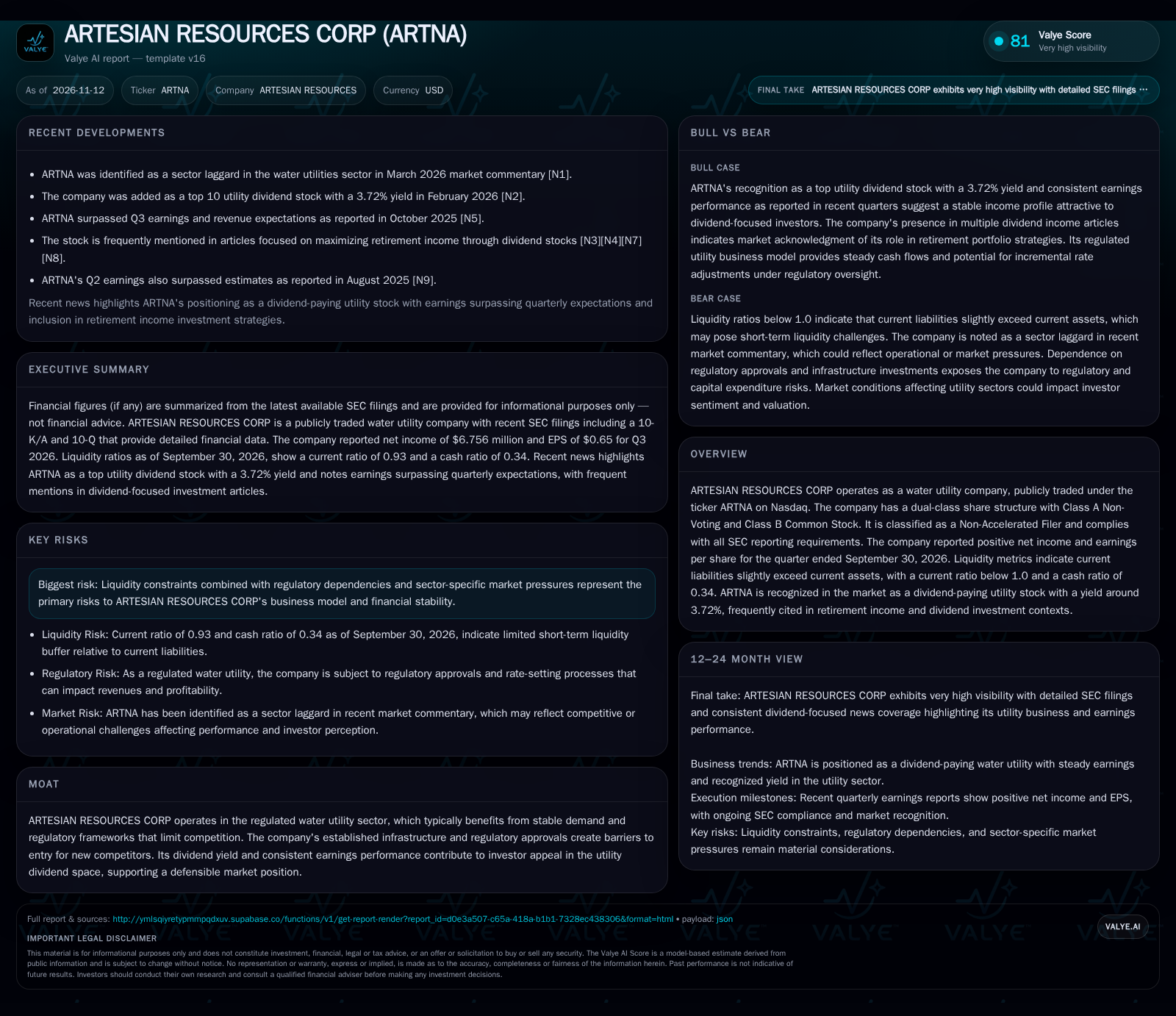
ARTNA remains a recognized dividend stock among water utilities, reporting positive net income and EPS in Q3 2026. However, its current ratio below 1.0 signals a tight liquidity position, and the company is viewed as a sector laggard. The investment case centers on regulated cash flows, dividend visibility, and the ability to navigate regulatory and capital expenditure demands without eroding potential financial flexibility. [S2] [N2] [N5] [N7] [N8]
Artesian Resources Corp exemplifies the classic attributes and trade-offs of a regional water utility: regulated revenue streams, high capital intensity, and consistent dividends that appeal to income-oriented investors. The investment thesis for ARTNA now hinges on its ability to maintain dividend reliability and manage regulatory and capital allocation risks, while addressing the near-term constraints evident in its balance sheet.
Where Artesian Resources Stands: Profitability, Liquidity, and Market Perception
Artesian Resources reported net income of $6.756 million and basic and diluted EPS of $0.65 for the quarter ended September 30, 2026, demonstrating continued profitability in its regulated water utility operations. However, as of the same date, the company’s current assets ($33.465 million) were slightly below current liabilities ($36.081 million), resulting in a current ratio of 0.93 and a cash ratio of 0.34. ARTNA remains a fixture in dividend-focused investment strategies, with a yield cited at 3.72%. Despite its income appeal, recent commentary labels ARTNA as a sector laggard, suggesting that its operational or growth trajectory may be trailing peers in the water utility space. [S2] [N2] [N7] [N8]
The Economics of Regulated Water Utilities: Revenue Predictability, Capital Demands, and Margin Structure
ARTNA’s core business model is built on regulated monopoly service, where revenue is primarily determined by approved rates on water and wastewater services. Pricing is set through multi-year rate cases with state regulatory commissions, providing revenue visibility but limiting pricing flexibility. This regulatory model typically ensures cost recovery plus a fixed return on invested capital, supporting stability and long-term planning. However, water utilities are capital-intensive, requiring ongoing investments in infrastructure (pipes, plants, treatment facilities) to maintain service reliability and comply with environmental standards.
Operating leverage is present but modest: while fixed infrastructure and regulatory compliance costs dominate, incremental volume growth is slow and tied to population or industrial expansion in the service area. Profitability is therefore driven by the timing and magnitude of approved rate increases versus underlying cost inflation and capital expenditure needs. The cited source reports dividend-related activity; that disclosure alone does not establish dividend-policy continuity, management confidence, or a material constraint on capital flexibility.
The capital intensity inherent to water utilities also introduces a nuanced interplay between regulatory frameworks and investment timing. Because rate cases typically lag actual capital expenditures, utilities must carefully manage the timing of investments to avoid prolonged periods of under-recovery that can strain cash flow. This dynamic necessitates a forward-looking capital planning process that anticipates regulatory scrutiny and aligns project execution with expected rate case cycles. Additionally, inflationary pressures on materials and labor can compress margins if regulatory adjustments do not keep pace, making cost control and efficiency critical levers for sustaining profitability within the allowed return parameters.
Defensibility and Constraints: Monopoly Rights, Regulatory Barriers, and Sector Dynamics
The regulated water utility sector is structurally protected from direct competition by exclusive service territories, high infrastructure barriers, and regulatory oversight. Artesian Resources enjoys these classic moats, with established infrastructure and rate base limiting the threat of new entrants. However, the sector’s defensibility also comes with constraints: regulatory commissions control allowable returns and rate adjustments, and public scrutiny can delay or limit rate hikes, especially during periods of inflation or economic stress.
Peer competition is indirect, manifesting through operational benchmarking, customer satisfaction, and the ability to secure favorable regulatory outcomes. Sector leadership is often defined by cost control, capital efficiency, and the smooth execution of infrastructure renewal programs. Recent identification of ARTNA as a sector laggard suggests it may be underperforming on one or more of these axes relative to other regulated water utilities, potentially impacting its long-term growth and valuation.
While monopoly status limits direct competition, sector dynamics increasingly emphasize operational excellence and innovation within regulatory boundaries. Utilities that leverage advanced asset management technologies and predictive maintenance can reduce unplanned outages and extend infrastructure life, thereby improving cost efficiency and customer satisfaction. Moreover, regulatory agencies are progressively attentive to environmental and sustainability metrics, which can influence rate case outcomes and public perception. Consequently, a utility’s ability to integrate these factors into its operational strategy can differentiate it from peers, potentially translating into more favorable regulatory treatment and enhanced long-term value creation despite the inherently constrained competitive landscape.
Unlocking Value: Regulatory Wins, Capital Efficiency, and Dividend Reinforcement
If the company can demonstrate improved capital allocation discipline—delivering infrastructure projects on time and on budget while minimizing regulatory lag—it could enhance free cash flow and potentially raise its dividend payout or undertake selective growth investments.
Confirmation of this scenario would come from regulatory approvals for rate increases that outpace cost inflation, improved operating margins, and upward revisions to dividend guidance. Evidence of reduced capex overruns, a reported liquidity-ratio trends, or successful refinancing at attractive rates would also support the case for improved potential financial flexibility and investor confidence.
Steady-State Utility: Navigating Regulatory Cycles and Managing Dividend Expectations
The company would likely secure periodic, incremental rate increases, offsetting most—but not all—cost and capital inflation.
In this scenario, liquidity remains tight but manageable, with the company relying on a combination of internal cash flows and periodic external financing to fund capex and working capital. Signs of regulatory pushback, capex delays, or persistent underperformance versus sector peers would signal risk to this steady-state outlook.
When Liquidity and Regulatory Friction Threaten Dividend Stability
A negative outcome could emerge if ARTNA faces regulatory delays, capped rate increases, or unforeseen capex overruns that erode cash flow below dividend and debt service requirements. The company’s current ratio below 1.0 and reported cash balance heighten vulnerability to such shocks. If liquidity tightens further, ARTNA may be forced to cut or suspend its dividend, raise dilutive equity, or increase leverage on less favorable terms—all of which could undermine its core investment appeal.
Persistent sector underperformance or downgrades by income-focused analysts would also reinforce downside risk.
Testing the Artesian Resources Thesis: Earnings, Regulatory Outcomes, and potential Financial Flexibility
The company reported profitability for the period. [S2]
Updates on rate case filings, approvals, and timing—regulatory outcomes directly affect revenue growth and margin stability.
Capex guidance and actual capital expenditure—monitor for overruns or delays, which could pressure liquidity and regulatory relationships.
Commentary on sector positioning or operational benchmarking—if disclosed, relative performance versus other water utilities would help clarify competitive standing.
Debt issuance, refinancing activity, or changes in credit rating—external financing terms and availability are critical given ongoing capital needs.
Disclaimer: This is research-only, informational analysis and not investment advice. It may include AI-generated interpretation and general industry context. Always verify important details using primary sources.

Comments