
United Bancorp’s Earnings Variability: Navigating Credit Losses, Deposit Growth, and Regional Dynamics
United Bancorp’s recent quarters reveal the duality of opportunity and risk for smaller regional banks: deposit and loan growth can drive earnings, but credit losses and competitive threats quickly erode gains. The bank’s consistent dividend activity and stable leadership provide continuity, but the business model’s exposure to local economic and credit cycles remains central to its forward trajectory.
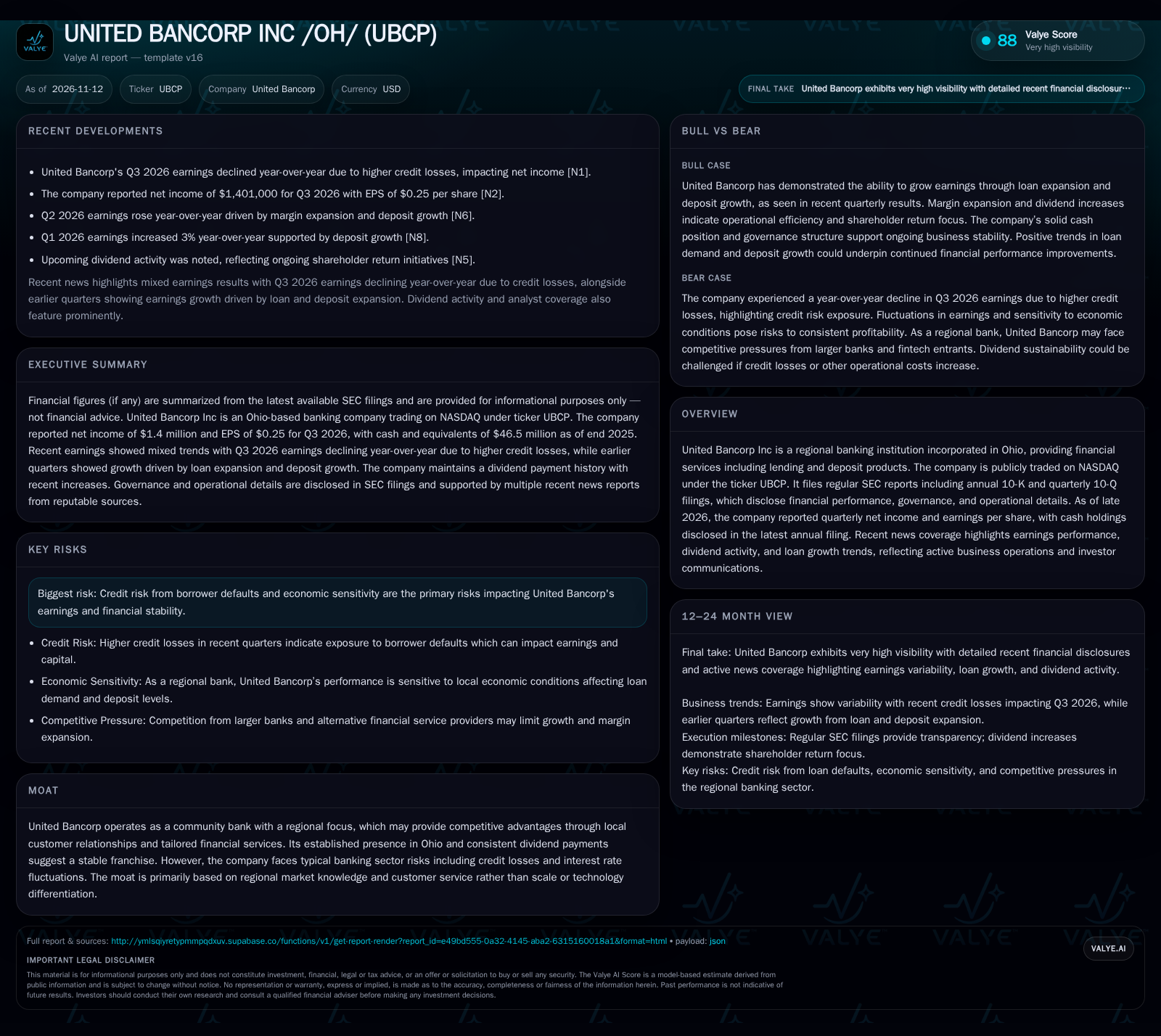
United Bancorp (UBCP) reported $1.4 million in Q3 2026 net income, with earnings pressured by higher credit losses after stronger results in prior quarters fueled by deposit and loan growth. The bank’s business model relies on regional relationship banking but faces ongoing credit, economic, and competitive risks. [S2] [N1] [N6] [N8]
United Bancorp, a regional Ohio-based bank, presents a classic case study in the strengths and fragilities of community banking. While recent quarters have shown the bank’s capacity to grow earnings through traditional levers like deposit and loan expansion, the latest results underscore the sector’s vulnerability: a spike in credit losses quickly dampens profitability. With stable leadership and a long-standing dividend, United Bancorp offers investors predictability—but its future depends on its ability to manage credit risk and defend its regional franchise in a changing competitive landscape. [S2] [N1] [N6] [N8]
Recent Performance: Credit Losses Undermine Momentum from Deposit and Loan Growth
United Bancorp’s third-quarter 2026 net income declined to $1,401,000, with earnings per share of $0.25, as higher credit losses offset gains from earlier quarters. This reversal follows a period of earnings expansion in Q1 and Q2 2026, driven by both margin improvement and deposit growth. The company reported cash and liquidity metrics for the period; these figures do not by themselves establish operating runway, investment capacity, financial flexibility, or financing capacity. The cited source reports dividend-related activity; that disclosure alone does not establish dividend-policy continuity, management confidence, or a material constraint on capital flexibility. [S1] [S2] [N1] [N5] [N6] [N8]
The interplay between credit losses and deposit growth at United Bancorp highlights the inherent volatility in regional banking earnings. While deposit inflows provide a stable funding base and facilitate loan origination, the quality of those loans ultimately dictates the sustainability of earnings. In environments where local economic conditions shift unfavorably, even modest increases in nonperforming loans can disproportionately impact net income due to the bank’s limited scale and capital buffers. Furthermore, the timing and magnitude of credit loss recognition can create lumpy earnings patterns, complicating investor assessment of underlying performance trends.
How United Bancorp Makes Money: Traditional Banking Levers and Margin Dynamics
United Bancorp’s business model is grounded in the classic regional bank playbook: gather local deposits at a low cost and deploy these funds into loans, earning a spread (net interest margin) on the difference. Fee income from ancillary services may contribute, but core profitability is highly sensitive to interest rates, loan demand, and credit quality. Fixed costs for branch operations and compliance create operating leverage, meaning incremental deposit and loan growth can disproportionately improve earnings—until credit losses rise, as seen in Q3 2026, compressing margins and net income. The bank’s capital needs are generally moderate, but rising credit costs or regulatory changes could force higher loan-loss provisioning or capital retention, limiting growth or dividend capacity.
United Bancorp’s sensitivity to interest rate fluctuations is a critical factor in its margin dynamics. In a rising rate environment, the bank may experience initial margin expansion as loan yields reset faster than deposit costs; however, prolonged rate increases can dampen loan demand and increase funding costs, compressing net interest margin. Additionally, the bank’s reliance on traditional branch networks imposes fixed costs that do not scale down easily during downturns, thereby amplifying operating leverage effects. The balance between managing credit risk and pursuing growth is further complicated by regulatory capital requirements, which may constrain risk-taking or dividend payouts in periods of heightened credit stress.
Defending the Regional Franchise: Local Relationships vs. Scale and Digital Threats
United Bancorp’s advantage lies in its community banking approach: local knowledge, relationship-driven lending, and tailored service can create customer loyalty and some pricing power within its Ohio footprint. However, the bank faces intensifying competition from larger regional and national banks with greater resources, as well as fintechs offering digital convenience and sometimes better rates. The absence of clear technology differentiation or scale economies means United Bancorp must rely on service quality and local reputation to retain business. In a benign credit environment, this model can deliver steady returns, but in downturns or periods of rapid digital adoption, the risk of customer attrition and margin pressure rises.
What Could Unlock Durable Earnings Growth? Credit Stabilization and Local Economic Strength
If United Bancorp can contain credit losses and benefit from continued local economic resilience, the bank could return to the positive earnings trajectory seen in early 2026. Sustained deposit and loan growth would expand the balance sheet, while stable or rising net interest margins could drive operating leverage and higher profitability. Confirmation would come from sequential improvements in net income, declining loan-loss provisions, and continued growth in deposits and loans. Evidence of expanding fee income or successful digital initiatives would further support an upside case—particularly if the bank demonstrates improved efficiency or customer retention relative to peers.
Earnings Oscillate with Credit and Rate Cycles, But Core Franchise Remains Stable
The most plausible scenario is that United Bancorp continues to experience earnings variability as credit costs and local economic conditions fluctuate. The company reported profitability for the period. Evidence supporting this path would include relatively stable net interest margins, controlled (but not eliminated) credit losses, and steady but unspectacular balance sheet growth.
Prolonged Credit Stress or Disintermediation Threatens Franchise Value
A more adverse path emerges if credit losses remain elevated or worsen—perhaps due to a local recession or deterioration in loan underwriting standards. In this scenario, net income could erode further, potentially forcing dividend cuts or capital raises. Alternatively, if digital or larger competitors aggressively target United Bancorp’s customer base, deposit attrition and pricing pressure could compress margins, undermining the bank’s ability to compete. Confirmation would include a rising nonperforming loan ratio, declining deposit balances, or a reduction in tangible book value—while evidence of branch closures or rising funding costs would further support the downside thesis.
Metrics and Developments That Will Shape United Bancorp’s Next Chapter
Net charge-off and loan-loss provision trends: Watch for quarterly changes in credit costs, as these directly affect earnings and capital.
Deposit growth and composition: Ongoing increases, especially in low-cost core deposits, would support margin and franchise stability.
Nonperforming asset ratio: A rising percentage could signal deteriorating credit quality and risk to future earnings.
Net interest margin movement: Compression would suggest competitive or funding pressures, while expansion implies pricing power or mix improvement.
Dividend continuity or changes: Any suspension or reduction would indicate internal stress or capital constraints.
Branch footprint changes or digital banking investments: Evidence of strategic adaptation or retrenchment would signal management’s competitive response.
Local economic indicators: Shifts in regional employment, real estate, or business activity could foreshadow changes in loan demand and credit performance.
Relative efficiency ratio (if disclosed): Improvement here would indicate successful cost control or operational leverage.
Disclaimer: This is research-only, informational analysis and not investment advice. It may include AI-generated interpretation and general industry context. Always verify important details using primary sources.

Comments