
Income Opportunity Realty Investors: Navigating Opaque Economics, Related-Party Dynamics, and Leadership Transition
Income Opportunity Realty Investors (IOR) posts positive net income and a substantial current asset base, yet faces persistent questions around liquidity, operational transparency, and the implications of heavy related-party influence. With a new CEO at the helm and insider buying activity noted, the company’s future will hinge on its ability to clarify business mechanics and demonstrate sustainable cash generation.
IOR’s recent net income and significant current assets provide a snapshot of stability, but with nearly all operations tied to related-party receivables and minimal cash on hand, the business’s true earning power and liquidity position remain uncertain. Leadership change and insider buying could signal a strategic inflection—but until clearer disclosures emerge, investors must weigh the risks of opacity and related-party dependence against the potential for operational improvement or asset realization.
Income Opportunity Realty Investors (IOR) stands out less for its reported profitability than for the opacity surrounding its core business mechanics. The company’s latest quarterly report shows positive net income and a robust current asset position, but with almost all operations tied to related-party receivables and only $6,000 in cash, the true economic engine remains obscure. Recent leadership changes and insider buying hint at potential strategic shifts, yet the fundamental questions around liquidity, arm’s-length value creation, and the durability of earnings persist. For investors, the next phase will depend on whether IOR can provide greater clarity on its operating economics and demonstrate genuine, sustainable cash flow.
Key Developments: Positive Net Income Overshadowed by Liquidity and Transparency Gaps
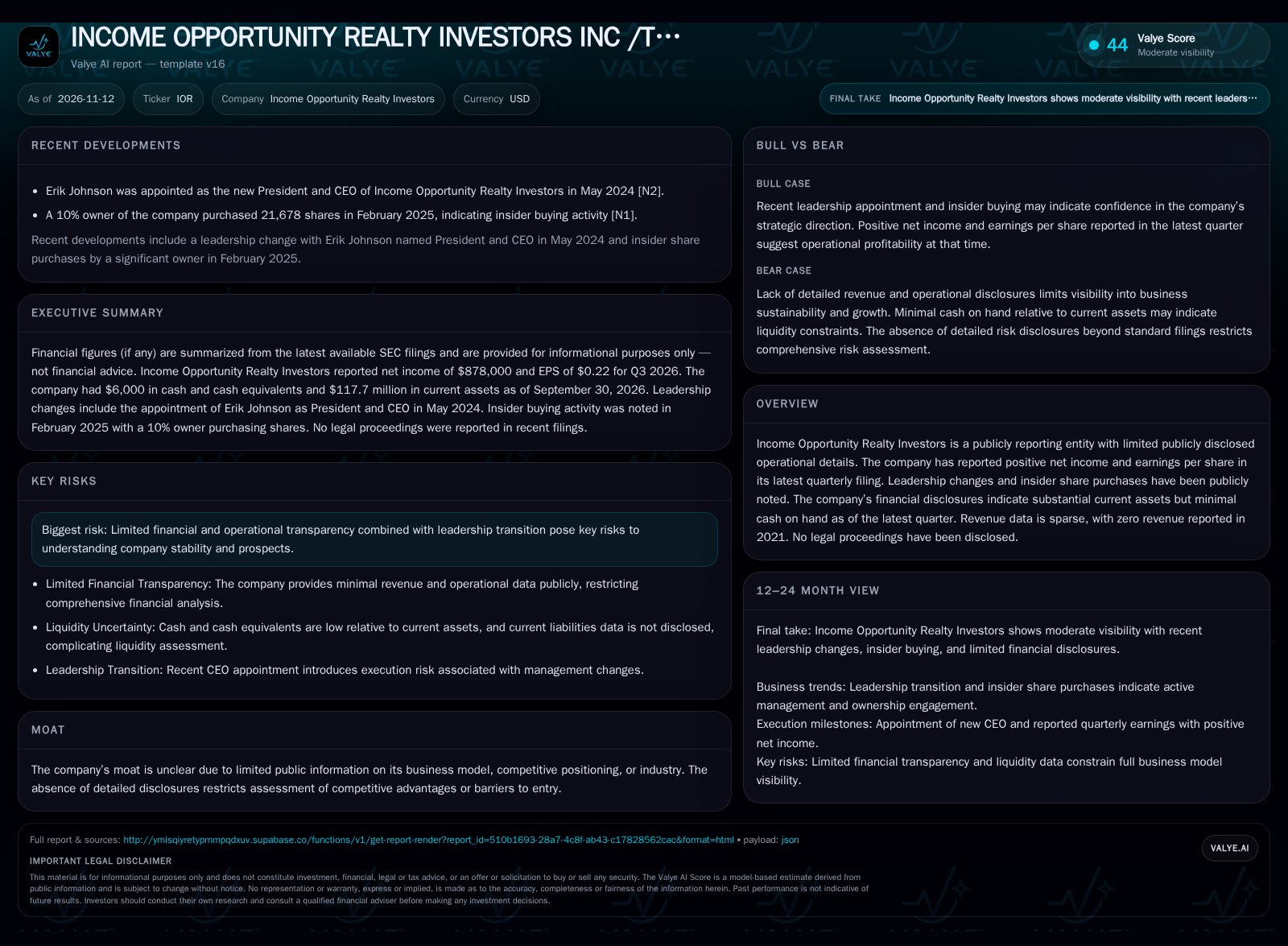
Income Opportunity Realty Investors reported net income of $878,000 and EPS of $0.22 for the quarter ending September 30, 2026, representing a period of apparent profitability [S2]. However, the company’s cash and cash equivalents were just $6,000, despite current assets totaling $117.7 million [S2]. This mismatch suggests that current assets are likely dominated by non-cash items—primarily receivables from related parties—which may not be readily convertible to cash. The business remains externally managed by Pillar and is highly reliant on related-party transactions. Further, Erik Johnson’s appointment as President and CEO in May 2024 and insider share purchases in February 2025 introduce signals of potential strategic change or internal confidence, but without corresponding operational disclosure, their significance is difficult to gauge [N2] [N1].
How Value is (or Isn’t) Created: The Mechanics and Risks of Related-Party Receivable Income
IOR’s principal source of income is interest from notes receivable, collateralized by income-producing properties—most of which are held in transactions with related parties [S2]. This business model is structurally different from conventional real estate investment trusts or property operators, as it does not involve direct property management or traditional rental income. The company is externally managed under an advisory agreement with Pillar, and has no employees of its own, which keeps fixed costs low but outsources all operational control.
The economics of this model hinge on the quality and collectability of receivables, the creditworthiness of related entities, and the terms of lending arrangements. If receivables are performing and properly collateralized, interest income can be steady. However, the absence of arm’s-length negotiations may lead to non-market terms, heightened credit risk, or delayed cash conversion. The company reported cash and liquidity metrics for the period; these figures do not by themselves establish operating runway, investment capacity, financial flexibility, or financing capacity. The company’s minimal direct operating expenses and lack of employees limit its operating leverage but also restrict its capacity for active management or growth.
Assessing the Competitive Landscape: Opaque Positioning and the Challenge of Related-Party Reliance
IOR’s competitive stance is difficult to benchmark due to the lack of disclosed peers, asset details, or market segments. Unlike traditional real estate investment companies that compete on asset quality, management expertise, and cost of capital, IOR’s model is largely inward-facing—its main counterparties are related entities. This structure can reduce external competition but also undermines transparency and may expose the company to conflicts of interest. The absence of direct property operations, development activities, or third-party tenant relationships limits the company’s ability to capture upside from market cycles or rental growth.
Potential substitutes for investors include other externally managed real estate vehicles, private credit funds, or REITs with more transparent asset bases and cash-generative models. The key counterforce is the risk that related-party arrangements do not deliver market returns, and that external management may not always align with minority shareholder interests. Without a clear moat, durable cost advantage, or demonstrated proprietary sourcing, IOR’s long-term competitive edge remains unproven.
Unlocking Asset Value: What a Favorable Turnaround Would Require
A bullish scenario would see IOR’s related-party receivables performing as promised, generating reliable interest income that can be converted into cash and, potentially, distributed to shareholders. If the new CEO, Erik Johnson, implements greater transparency or restructures the portfolio to include higher-yield third-party assets, the company could transition toward a more conventional, market-facing real estate or credit model. Insider buying by a 10% owner may signal an expectation of such positive change [N1].
Confirmation of this scenario would come from increased cash balances, regular dividend payments sourced from operating cash flow, and detailed disclosures on the performance and collectability of receivables. Announcements of new third-party deals, asset monetizations, or acquisitions could further validate a turnaround. Conversely, if receivables continue to dominate the balance sheet without generating cash or if disclosures remain opaque, this upside would be cast into doubt.
Status Quo: Prolonged Opacity and Reliance on Related-Party Flows
The most plausible near-term scenario is that IOR continues to operate as a vehicle for related-party lending, with reported income derived from interest on receivables that may not translate into tangible cash flow. The company’s externally managed structure is likely to persist, given the common ownership ties between Pillar, TCI (the controlling shareholder), and IOR itself [S2]. Absent clear evidence of asset sales, third-party deals, or cash-generative operations, investors should expect ongoing limited transparency and modest reported profitability.
Any deviation from this pattern—such as a sudden increase in cash, a shift in the composition of current assets, or a move into third-party business lines—would challenge the base assumption.
What Could Go Wrong: Liquidity Crunch or Deterioration in Related-Party Performance
The principal risk is that the company’s receivables become impaired or uncollectible, particularly if related parties face financial distress or if the collateral (income-producing properties) loses value. [S2] If receivable income is delayed or defaulted upon, the company could struggle to meet its own obligations, potentially triggering asset sales at unfavorable prices or dilutive financing.
A further adverse scenario would see increased regulatory or shareholder scrutiny of related-party dealings, leading to forced disclosures, restatements, or governance changes. Evidence of receivable impairments, legal disputes, or negative developments at Pillar or TCI would reinforce this downside. If the company is unable to convert its current assets into cash or sustain operational profitability, equity value could erode rapidly.
Testing the IOR Thesis: Disclosure, Cash Flow, and Receivable Performance
Quarterly cash and cash equivalents balances—material increases or decreases would signal changes in liquidity or operational cash flow.
Detailed disclosures on the composition, maturity, and performance of related-party receivables—would clarify collectability and credit risk.
Any initiation of dividend payments or return of capital—would indicate surplus cash generation and shareholder alignment.
Announcements of asset sales, acquisitions, or moves into third-party lending—would mark a shift toward market-facing operations.
Management commentary or filings that increase transparency around Pillar’s role, advisory fees, or conflicts of interest—would help assess alignment.
Changes in insider ownership levels, particularly additional insider buying or selling—could signal shifting internal expectations.
Emergence of legal proceedings, regulatory actions, or adverse news related to TCI, Pillar, or IOR itself—would highlight governance or credit risk.
If disclosed, metrics on receivable impairments or non-performing assets—would provide a direct test of asset quality and income sustainability.
Disclaimer: This is research-only, informational analysis and not investment advice. It may include AI-generated interpretation and general industry context. Always verify important details using primary sources.

Comments