
Trio-Tech’s Revenue Surge Masks Margin Compression and Strategic Trade-offs in Semiconductor Test Services
Despite a near-doubling of semiconductor back-end solutions revenue and expanded Asian capacity, Trio-Tech International faces persistent margin compression, rising operating expenses, and pronounced market skepticism. The company’s ability to translate top-line momentum into sustainable profitability hinges on managing cost inflation, supply chain risk, and the delicate economics of high-mix, engineering-intensive test services.
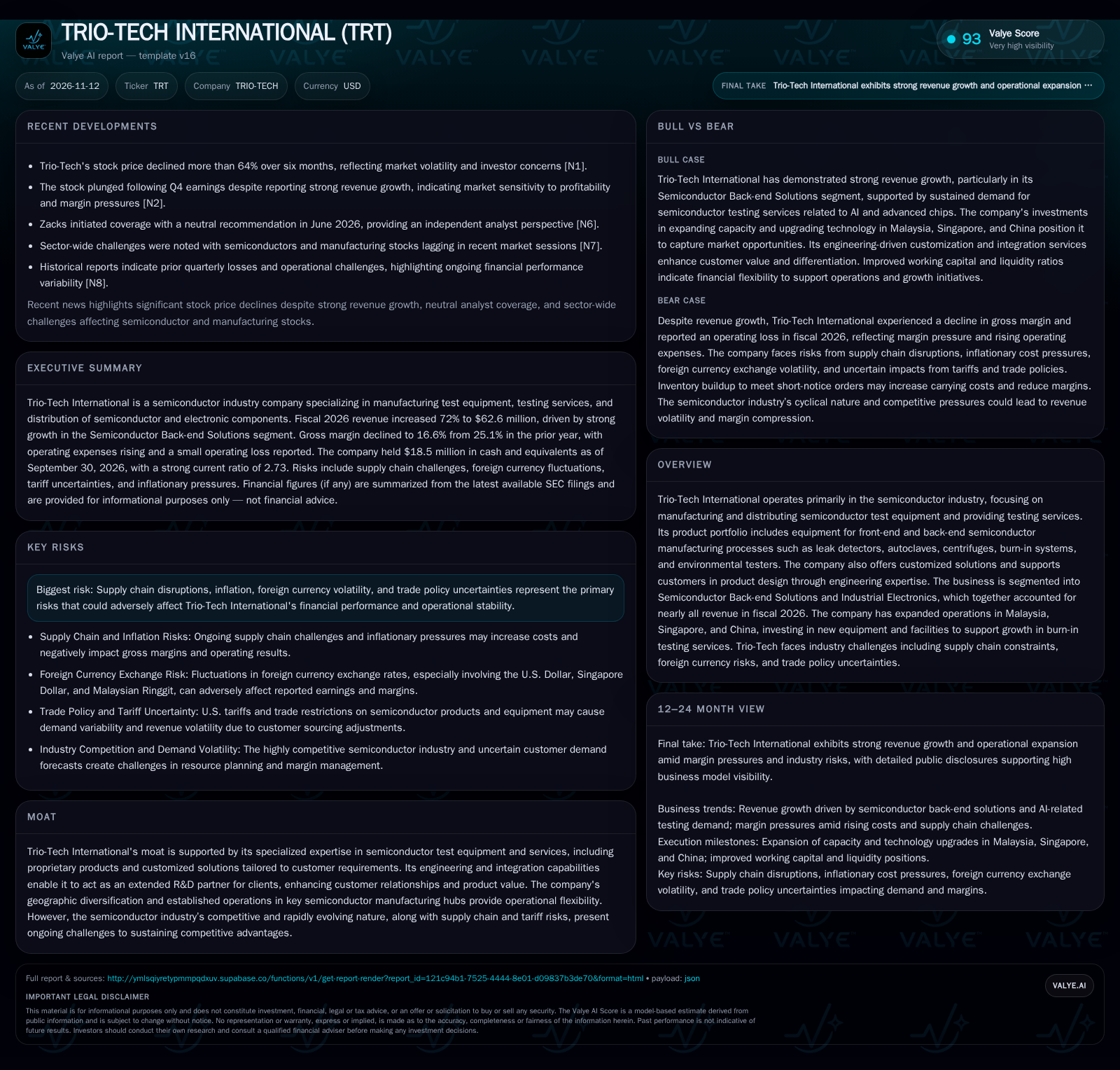
Trio-Tech International delivered 72% revenue growth in fiscal 2026, led by its Semiconductor Back-end Solutions segment and capacity expansions in Asia. However, gross margin dropped sharply, operating expenses climbed, and the company dipped into a small operating loss despite top-line gains. Recent stock price declines and neutral analyst coverage reflect market unease about Trio-Tech’s ability to convert growth into durable profits amid industry volatility and rising costs. The company’s future will depend on its margin management, supply chain resilience, and competitive positioning in a cyclical, innovation-driven sector. [S1] [S2] [N1] [N2] [N6]
Trio-Tech International’s fiscal 2026 results paint a classic picture of growth-versus-margin tension in a cyclical, capital-intensive technology niche. While the company captured surging demand for semiconductor test services—especially those supporting AI and advanced chip manufacturing—its gross margin compressed sharply and operating profitability slipped into the red. Ongoing investments in Asian capacity and engineering resources have expanded Trio-Tech’s service reach, yet rising costs, inventory build-up, and continued exposure to supply chain and macro risks have left the market unconvinced. Trio-Tech’s challenge now is to convert its top-line momentum into resilient, scalable earnings in an industry defined by rapid change and relentless cost pressure.
Recent Results Spotlight Growth-Margin Trade-offs and Market Skepticism
Trio-Tech International delivered $62.6 million in revenue for fiscal 2026, up 72% from the previous year, with the Semiconductor Back-end Solutions segment nearly doubling to $49.0 million. This surge reflects robust demand for testing equipment and services as global semiconductor manufacturers ramp production for AI and advanced electronics. However, gross margin fell steeply from 25.1% to 16.6%, and operating expenses outpaced gross profit growth, resulting in a small operating loss of $0.2 million. Stock price performance has been punishing: shares dropped over 64% in six months and plunged post-Q4 earnings, despite revenue gains, as investors reacted to persistent margin pressure and bottom-line volatility. The company reported cash and liquidity metrics for the period; these figures do not by themselves establish operating runway, investment capacity, financial flexibility, or financing capacity. [S1] [S2] [N1] [N2]
How Trio-Tech’s Economics Depend on Volume, Mix, and Cost Discipline
Trio-Tech’s core business model hinges on manufacturing specialized test equipment and delivering high-mix, engineering-intensive testing services for semiconductor manufacturers. The company’s revenues are split between capital equipment sales, recurring test services, and the distribution of complementary components. The economics are sensitive to product mix—capital equipment can drive large, lumpy sales but may carry lower gross margins due to competition and customer bargaining power, while custom test services often bring higher margins but require significant engineering resources and ongoing investment in capacity.
Operating leverage is a double-edged sword: capacity expansions in Malaysia, Singapore, and China increase fixed costs and asset intensity, so Trio-Tech must maintain high utilization to protect margins. The 2026 margin compression suggests that higher input costs (labor, materials, logistics) and inflationary pressures outpaced the company’s ability to pass on costs or achieve pricing power. Inventory build-up to serve short-notice customer orders further ties up capital and may erode margins if demand shifts or costs rise unexpectedly. If Trio-Tech can optimize asset utilization, improve pricing discipline, and streamline overhead, operating leverage could work in its favor—but these gains are not automatic in a cyclical, competitive market.
Engineering Differentiation Meets Intense Semiconductor Industry Headwinds
Trio-Tech’s competitive position rests on its reputation for engineering-driven customization, acting as an extended R&D partner for semiconductor manufacturers. Its ability to tailor test equipment and integrate solutions can deepen customer relationships and create switching frictions, especially for clients with specialized requirements or rapid innovation cycles. Geographic diversification across Asia’s key semiconductor hubs provides operational flexibility and access to growth markets.
However, the semiconductor test equipment and services market is highly competitive, with well-established global and regional players, continuous technology substitution, and frequent price-based competition. New entrants or larger incumbents can pressure margins by offering integrated solutions or leveraging scale. Cyclical demand, rapid technology shifts (e.g., new chip architectures, packaging methods), and customer insourcing all present ongoing threats. While Trio-Tech’s engineering expertise is a moat component, its durability will be tested by the ability to innovate, control costs, and sustain high service levels as industry dynamics evolve.
Margin Recovery and High-Utilization Unlock Profitable Scale
A favorable outcome for Trio-Tech would see the company leverage its expanded Asian capacity to capture incremental demand for advanced testing services, particularly as AI, automotive, and IoT chip volumes rise globally. If cost inflation moderates and Trio-Tech succeeds in optimizing asset utilization—keeping new facilities and equipment highly loaded—gross margins could recover. Improved pricing discipline, potential for value-added services, and reduced supply chain friction would further support margin expansion.
Confirmation of this scenario would come from sequential improvement in gross margin percentage, a return to sustained operating income, and evidence of positive operating cash flow. Additional signals might include new long-term customer engagements, reductions in inventory days, and management commentary on successful cost pass-through or supply chain stabilization. Falsification would be indicated by persistently low or declining margins, continued operating losses, or further inventory build-up without corresponding revenue growth.
Volatility Persists as Trio-Tech Balances Growth with Margin Pressure
The most plausible near-term path is one of ongoing top-line strength—supported by secular semiconductor demand and Trio-Tech’s expanded test capacity—offset by continued margin pressure and earnings volatility. Inflation, supply chain disruptions, and competitive pricing are likely to constrain gross margin recovery even as revenues grow. Inventory levels may remain elevated as the company seeks to meet customer demand with short lead times, sustaining working capital requirements and exposing Trio-Tech to sudden demand shifts.
Evidence for this scenario would include continued revenue growth in the Semiconductor Back-end Solutions segment, modest improvements (but not full recovery) in gross margin percentage, and lumpy profitability with occasional quarterly losses. Watch for management focus on cost controls, operational efficiency initiatives, and cautious capital allocation. A base scenario would be falsified by a sharp reversal in revenue momentum, a sustained return to operating profitability (suggesting upside), or a dramatic deterioration in cash/working capital (indicating downside risk).
Cost Inflation and Utilization Shortfalls Trigger Margin Spiral
The risk case centers on Trio-Tech’s inability to offset cost inflation, supply chain disruptions, or competitive price pressures, leading to further gross margin erosion and recurring operating losses. If demand slows—due to semiconductor industry cyclicality, customer insourcing, or geopolitical shocks—Trio-Tech could be left with underutilized capacity, higher inventory write-downs, and fixed costs that outpace revenue. Prolonged margin compression could deplete cash reserves and force retrenchment or restructuring.
Downside confirmation would include a further drop in gross margin below the 16% level, multiple consecutive quarters of operating losses, negative operating cash flow, or a sharp increase in net working capital (especially inventory). Additional warning signs: customer concentration risk materializing as contract losses or pricing concessions, or evidence that expanded capacity is not being absorbed by revenue growth. Downside would be less likely if Trio-Tech demonstrates rapid cost adaptation, flexible capacity management, or unexpected strength in high-margin service contracts.
Signals That Will Clarify Trio-Tech’s Path to Sustainable Profitability
Sequential gross margin percentage: Is Trio-Tech stabilizing or improving its margin profile as capacity ramps and inflationary pressures evolve?
Operating income trend: Does the company return to consistent positive operating income, or do losses persist as costs rise?
Inventory days and turnover: Are inventory levels being managed efficiently, or is capital tied up in slow-moving stock, risking write-downs and further margin drag?
Capacity utilization rates: How effectively are new facilities and equipment in Malaysia, Singapore, and China being absorbed into revenue-generating activity?
Customer concentration and contract duration: Is Trio-Tech winning multi-year, high-value agreements that reduce revenue volatility and improve visibility?
Cash flow from operations: Is revenue growth translating into positive cash flow, or are working capital and margin pressures eroding liquidity?
Competitive pricing environment: Are industry peers experiencing similar margin compression, or is Trio-Tech losing share or pricing power in core segments?
Disclaimer: This is research-only, informational analysis and not investment advice. It may include AI-generated interpretation and general industry context. Always verify important details using primary sources.

Comments