
LiveRamp’s Pending Publicis Merger: Platform Economics, Strategic Stakes, and the Future of Data Collaboration
LiveRamp’s 9% revenue growth and robust margins underscore the economic resilience of its data collaboration platform, but the pending acquisition by Publicis Groupe reframes both its strategic opportunities and integration risks. This analysis examines how LiveRamp’s business mechanics, ecosystem, and regulatory landscape shape the merger’s significance—and what would need to happen for the combined entity to unlock new value.
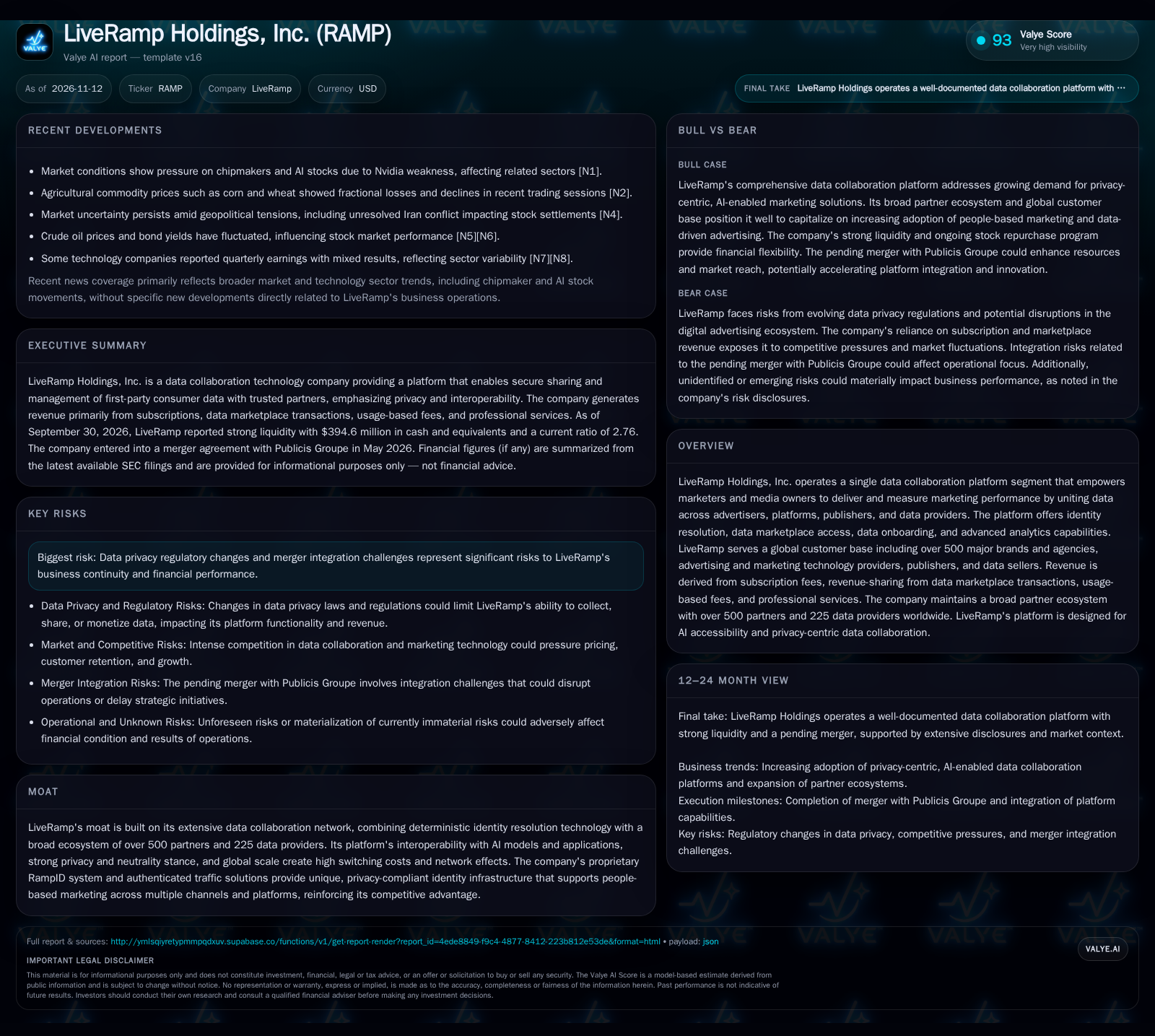
LiveRamp operates a privacy-centric data collaboration platform with strong gross margins and a broad ecosystem, recently reporting $812.9 million in annual revenue and a 70.7% gross margin. The company is set to be acquired by Publicis Groupe for $38.50 per share, a move that could expand its reach but introduces integration and execution risk. The core challenge is whether LiveRamp’s network effects and identity infrastructure can sustain advantage as regulations and competition intensify.
LiveRamp Holdings sits at a critical inflection point: its core data collaboration platform has demonstrated durable growth and profitability, but the pending merger with Publicis Groupe will fundamentally reshape its trajectory. The company’s high-margin, subscription-driven model and network of over 500 partners enable it to serve a broad swath of industries amid mounting demand for privacy-centric, AI-compatible data solutions. Yet, as regulatory scrutiny intensifies and the digital marketing landscape shifts, LiveRamp’s ability to sustain its edge—and to successfully integrate into Publicis’s global media and marketing empire—will determine the long-term outcome for both its platform economics and its customers.
A Year of Growth, High Margins, and a Major Strategic Pivot
LiveRamp reported $812.9 million in revenue for the twelve months ended March 31, 2026, representing 9% year-over-year growth. The company maintained a robust gross margin of 70.7% and net earnings of $146.0 million ($2.24 per diluted share), signaling underlying business resilience and operating leverage [S1].
As of September 30, 2026, LiveRamp held $394.6 million in cash and equivalents, with a further $7.5 million in short-term investments, and a current ratio of 2.76—indicating a conservative liquidity position [S2].
In May 2026, LiveRamp entered into a definitive merger agreement to be acquired by Publicis Groupe for $38.50/share in cash, with the transaction structured to convert existing equity awards into restricted cash subject to vesting [S1].
These developments matter because they signal both the company’s standalone economic health and a strategic transition that will test its ability to scale and innovate within a larger organizational context.
Subscription-Led Platform Economics and the Leverage of Data Networks
LiveRamp’s revenue model blends subscription fees for platform access, revenue-sharing on data marketplace transactions, usage-based fees from publishers and addressable TV providers, and incremental professional services [S1]. This mix supports a high gross margin structure—over 70%—suggesting that the core platform enjoys significant scale economies and a largely fixed-cost infrastructure for identity resolution, onboarding, and analytics.
Subscription and recurring platform fees likely provide predictability and lower churn risk, especially as integration with customer data stacks increases switching friction. Marketplace and usage-based components introduce volume-driven upside but may be more sensitive to macro advertising trends and partner activity. Professional services, while incremental, support onboarding and customization but are unlikely to scale as profitably as core software revenue.
Capital requirements are modest relative to revenue, given the asset-light, SaaS-like nature of the business. The company reported cash and liquidity metrics for the period; these figures do not by themselves establish operating runway, investment capacity, financial flexibility, or financing capacity.
Network Effects, Identity Infrastructure, and the Competitive Stakes in Data Collaboration
LiveRamp’s competitive position is anchored by its proprietary identity infrastructure (notably RampID), a privacy-centric design, and integration with over 500 partners and 225 data providers [S1]. This creates potential network effects: as more participants join the platform, the utility and richness of data collaboration increase, making the platform stickier for both buyers and sellers of data.
Key competitor categories include global marketing clouds, large advertising technology providers, enterprise CDPs (customer data platforms), and privacy-focused data interoperability startups. The primary counterforces are rapid regulatory change, the increasing sophistication of in-house solutions by large brands, and potential disintermediation by cloud infrastructure players moving up the stack.
Switching costs could be high for enterprise customers deeply integrated with LiveRamp’s identity and analytics capabilities, especially where compliance and cross-channel measurement are critical. However, ongoing regulatory uncertainty and advances in privacy-preserving technologies may compress these advantages over time if LiveRamp cannot continuously adapt its value proposition.
Merger Synergies Unlock a New Tier of Platform Scale and Innovation
If the Publicis acquisition closes smoothly and integration is executed with minimal friction, LiveRamp could benefit from immediate access to a broader global client roster, increased sales leverage, and enhanced data assets. The combined entity may accelerate adoption of privacy-safe, AI-enabled marketing solutions—particularly as global brands seek unified identity resolution across channels and geographies.
Upside would be confirmed by rapid cross-selling into Publicis’s client base, accelerated partner onboarding, and evidence of new, high-margin products emerging from combined R&D. Growth in international revenue and expansion of the platform’s analytics and AI capabilities would also support this scenario.
A successful integration would likely be evident in sustained double-digit revenue growth, further margin expansion, and a stable or improving retention rate among both legacy and newly acquired customers.
Integration Brings Moderate Expansion Amid Regulatory and Competitive Crosswinds
The most plausible outcome is that LiveRamp, as a Publicis subsidiary, experiences moderate revenue growth—incremental cross-sell benefits and deeper integration with Publicis’s agency operations, but offset by regulatory complexity, integration friction, and ongoing competition from both established and emerging data platforms.
In this scenario, the platform continues to see steady (but not accelerating) adoption among large enterprises and publishers, with gross margins remaining high but operating expense growth tracking integration and compliance costs. Revenue growth in the high-single to low-double digits would confirm this trajectory.
Falsification would come from either a sharp drop in customer retention (indicating integration or competitive issues), or from a regulatory shift that materially impacts the ability to monetize data at scale.
Regulatory Headwinds or Integration Missteps Erode Platform Advantage
A negative scenario could materialize if the merger triggers organizational disruption, loss of key talent, or cultural misalignment—leading to customer churn and stalled product innovation. Alternatively, if new privacy regulations (e.g., more restrictive cross-border data transfer rules or bans on certain types of data sharing) are enacted, LiveRamp’s core value proposition could be undermined, forcing costly platform changes or limiting addressable market size.
Early warning signs would include a decline in net new customer additions, margin compression from increased compliance costs, or delays in launching new features. Inability to retain major enterprise clients or partners post-merger would be a strong signal that integration is not proceeding smoothly.
This scenario would be confirmed by a flattening or contraction in revenue, declining gross margin, and negative commentary from customers or partners about platform reliability or regulatory hurdles.
Core Developments That Will Shape the LiveRamp–Publicis Outcome
Pace and transparency of merger closing and integration milestones—updates on regulatory approvals, leadership continuity, and operational transition will be critical.
Customer retention and expansion rates, especially among enterprise and strategic accounts, would help test whether integration is supporting or disrupting platform adoption.
Growth in cross-sell and upsell activity within the Publicis client base—if disclosed—would provide evidence of realized synergies.
Platform revenue mix evolution: shifts in subscription, marketplace, and usage-based fees could indicate changing demand or margin profile.
Gross margin trends post-merger: sustained or improved margins would suggest operational leverage and successful integration.
Regulatory developments in core markets (US, EU, APAC) that could impact data sharing, onboarding, or analytics capabilities.
Retention of key personnel and leadership, particularly in product, technology, and customer-facing roles.
Announcements of new product launches, AI integrations, or expanded partner relationships—if disclosed—would signal ongoing innovation momentum.
Disclaimer: This is research-only, informational analysis and not investment advice. It may include AI-generated interpretation and general industry context. Always verify important details using primary sources.

Comments