
Rockwell Automation: Margin Expansion, Software Acceleration, and the Stakes of Industrial Digitalization
Rockwell Automation’s recent margin gains and segment outperformance highlight the power of software and digital infrastructure investments, but the company’s exposure to macro cycles, supply chain cost volatility, and execution risk on major capital projects remain unresolved challenges. The next phase for ROK will hinge on translating a Connected Enterprise vision into recurring revenue, resilient margins, and adaptive global operations.
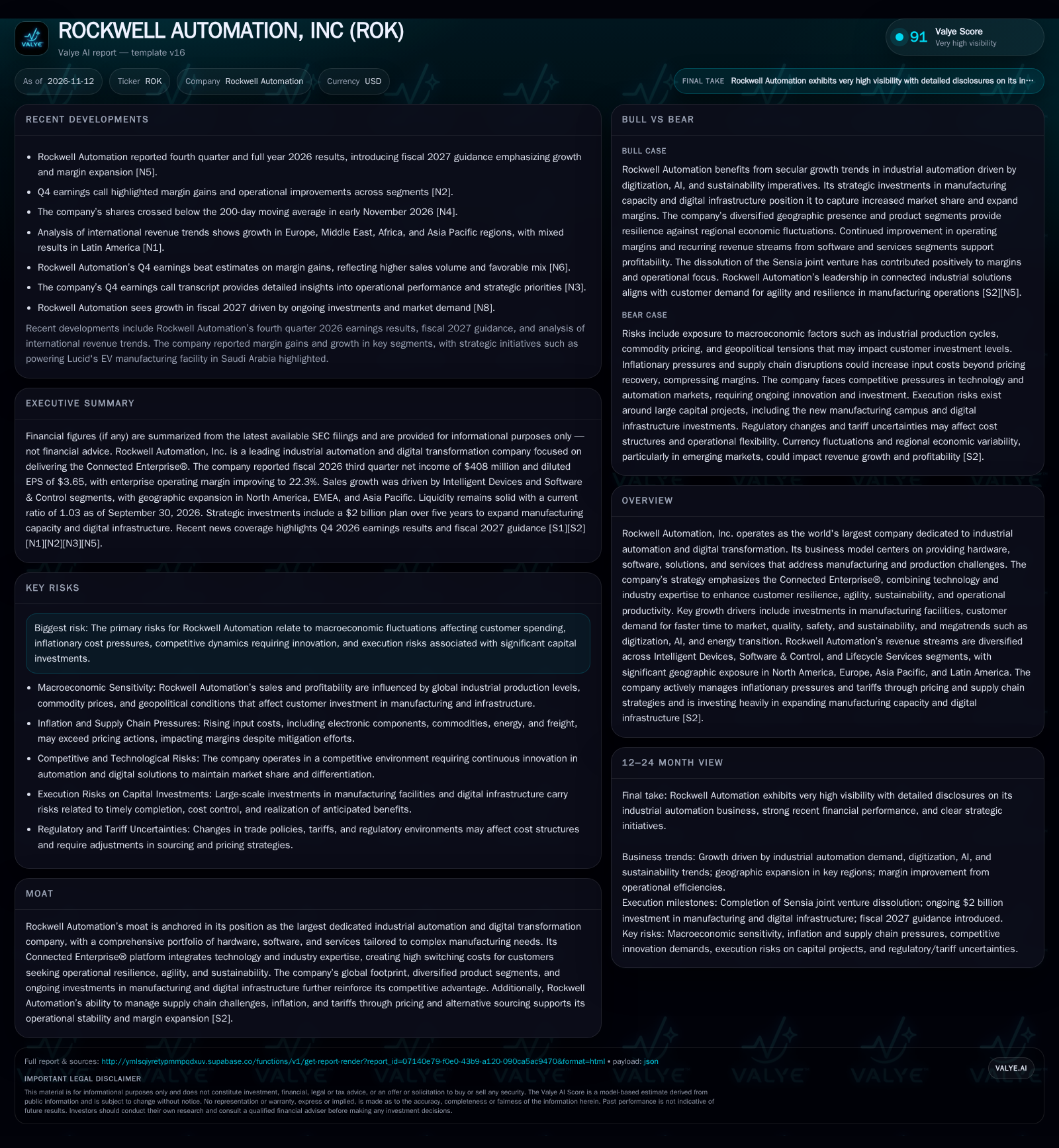
Rockwell Automation reported robust third-quarter 2026 results, with segment margin improvements and double-digit organic growth in Software & Control and Intelligent Devices. The company is executing a $2 billion multi-year investment in manufacturing and digital infrastructure, and has completed the Sensia JV exit, both of which are reshaping its margin profile and operational focus. However, ROK’s fortunes remain tightly linked to global industrial capex cycles, inflationary pressures, and the success of its software-driven Connected Enterprise strategy. Fiscal 2027 guidance points to continued growth, but real resilience will depend on recurring revenue traction and the ability to absorb volatility in input costs and regional demand.
Rockwell Automation enters fiscal 2027 with momentum in both sales and operating margin, propelled by double-digit growth in software and hardware and a strategic shift toward a more integrated, digitalized industrial offering. The completion of the Sensia JV dissolution and a bold $2 billion investment in new facilities and digital infrastructure signal a company intent on reshaping its business model for resilience and margin expansion. Yet, the real test for Rockwell will be whether its Connected Enterprise vision can consistently deliver recurring revenue and withstand macro, competitive, and supply chain shocks as industrial automation enters its next era.
Recent Margin Surge and Strategic Shifts Define ROK’s Operating Landscape
Rockwell Automation reported an 8% year-over-year sales increase in the third quarter of fiscal 2026, with organic growth strongest in Software & Control (18%) and Intelligent Devices (10%) [S2]. Segment operating margins improved across the board—Software & Control reached 34.8%, Intelligent Devices 20.0%, and Lifecycle Services 15.1%. The overall enterprise operating margin rose to 22.3% from 19.5% a year earlier, driven by higher volumes, favorable mix, and the beneficial impact of the Sensia joint venture dissolution [S2].
The company announced a $2 billion, five-year investment program focused on plant expansion, digital infrastructure, and talent, including a new manufacturing campus in Southeastern Wisconsin [S2]. Liquidity as of September 30, 2026, included $433 million in cash and equivalents and a current ratio of 1.03 [S1]. Fiscal 2027 guidance calls for continued growth and further margin expansion [N5] [N8]. These moves position Rockwell for both scale and digital transformation, but they also heighten execution risk and capital requirements.
How Rockwell’s Mix Shift and Software Push Could Reshape Profitability
Rockwell Automation’s revenue model blends capital-intensive hardware with higher-margin software and services, creating a complex mix of upfront and recurring revenue streams. The company’s recent outperformance in Software & Control—now growing at nearly double the rate of Intelligent Devices—suggests that a greater share of revenue is coming from software licenses, automation platforms, and control systems. These products typically exhibit higher gross margins and more predictable, recurring revenue if structured as multi-year contracts or subscriptions.
The company’s $2 billion investment in manufacturing and digital infrastructure is likely to increase fixed costs in the near term, but it may also enable greater operating leverage if volumes continue rising and digital solutions gain traction. Capital needs will remain significant, particularly as Rockwell seeks to localize production, meet resiliency demands, and expand globally. The dissolution of the Sensia JV removes a layer of operational complexity and could allow for more focused resource allocation.
Pricing power is partly supported by the mission-critical nature of Rockwell’s automation solutions, but inflation and supply chain volatility still threaten margins if cost increases outpace the company’s ability to raise prices or source alternatives. The real economic test will be whether Rockwell can transition a greater portion of its portfolio to recurring software and service revenue, dampening the cyclicality of hardware-centric capital spending.
Digital Differentiation Meets Global Competition in Industrial Automation
Rockwell Automation’s competitive moat is built on its scale, integrated product portfolio, and the Connected Enterprise® platform, which aims to unify hardware, software, and analytics for industrial customers. This integration could increase switching costs for customers who rely on Rockwell’s solutions for uptime, productivity, and compliance. However, the competitive landscape is intense: global conglomerates, European automation specialists, and emerging digital-native firms all vie for share in both legacy automation and new digital transformation projects.
The shift toward software and industrial IoT platforms increases the risk of competition from large enterprise software vendors, cloud providers, and nimble start-ups that can deliver modular, cloud-based solutions with lower upfront cost and faster deployment cycles. Customer incentives are evolving as manufacturers seek agility, resiliency, and sustainability—areas where Rockwell’s domain expertise and installed base are assets, but where rapid innovation and integration with third-party systems are also essential.
Technology substitution risk is real: as open protocols, AI-powered analytics, and cloud-native controls proliferate, traditional hardware-centric automation providers face margin and share pressure unless they can prove superior integration, reliability, or regulatory compliance. Rockwell’s global footprint and ongoing investments provide scale advantages, but the company must continually refresh its offerings to maintain its edge.
If Recurring Revenue and Digital Ecosystems Take Hold, Margin Resilience Could Follow
The most favorable scenario for Rockwell Automation involves a sustained acceleration in software and digital services, driving a higher proportion of recurring revenue and boosting blended margins. If the company successfully leverages its Connected Enterprise® platform to lock in customers with multi-year software subscriptions, analytics, and managed services, its revenue base could become less sensitive to capex cycles and more resilient to economic shocks.
Confirmation would come from disclosed increases in software and services as a percentage of total revenue, rising renewal rates, and evidence of customer stickiness—such as multi-year contract wins or expansion of platform deployments. Additional signals would include margin expansion outpacing hardware peers, and successful scaling of digital offerings in new geographies or verticals.
This scenario would be further supported if the $2 billion investment program delivers both capacity and digital capability without significant cost overruns. A growing international footprint, especially in fast-growing Asia Pacific and EMEA markets, would reinforce the case for durable, above-market growth.
Most Likely: Hardware Cyclicality Balanced by Digital Gains and Execution Challenges
The most plausible trajectory for Rockwell Automation is a blend of steady, mid-single-digit organic growth, driven by ongoing capital investment in industrial automation, offset by periodic slowdowns tied to global industrial cycles. Software and Control will likely continue to outpace hardware, but the company’s overall revenue mix will remain anchored in large, sometimes lumpy, project-based sales.
Margins are likely to improve modestly, as productivity gains, favorable mix, and pricing actions offset inflationary pressures. However, recurring revenue will probably remain a minority share for several years, leaving Rockwell exposed to swings in customer capex and competitive pricing. Execution risk around the $2 billion investment plan—including cost discipline, timely project delivery, and effective talent deployment—will be a constant management challenge.
Evidence confirming this scenario would include continued, but not accelerating, growth in software and services, stable or gradually rising margins, and no material surprises in regional performance or capital project outcomes.
How Macroeconomic Shocks and Execution Missteps Could Undermine the Thesis
A negative scenario for Rockwell Automation would be triggered by a sharp downturn in global industrial production, causing customers to delay or cancel automation investments. This would hit hardware volumes hardest, but could also slow adoption of new software and digital services, particularly if customers freeze discretionary spending.
Margin compression could intensify if input costs rise faster than Rockwell can implement price increases or source alternatives, especially in a period of persistent inflation or supply chain bottlenecks. Execution risk around the $2 billion capex plan could materialize if projects are delayed, over budget, or fail to deliver the expected operational improvements.
Additional downside risks include aggressive competitive pricing, loss of major contracts, or regulatory/tariff changes that disrupt global supply chains. Confirmation of this scenario would be seen in declining operating margins, stalled or negative sales growth, cost overruns on capital projects, or a deterioration in working capital metrics.
Milestones and Metrics for Testing Rockwell’s Shift to Digital and Recurring Revenue
Watch for the percentage of total revenue derived from software, analytics, and digital services—if disclosed—as a signal of progress toward recurring revenue.
Track segment operating margins, especially in Software & Control, for evidence of sustainable margin expansion and improved mix.
Monitor the pace and cost efficiency of the $2 billion capital investment program, including updates on the new Southeastern Wisconsin campus.
Evaluate renewal rates and contract duration in digital/software offerings, if disclosed, to assess customer stickiness.
Follow regional sales trends, particularly in Asia Pacific and EMEA, for signs of successful global expansion or emerging headwinds.
Watch for signs of cost inflation or supply chain disruptions that could impact gross margins and project delivery.
Assess the impact of the Sensia JV dissolution on both sales and operating margin in subsequent quarters.
A useful metric would be churn or retention rates in managed services and digital solutions, if the company begins to disclose them.
Disclaimer: This is research-only, informational analysis and not investment advice. It may include AI-generated interpretation and general industry context. Always verify important details using primary sources.

Comments