
American Realty Investors: potential Financial Flexibility Meets Persistent Profitability Pressure in a Shifting Real Estate Landscape
American Realty Investors Inc (ARL) faces a complex operating environment: recent quarters show both technical stock momentum and a rebound in earnings, yet Q3 2026 brought a return to net losses even as the company maintains a sizable liquidity buffer. The central question is whether ARL can convert its asset base and short-term investment capacity into consistent profitability amid sector volatility and debt-related scrutiny.
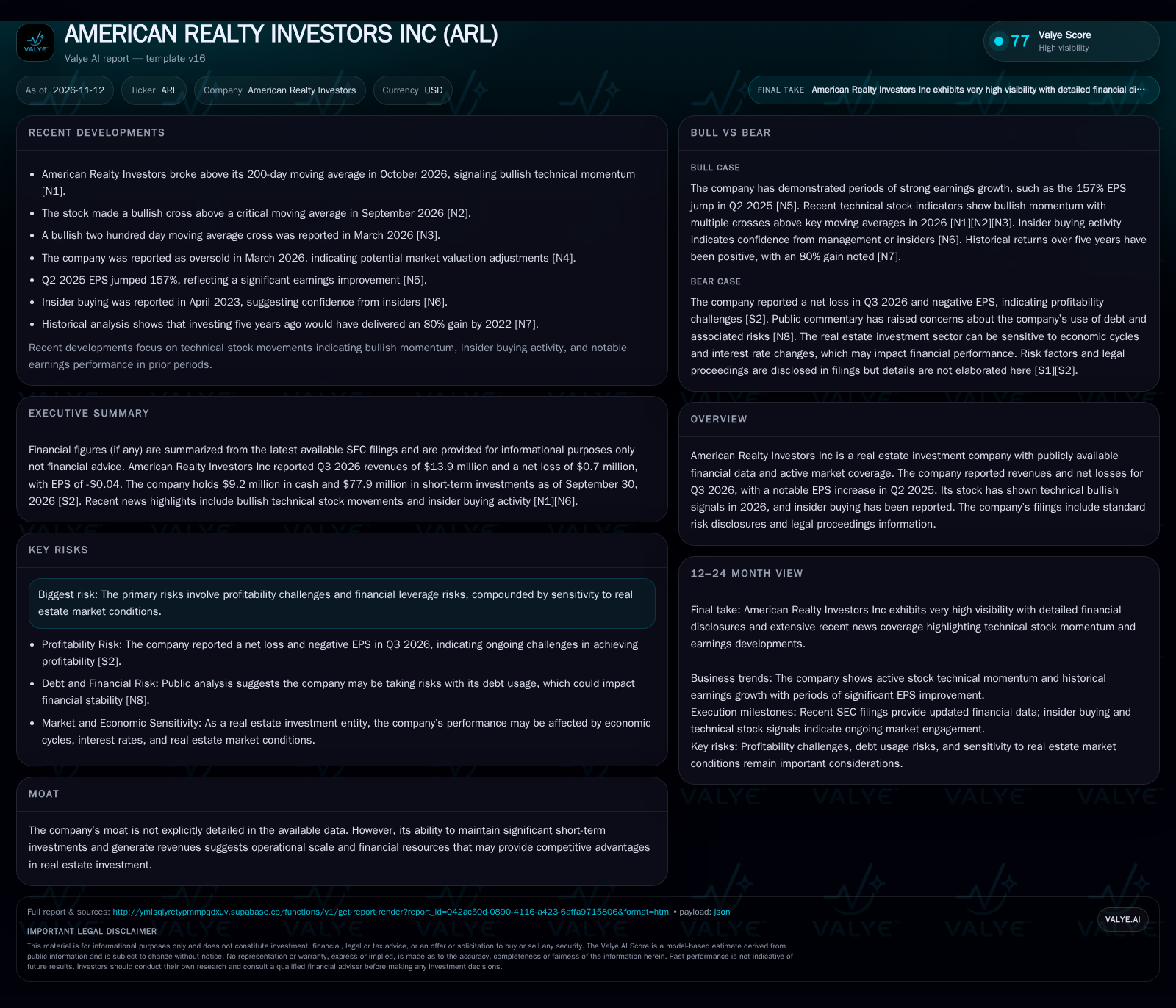
ARL reported Q3 2026 revenues of $13.9 million and a net loss of $0.7 million, despite holding over $87 million in cash and short-term investments [S2]. Technical indicators in 2026 have been bullish, and a 157% EPS surge was logged in Q2 2025 [N5]. However, public discussion of debt risks and persistent profitability challenges underline the company's sensitivity to market cycles and capital structure decisions.
The company's Q3 2026 results—$13.9 million in revenue and a net loss of $0.7 million—underscore these tensions, as do recent bullish technical signals and a dramatic, but brief, EPS spike in 2025. With over $87 million in cash and short-term investments, ARL possesses financial resources that could support opportunistic moves or cushion downturns, but its ability to translate this into steady returns remains contested amid sector headwinds and debt-related concerns.
Recent Financial Results and Liquidity Define Strategic Options
For the quarter ending September 30, 2026, American Realty Investors reported revenues of $13.906 million and a net loss of $0.702 million, translating to a basic and diluted EPS of -$0.04 [S2]. This return to negative earnings interrupts the company’s prior period of significant EPS growth, notably the 157% surge in Q2 2025 [N5].
On the balance sheet, ARL held $9.243 million in cash and $77.927 million in short-term investments as of the same date, providing a liquidity pool exceeding $87 million [S2]. This level of potential financial flexibility could enable the company to pursue new investment opportunities, navigate cyclical downturns, or address debt obligations. However, the persistence of net losses raises questions about the underlying profitability and efficiency of the asset base.
The interplay between ARL's liquidity position and its earnings trajectory invites a nuanced examination of capital efficiency. Holding substantial cash and short-term investments can be a double-edged sword: while it provides a safety net and optionality, it may also indicate underutilized capital if not deployed effectively. In real estate investment, idle liquidity often results in opportunity costs, especially when market conditions favor acquisitions or asset enhancements. Therefore, the strategic challenge lies in balancing the preservation of potential financial flexibility against the imperative to generate returns that exceed the cost of capital, particularly in an environment where property valuations and rental markets can shift rapidly.
Revenue Streams, Cost Structure, and the Profitability Puzzle
As a real estate investment company, ARL’s revenues are likely derived from a combination of property rental income, asset management fees, and potentially gains (or losses) from property sales or revaluations. Revenue in the latest quarter stood at $13.9 million, but the company nonetheless posted a net loss, suggesting that fixed costs, interest expenses, or impairments may be offsetting top-line gains.
The sector typically exhibits high operating leverage: fixed property costs and debt service magnify the impact of occupancy changes, rent roll adjustments, or asset revaluations. If ARL’s cost base remains inflexible or interest burdens are high, even moderate revenue gains may not translate to net profitability. The company’s sizable short-term investments could provide interest income or a buffer against volatility, but their yield is often modest compared to operating losses. Sustainable value creation will likely depend on improving property-level margins, managing leverage, and timing asset rotations to maximize returns relative to capital costs.
Beyond the headline revenue and loss figures, a deeper dive into ARL's cost structure would be instructive. Real estate firms typically face fixed operating expenses such as property taxes, maintenance, and administrative overhead, which can be relatively inflexible in the short term. If these fixed costs are high relative to revenue, the company’s break-even occupancy or rent level rises, compressing margins during downturns. Moreover, interest expense from debt financing can exacerbate this pressure, especially if the debt profile includes variable rates or near-term maturities. Therefore, the company’s ability to manage or restructure its cost base, including negotiating favorable debt terms or reducing non-essential expenses, will be critical to improving net profitability.
Strategic Standing Amid Real Estate Cyclicality and Peer Pressures
ARL operates in a highly competitive real estate investment landscape, where capital access, property selection, and cost discipline are critical. Larger REITs and institutional investors often benefit from scale, lower capital costs, and diversified portfolios, putting pressure on smaller or less diversified players to demonstrate unique sourcing or operational advantages.
The company’s substantial liquidity and asset base may enable it to act opportunistically during market dislocations—acquiring distressed properties or repositioning assets when competitors are constrained. However, public discussion of ARL’s debt usage implies that balance sheet leverage could also amplify downside risk in a downturn. Without evidence of differentiated property management, proprietary deal flow, or sustained cost advantages, ARL’s competitive position may hinge on its ability to smartly allocate capital and manage risk through cycles.
In assessing ARL's competitive positioning, the company's scale and portfolio composition are key factors influencing its resilience. Smaller or less diversified real estate investors often face higher per-unit operating costs and limited bargaining power with tenants and service providers. This can constrain margin expansion and limit the ability to absorb cyclical shocks. Conversely, a focused portfolio in niche markets or property types with stable demand can confer competitive advantages if coupled with active asset management. Additionally, access to proprietary deal flow or partnerships can differentiate ARL from peers, enabling it to acquire assets at favorable valuations. Without such advantages, the company's liquidity may only partially offset competitive disadvantages inherent in scale and diversification.
Turning Liquidity Into Alpha: Pathways to Outperformance
If ARL can deploy its $87 million in cash and short-term investments into high-yielding, accretive real estate assets or strategic acquisitions while maintaining cost control, it could reignite earnings growth and improve market valuation. The 157% EPS jump in Q2 2025 shows that operational leverage can swing sharply positive under the right conditions [N5].
Confirmation of this scenario would require evidence of new property acquisitions at attractive cap rates, rising rental income, or successfully refinancing debt on favorable terms. Sustained quarterly profitability, improving cash flow from operations, and a reduction in net debt would further validate a positive inflection. Conversely, if liquidity remains idle or is consumed by non-productive uses, the opportunity cost could weigh on shareholder returns.
Operating in a Holding Pattern: Incremental Gains, Persistent Margin Pressure
The most plausible trajectory is that ARL continues to generate modest revenues from its portfolio while facing ongoing cost and debt-servicing pressures. Periodic earnings volatility—such as the Q2 2025 spike—may recur, but sustainable net profitability could remain elusive unless operating margins improve or capital is redeployed more effectively.
This scenario would be confirmed by a continuation of small net losses or low single-digit positive/negative EPS, stable but unremarkable cash flow, and limited asset churn. If debt costs rise or property values stagnate, the company may be forced to conserve cash, limiting growth initiatives. Evidence refuting this view would include a clear, sustained trend toward higher net income and asset base expansion without proportional increases in leverage.
Leverage and Market Shocks: How Downturns Could Erode Value
Should real estate market conditions deteriorate—via rising interest rates, falling property values, or weakening tenant demand—ARL’s cost structure and debt load could lead to larger, sustained losses. If the company is unable to refinance maturing debt or must liquidate assets at distressed prices, equity value could be severely impaired.
Signs that this scenario is unfolding would include a sharp increase in net losses, negative operating cash flows, asset sales at a loss, or covenant breaches leading to forced deleveraging. Public scrutiny of debt usage would likely intensify, and liquidity reserves could be depleted faster than anticipated. The absence of new investments or asset growth would further signal distress.
Signals That Will Clarify ARL’s Profit Sustainability and Capital Allocation
Quarterly changes in net income and EPS—particularly evidence of a shift from persistent losses to recurring profitability.
Updates on new property acquisitions, dispositions, or major capital deployments, especially if these are funded from short-term investments.
Trends in operating cash flow versus net income, to assess the quality and sustainability of reported earnings.
Debt metrics, including total debt outstanding, average interest rates, and upcoming maturities—if disclosed—to gauge refinancing risk.
Rental income growth, occupancy rates, or same-property NOI (net operating income) trends, if the company provides these data.
Disclosures about asset impairments, legal proceedings, or risk factor updates in future SEC filings.
Disclaimer: This is research-only, informational analysis and not investment advice. It may include AI-generated interpretation and general industry context. Always verify important details using primary sources.

Comments