
Wolverine World Wide: Portfolio Leverage and Growth Ambitions in a Shifting Footwear Landscape
Wolverine World Wide’s Q3 2026 net income of $65.8 million and year-to-date earnings outperformance underscore near-term operational execution.
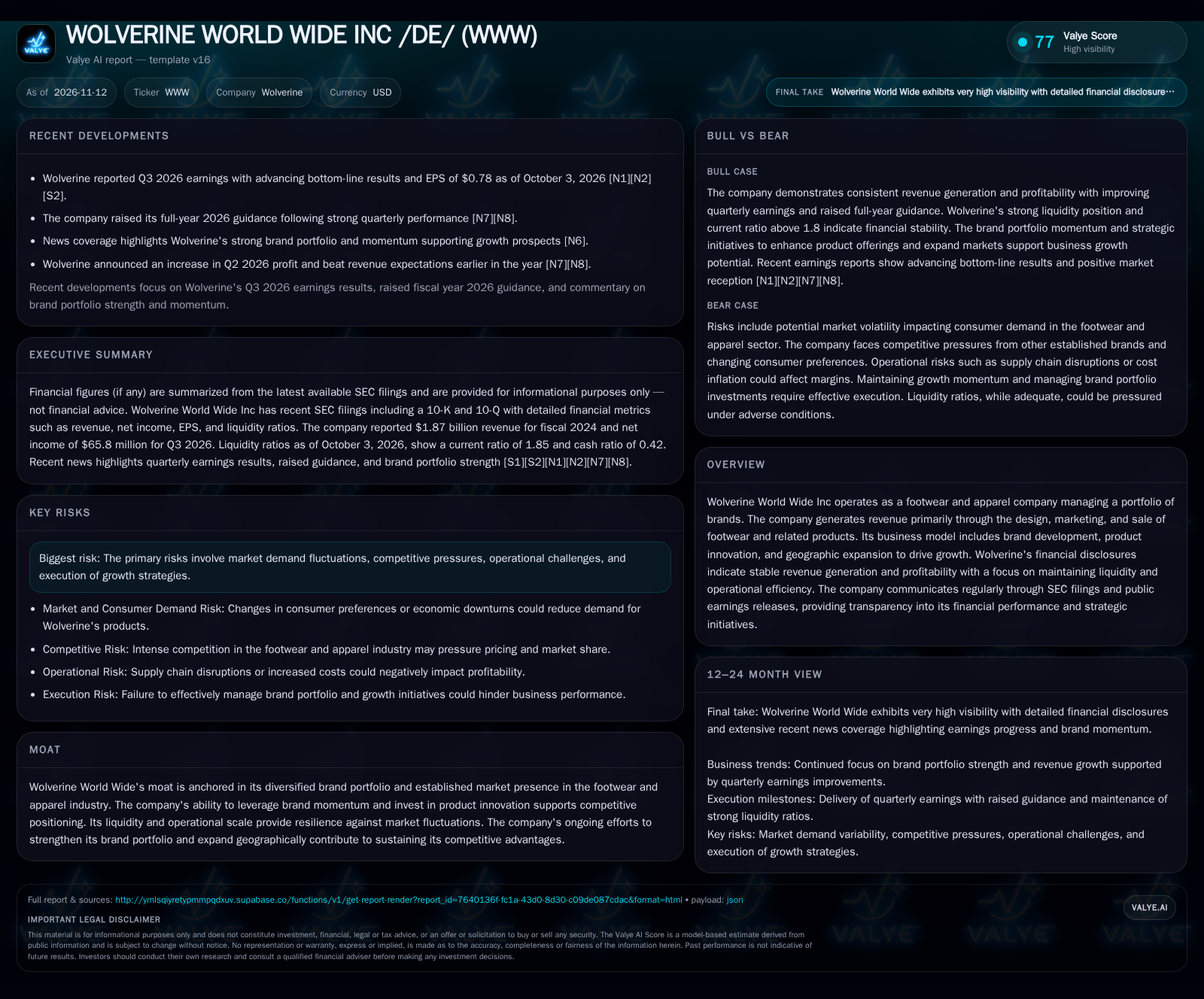
Wolverine World Wide’s Q3 2026 net income of $65.8 million and year-to-date earnings outperformance underscore near-term operational execution. Yet, the company’s strategic leverage—its portfolio of brands and innovation focus—will be tested by shifting demand trends, cost volatility, and the persistent push for differentiation in a crowded market. The question for investors is whether Wolverine can drive durable margin expansion and pricing power, or if competitive and macro headwinds will erode its recent gains. [S2] [N2]
Wolverine World Wide’s most recent filings and earnings results paint a picture of a footwear and apparel company delivering operational stability and margin improvement in the near term. With $1.87 billion in fiscal 2024 revenue and Q3 2026 net income of $65.8 million, Wolverine’s financial disclosures point to a business leveraging its brand portfolio to navigate a competitive and often unpredictable sector. However, as the company seeks to capitalize on product innovation and geographic expansion, the critical question is whether these initiatives can offset industry headwinds—including cost pressures, evolving consumer tastes, and relentless competition from both legacy and digital-native brands.
Earnings Momentum and Financial Position: The Latest Snapshot
Wolverine World Wide reported net income of $65.8 million and EPS of $0.78 for Q3 2026, signaling continued profitability and execution on cost and operational controls. Fiscal 2024 revenue reached approximately $1.87 billion, underscoring Wolverine’s scale in the global footwear and apparel market. However, the company’s liquidity ratios, while comfortably above distress levels, would be tested in a severe downturn or if inventory or receivables conversion slowed materially. [S1] [S2]
How Brand Portfolios and Innovation Power Wolverine’s Profit Engine
Wolverine’s business model turns on the design, marketing, and sale of a diversified portfolio of footwear and apparel brands. Revenue is primarily driven by product volume and mix, with the company seeking to capture margin through brand differentiation, premiumization, and operational scale. The underlying economics hinge on balancing fixed costs—such as product development, marketing, and distribution infrastructure—against variable costs tied to manufacturing, logistics, and sales commissions. When brand strength enables premium pricing, incremental sales can drive operating leverage, as fixed overhead is spread across higher revenue.
Capital needs are moderate relative to heavy manufacturing businesses, since Wolverine outsources a significant portion of production, focusing internal investment on brand management, design, and inventory. Still, working capital—especially inventory and receivables—remains a major use of funds and a potential source of risk if demand fluctuates. Operating leverage can be a double-edged sword: strong sell-through rates and favorable product mix can lift margins, but excess inventory or discounting in the face of weak demand can quickly erode profitability.
A critical dimension of Wolverine’s operating economics involves the interplay between fixed and variable costs in the context of scale and product lifecycle management. Since fixed costs such as marketing campaigns and design investments do not fluctuate directly with sales volume, the company benefits from incremental revenue growth that leverages these sunk costs. However, this dynamic also introduces risk when product launches underperform, as fixed expenses remain constant while revenue falls short, compressing margins. Furthermore, the timing of inventory procurement and production cycles relative to demand forecasting accuracy significantly impacts working capital efficiency. Misalignment can lead to either excess stock, necessitating markdowns, or stockouts, which forfeit potential sales and damage brand reputation.
Another important factor is the degree of vertical integration versus outsourcing in Wolverine’s supply chain. Outsourcing production reduces capital intensity and provides flexibility to scale manufacturing up or down based on demand signals, but it can also limit control over quality, lead times, and cost structures. This trade-off becomes more pronounced in periods of supply chain disruption or inflationary pressure, where the ability to negotiate favorable terms or pivot sourcing strategies quickly can materially affect margins. Additionally, the company’s investment in digital tools for demand sensing, inventory management, and consumer analytics could enhance responsiveness and reduce working capital risk, though these benefits depend on successful implementation and integration across functions.
Navigating a Crowded Field: Wolverine’s Relative Advantages and Threats
Wolverine’s core advantage lies in its multi-brand portfolio, which allows for diversification across consumer segments, geographies, and price points. This breadth can cushion the impact of demand swings in any one brand or market. The company’s established distribution relationships, both wholesale and direct-to-consumer (DTC), also provide flexibility in channel strategy. However, the footwear and apparel sector is intensely competitive, with global brand houses, athletic giants, and agile digital-native entrants all vying for share.
Switching costs for consumers are generally low—brand loyalty and perceived value are critical, but price promotions and new entrants can rapidly shift preferences. Digitalization and DTC expansion offer upside for margin and customer insight, but also bring new marketing and fulfillment costs. Product innovation and speed-to-market are increasingly important, as fashion cycles shorten and consumer expectations shift. Wolverine’s ability to sustain a moat will depend on continuously refreshing its brand narratives, investing in product and channel innovation, and managing costs as larger and nimbler rivals press on pricing and relevance.
When Brand Investments Pay Off: Pathways to Margin Upside
A favorable outcome for Wolverine would see its brand portfolio investments and product innovation efforts translating into both top-line growth and improved margin structure. This could occur if new product introductions successfully capture consumer attention, enabling the company to command higher average selling prices and reduce promotional intensity. Geographic expansion—especially in markets with rising disposable income—could amplify volume growth.
Evidence supporting this scenario would include sustained revenue growth above industry averages, rising gross margins, and increased DTC penetration (if disclosed), which typically carries higher margins than wholesale. Additional confirmation would come from stable or improving inventory turns and cash conversion cycles, indicating demand is matching supply and reducing the need for discounting. Announcements of successful new brand launches or product lines gaining traction would further validate this trajectory.
Brand Strength Supports Steady Performance—But Margin Leverage Is Limited
The most plausible near-term scenario is that Wolverine maintains a stable revenue base and modest margin gains by leveraging its brand portfolio and operational efficiencies, but faces headwinds that cap outsized profitability. This would manifest as revenue growth in line with the broader footwear/apparel sector, with gross and operating margins fluctuating within historical ranges due to ongoing promotional activity and input cost pressures.
Confirmation of this scenario would include consistent, but not accelerating, revenue growth; gross margins holding steady or improving slightly; and working capital levels remaining under control. Conversely, evidence of sharp margin compression or working capital build-up would suggest the company is falling behind sector peers or losing pricing power.
Margin Compression Risks: When Brand Power Fails to Offset Market Shocks
The adverse scenario for Wolverine involves a combination of demand weakness, intensified competition, and operational missteps that erode both revenue and earnings power. If consumer preferences shift away from Wolverine’s core brands—or if competitors aggressively discount or innovate faster—the company could be forced to increase promotions, sacrificing margin to maintain volume. Supply chain disruptions or cost inflation could further squeeze profitability, especially if the company cannot pass costs through to consumers.
Evidence confirming this downside would include declining revenue or market share, falling gross and operating margins, and a buildup of inventory or slow-moving product. Negative revisions to guidance or disclosures of restructuring efforts could also point to this scenario unfolding.
Signals That Will Shape Wolverine’s Long-Term Brand Value Proposition
Gross margin trends: Sustained improvement would indicate pricing power and product mix gains; deterioration could signal discounting or cost pressure.
Inventory and receivables turnover: If disclosed, these metrics would show how effectively Wolverine is matching supply to demand and managing working capital risk.
Direct-to-consumer (DTC) revenue mix: A rising DTC percentage, if reported, would suggest progress on margin-enhancing channel strategies.
Brand and product launch performance: Evidence of successful new introductions or geographic expansion would validate the innovation thesis.
Promotional intensity: If disclosed, rising promotional activity could signal demand weakness or competitive pressure.
Sector-wide consumer demand trends: External data on footwear and apparel spending will contextualize Wolverine’s revenue trajectory.
Competitive pricing actions: Monitoring category peers’ pricing and promotional moves will help assess Wolverine’s ability to maintain margin discipline.
Disclaimer: This is research-only, informational analysis and not investment advice. It may include AI-generated interpretation and general industry context. Always verify important details using primary sources.

Comments