
Circle Energy: Exploration-Stage Stakes, Capital Dependencies, and the Realities of Permian Ambition
Circle Energy, Inc. holds a controlling interest in undeveloped Permian Basin acreage and faces near-term drilling obligations, but its ability to convert potential into production—and value—hinges on capital access, execution, and successfully navigating a competitive, regulated landscape.
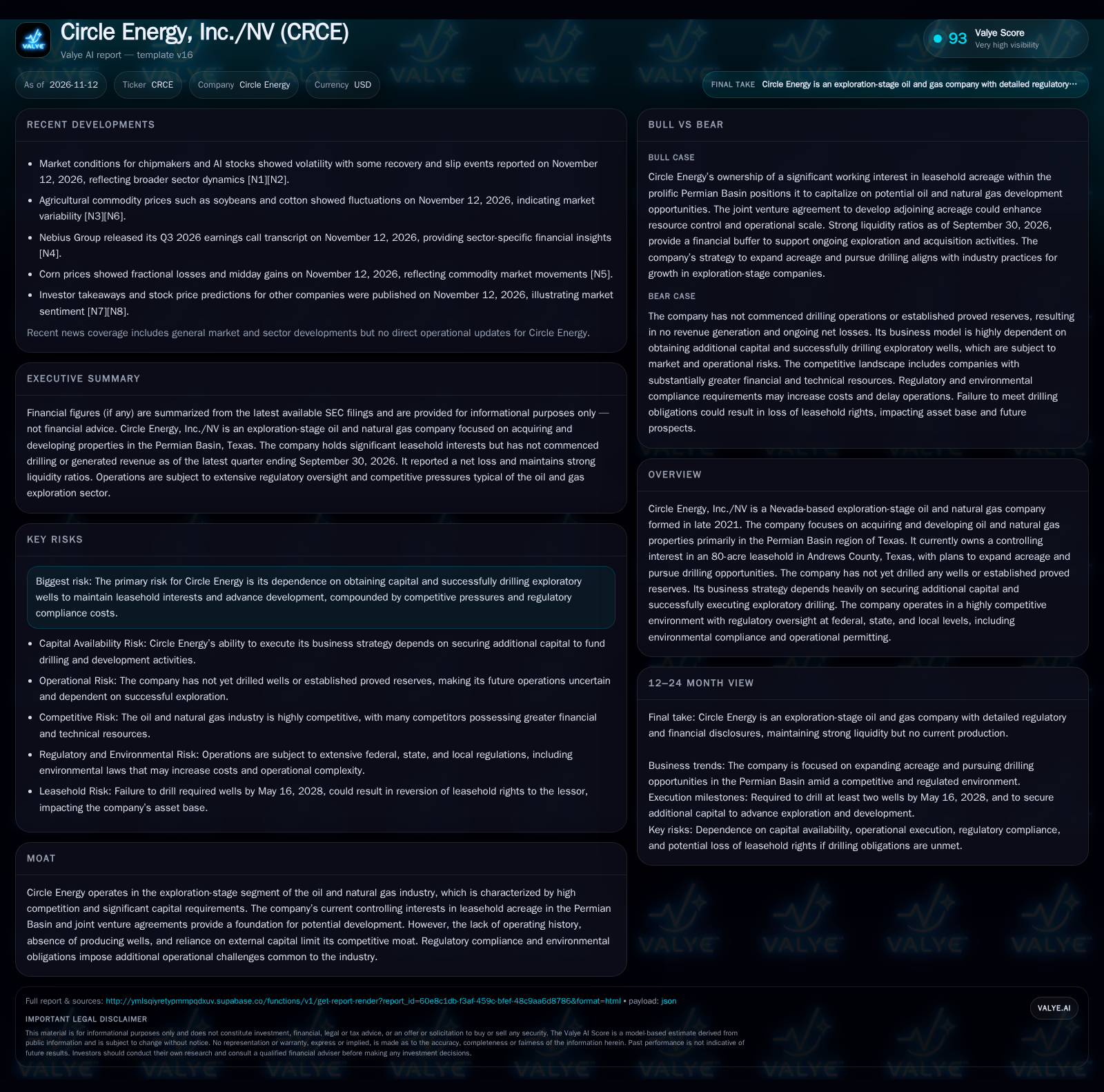
Circle Energy owns a majority working interest in 80 Permian Basin acres and is party to a joint venture on adjacent land, but as of late 2026 has drilled no wells, generated no revenue, and reported ongoing net losses. The next phase will test whether Circle Energy can move from exploration stage to proven production in a crowded, capital-intensive sector. [S2]
Circle Energy, Inc. stands at the classic inflection point faced by oil and gas exploration startups: it holds a meaningful working interest in undeveloped Permian Basin acreage, has obligations to drill or risk losing rights, and faces intense competition from much larger players. Yet, as of late 2026, Circle Energy has not drilled a single well, has no established reserves, and remains loss-making, with minimal absolute cash despite reported liquidity position. The company’s near-term future depends on its ability to secure significant external capital, execute on its drilling commitments, and turn potential into tangible reserves—before time or competitors erode its position.
Leasehold Control, Drilling Deadlines, and the Capital Conundrum
As of September 30, 2026, Circle Energy owns a 75% working interest and a 55.5% net revenue interest in an 80-acre leasehold in Andrews County, Texas, within the prolific Permian Basin. The company is contractually obligated to drill at least two wells by May 16, 2028, or risk reversion of undrilled tracts to the lessor. Despite these assets, Circle Energy has not commenced drilling or established proved reserves, reporting zero revenue and a net loss of $17,210 for the quarter ended September 30, 2026. Additionally, Circle Energy has entered a joint venture covering 880 adjacent acres, expanding its potential footprint but increasing the scale of required investment. These facts set the stage for a business model that is asset-rich on paper but wholly dependent on capital access and execution to realize value. [S2]
From Acreage to Output: How Value Creation Hangs on Drilling and Funding
Circle Energy’s economics are typical of an exploration-stage oil and gas company: value is unlocked only through converting undeveloped acreage into producing assets. The company’s 75% working interest entitles it to a corresponding share of production revenues—if and when wells are drilled and hydrocarbons are produced. However, the capital intensity of drilling even a single vertical or horizontal well in the Permian Basin is significant, often running into the millions of dollars per well, depending on depth, completion technique, and infrastructure requirements.
However, the company’s economics are highly sensitive to drilling outcomes, commodity prices, and cost discipline. In the absence of production, all expenses flow directly to net loss, and dilution or debt overhang risk is high for shareholders if capital is raised on unfavorable terms.
Navigating the Permian: Scale, Experience, and the Realities of Competitive Disadvantage
Circle Energy operates in the most competitive oil and gas basin in North America, facing rival operators with vastly greater technical, financial, and operational resources. Larger competitors typically enjoy economies of scale in drilling, access to lower-cost capital, experienced technical teams, and established relationships with service providers. For Circle Energy, the absence of a track record, producing wells, or proved reserves is a material competitive disadvantage: it limits bargaining power with capital providers and may result in higher financing costs or less favorable joint venture terms.
The joint venture on 880 adjacent acres offers a potential path to scale, but only if Circle Energy can contribute its share of capital and influence operational outcomes. Regulatory compliance adds another layer of complexity, as environmental and permitting requirements can delay operations or increase costs—an area where larger operators can more easily absorb setbacks. The question is whether Circle Energy’s early-mover position on specific tracts can be translated into a sustainable economic advantage before competitors or regulatory hurdles undercut its optionality.
Unlocking Value: Successful Capital Raise and Early Drilling Results as Catalysts
The most favorable scenario for Circle Energy is one where it secures sufficient capital—through equity, debt, or strategic partnerships—to drill its first obligation wells before the May 2028 deadline. If initial wells encounter commercial hydrocarbons, the company could establish its first proved reserves, generating revenue and dramatically improving its ability to access further funding at better terms. Early drilling success would also validate the geology of both its 80-acre leasehold and the larger joint venture area, potentially attracting interest from larger industry players or enabling asset sales at a premium.
Evidence confirming this upside scenario would include: announcements of successful capital raises or farm-outs; spud or completion notices for new wells; and the booking of initial proved reserves. Confirmation would also be seen in the transition from zero to positive revenue, and in improved net cash flow from operations. Conversely, failure to secure funding or disappointing drilling results would quickly falsify this path.
Progress Hinges on Capital Access and Execution—But Time Is Ticking
The most plausible middle path is that Circle Energy spends the next 12-24 months seeking capital, negotiating joint venture terms, and preparing for its first drilling campaign. The company may experience incremental dilution as it raises modest rounds of funding to cover G&A and preparatory costs, but delays in drilling could persist if capital markets are tight or if the company struggles to attract partners. Regulatory hurdles and permitting could further slow progress.
Evidence supporting this scenario would include: continued net losses and zero revenue, periodic small-scale capital raises, and little or no physical development on the leasehold. If the company manages to spud a well before the May 2028 deadline—even if only to maintain lease rights—this would be a partial success, but the lack of rapid development or material reserves would keep the company in a speculative holding pattern.
Failure to Fund or Drill—Lease Loss and Asset Erosion
The adverse scenario is that Circle Energy is unable to secure the capital required to drill its obligation wells before the May 2028 deadline. In this case, leasehold rights to undrilled tracts would revert to the lessor, eroding the company’s asset base and future prospects. The lack of operational progress would likely make subsequent capital raises even more challenging, trapping the company in a cycle of net losses and diminishing optionality.
Evidence confirming this downside would include: persistent cash burn with no drilling activity, disclosure of lease forfeiture or reversion, or failure to announce any material capital raises or partnerships as deadlines approach. Any regulatory or environmental enforcement actions could further exacerbate downside risk by draining already limited resources.
Milestones That Will Define Whether Circle Energy Moves Beyond Speculation
Disclosure of a material capital raise, joint venture funding, or farm-out agreement sufficient to fund the first two obligation wells.
Announcements of drilling commencement (spud dates) or well completion within the 80-acre leasehold or joint venture area.
Booking of initial proved reserves and associated revenue recognition, if disclosed.
Changes in leasehold status or evidence of reversion due to missed drilling deadlines.
Regulatory or permitting developments that could accelerate or impede drilling timelines.
Any change in the company’s working or net revenue interest as a result of capital-raising or partnership dilution.
Shifts in broader Permian Basin drilling economics (e.g., service costs, commodity prices) that may affect project viability.
Disclaimer: This is research-only, informational analysis and not investment advice. It may include AI-generated interpretation and general industry context. Always verify important details using primary sources.

Comments