
Starwood Real Estate Income Trust: Cybersecurity Investment, Opaque Economics, and the Stakes of Sustained Losses
Investors must weigh the value of operational risk controls against opaque underlying economics and ongoing unprofitability.
Investors must weigh the value of operational risk controls against opaque underlying economics and ongoing unprofitability. [S1] [S2]
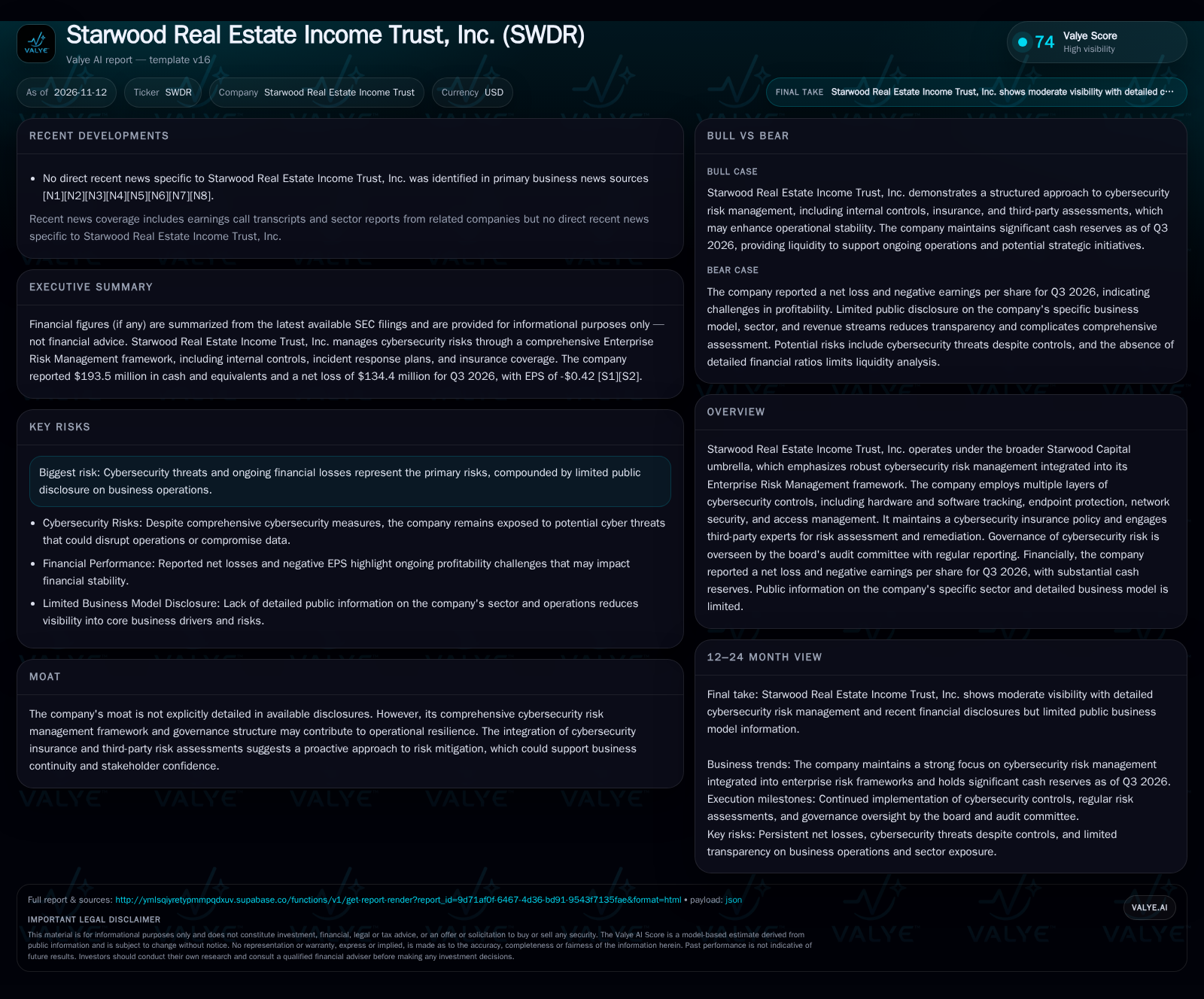
Starwood Real Estate Income Trust, Inc. With $193.5 million in cash as of September 30, 2026, and a quarterly loss of $134.4 million, Starwood REIT’s financial runway is not immediately in crisis, yet the lack of insight into its revenue sources, portfolio composition, or operational levers leaves investors unable to confidently assess future earnings power or risk exposures. The company’s highly structured approach to cybersecurity may reduce operational risk, but without clarity on how capital is deployed or value is created, the investment case remains blurred. [S1] [S2]
Recent Losses and Cash Reserves Frame the Near-Term Outlook
Starwood Real Estate Income Trust, Inc. reported a net loss of $134.4 million for the quarter ended September 30, 2026, translating to earnings per share of -$0.42. As of the same date, the company held $193.5 million in cash and equivalents. These two facts together suggest the company is operating at a significant quarterly loss while still holding a sizable liquidity buffer. There are no disclosed material legal proceedings, and the company is not the subject of recent news headlines or sector-specific events. The most distinctive operational fact is Starwood’s formal cybersecurity risk management, which is deeply integrated into its enterprise governance and actively monitored by the audit committee. [S1] [S2]
Opaque Revenue Streams and the Challenge of Assessing Core Profitability
The company’s public disclosures do not detail its property portfolio, revenue composition, or sector focus, making it difficult to analyze the underlying business economics. As a real estate income trust, Starwood REIT likely derives income from property leasing, rent collection, and potentially capital appreciation or asset sales—typical of REIT structures. If the portfolio is diversified across property types (office, retail, residential, industrial), revenue stability and risk would depend on tenant mix, lease durations, and market cycles.
Fixed costs in real estate trusts are typically high due to property management, maintenance, and debt service, while variable costs depend on occupancy and leasing activity. Operating leverage can be significant: small changes in occupancy or rent can disproportionately impact bottom-line results. The reported net loss suggests that current revenues are insufficient to cover the cost structure, or that asset impairments, interest expense, or one-time charges are weighing on results. Without transparency on debt levels, asset yields, or cost allocation, it is impossible to determine if the losses are structural or cyclical.
The company reported cash and liquidity metrics for the period; these figures do not by themselves establish operating runway, investment capacity, financial flexibility, or financing capacity. The absence of disclosed current or quick ratios further complicates the liquidity and solvency analysis. [S2]
Cybersecurity as a Differentiator, But Market Positioning Remains Unclear
Starwood REIT’s most clearly articulated advantage is its multi-layered cybersecurity program, which includes insurance, third-party risk assessments, and a governance structure involving the CTO and board audit committee. In a sector increasingly targeted by cyberattacks—especially given the sensitive financial and tenant data managed by real estate operators—such controls may help prevent operational disruptions, regulatory penalties, or reputational damage.
However, in the absence of public information on asset mix, geographic focus, or tenant quality, it is not possible to assess whether Starwood’s cybersecurity posture translates into higher tenant retention, lower insurance costs, or access to premium clients. Competitors in the REIT space include both diversified and sector-focused trusts, many of which have also increased investment in technology and risk management. The question is whether Starwood’s controls materially lower risk-adjusted costs or drive superior returns, which cannot be established from current disclosures.
A further unknown is the company’s capital structure and cost of debt, both of which are critical in a rising rate environment for real estate vehicles. If Starwood’s cybersecurity program supports lower borrowing costs or smoother operations, this could provide a marginal advantage, but the lack of comparative data prevents confirmation.
If Cybersecurity and Operational Discipline Enable Turnaround
A favorable scenario would see Starwood REIT’s robust risk controls preventing costly cyber incidents and operational disruptions, while management reallocates capital or restructures operations to restore profitability. If undisclosed portfolio repositioning or strategic asset sales are underway, these could help stem losses and rebuild investor confidence.
Confirmation of this scenario would require disclosure of improving net operating income, asset sales at premiums to book value, or successful leasing activity in key properties.
Alternatively, if cybersecurity investments attract institutional tenants or lower the company’s insurance/bonding costs, this could provide a differentiated value proposition in a cautious commercial real estate market. An observable decline in the quarterly loss rate or a shift to positive cash flow would be strong validators.
Continued Losses Amid Opaque Economics and Defensive Posture
In the absence of portfolio-level transparency or clear evidence of operational turnaround, investors are likely to ascribe a discount to the trust’s equity, reflecting uncertainty around asset quality, debt load, and earnings power.
Confirmation of this scenario would include persistently negative EPS, stagnant or declining cash balances, and the absence of material asset sales or capital inflows.
Falsification would require a shift in disclosure practices or a sudden improvement in profitability, supported by new business wins, portfolio expansion, or successful refinancing on favorable terms.
Liquidity Erosion and the Risks of Prolonged Unprofitability
The adverse scenario would see continued or accelerating losses, rapidly depleting the company’s $193.5 million cash reserve. If revenue generation or cost controls do not improve, Starwood REIT could be forced to dispose of assets under pressure, raise dilutive capital, or take on expensive debt—especially challenging in a tightening credit environment for commercial real estate.
A major cyber incident, despite strong controls, could inflict direct financial loss or disrupt operations, compounding financial strain. The lack of material legal proceedings as of the last reporting period is positive, but offers no guarantee against future adverse events.
Confirmation of the downside would come from sharp quarter-over-quarter declines in cash, debt covenant breaches, asset impairments, or management guidance warning of going-concern risks. Falsification would require evidence of cost containment, external capital raised on favorable terms, or a sudden improvement in cash-generating capacity.
Testing the Thesis: Concrete Markers for Starwood REIT’s Trajectory
Quarterly net operating income (NOI) and same-store sales/rental growth, if disclosed, would clarify whether core property economics are improving or deteriorating.
Disclosure of property portfolio composition—by asset type, geography, and tenant quality—would help investors assess diversification, risk concentration, and sector exposure.
Updates on occupancy rates and lease renewal activity would indicate whether Starwood is maintaining tenant demand or facing elevated vacancy risk.
Trends in quarterly cash balances and burn rate are essential to gauge runway and the risk of forced asset sales or capital raises.
Details on debt maturities, refinancing activity, and interest expense would illuminate balance sheet risk and potential financial flexibility—especially if rates rise or asset values decline.
Any reported cybersecurity incidents, insurance claims, or operational disruptions would be critical for assessing the efficacy of the company’s risk controls.
Changes in disclosure practices or investor communications—such as enhanced transparency on business drivers—would help test the company’s commitment to reducing information asymmetry.
Disclaimer: This is research-only, informational analysis and not investment advice. It may include AI-generated interpretation and general industry context. Always verify important details using primary sources.

Comments