
BlueOne Technologies: Strategic Shift to B2B Payment Infrastructure Amid Liquidity Constraints
BlueOne’s acquisition of Millennium EBS marks a pivot from prepaid card programs to advanced payment infrastructure for financial institutions, targeting the growing demand for ISO 20022 migration and digital remittance. However, the company’s financial snapshot reveals severe liquidity pressure, raising questions about its ability to scale and compete in a crowded fintech landscape.
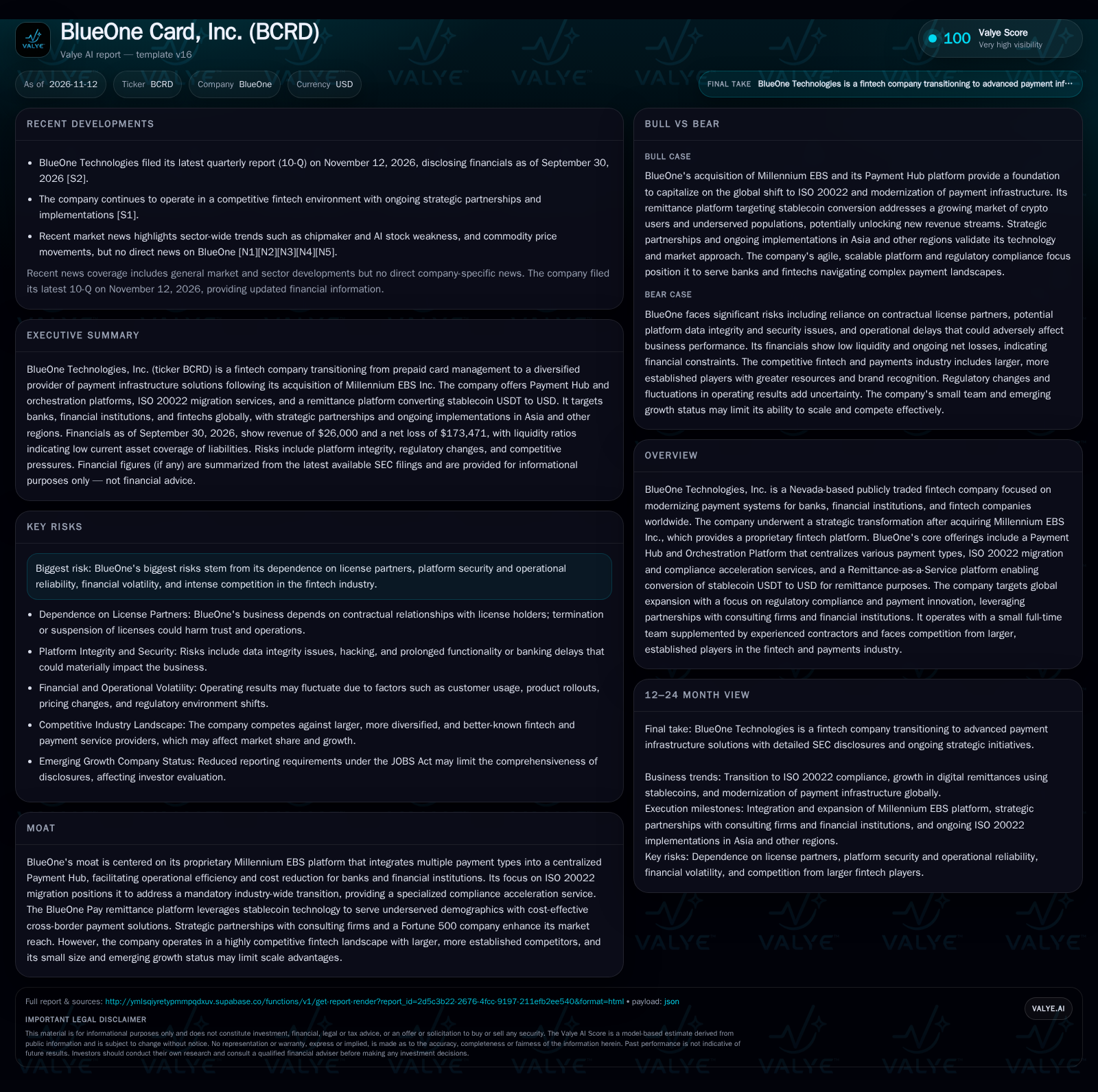
BlueOne Technologies has repositioned itself as a B2B fintech infrastructure provider, leveraging its Millennium EBS platform to serve banks and fintechs in payment orchestration, ISO 20022 compliance, and stablecoin-to-USD remittance. While strategic partnerships and global ambitions offer growth potential, acute liquidity shortages and ongoing net losses threaten operational continuity and competitive execution. The next phase depends on BlueOne’s ability to convert partnerships into scalable, recurring revenue while addressing structural financial weaknesses. [S1] [S2]
BlueOne Technologies has undertaken a high-stakes transformation—from a niche prepaid card manager to a global B2B payments infrastructure provider—after acquiring Millennium EBS. Its Payment Hub and ISO 20022 migration solutions position it for a wave of banking modernization and regulatory-driven demand, while its stablecoin-enabled remittance platform targets a fast-growing but compliance-sensitive market. Despite this strategic pivot and new partnerships, BlueOne’s financials as of September 2026 highlight a critical vulnerability: minimal liquidity and continued losses. The company’s next chapter hinges on its ability to convert technical and regulatory tailwinds into durable, recurring revenue before its balance sheet constraints force hard choices.
Liquidity Crunch and Strategic Realignment Shape BlueOne’s Present
BlueOne Technologies’ September 2026 financials underscore a precarious liquidity position: just $44,967 in current assets against $2.44 million in current liabilities, yielding a current ratio of 0.02 and a cash ratio of 0.06 [S2]. This acute imbalance signals immediate funding pressure and operational risk. At the same time, BlueOne has completed a strategic pivot via its Millennium EBS acquisition, now offering a Payment Hub platform, ISO 20022 migration services, and a stablecoin-enabled remittance product [S1]. Revenue remains nascent at $26,000 for the quarter, with a net loss of $173,471 [S2]. The company is actively pursuing partnerships and implementation projects in Asia and other markets, but has not yet demonstrated scale or recurring revenue. These facts set the stage for a company with ambitious technology and market objectives, but with a financial runway that is extremely limited.
How BlueOne’s Platform Model Could Drive Revenue—And Where the Economics May Falter
BlueOne’s revenue model is built around B2B platform licensing, service fees, and potentially transaction-based or usage-based pricing for its Payment Hub and remittance offerings. In theory, platform economics offer high fixed development costs but low incremental delivery costs, enabling operating leverage as the customer base grows. ISO 20022 migration services and compliance acceleration are likely project-based or subscription/retainer arrangements, with revenue visibility tied to customer contracts and regulatory deadlines.
The remittance-as-a-service business—especially one converting stablecoin USDT to fiat—may generate revenue through transaction fees, FX spreads, or service charges. However, margins could be pressured by regulatory compliance costs, partner commissions, and the need to subsidize user acquisition in a crowded remittance market.
Currently, BlueOne’s tiny full-time staff (two employees plus 8-10 contractors) suggests a lean cost structure, but also limits capacity for rapid scaling and customer support [S1]. The company’s dependence on contractual license partners introduces volatility in revenue recognition and exposes it to partner churn or contract renegotiation. With current liabilities vastly outweighing assets, BlueOne’s ability to invest in product development, sales, or customer onboarding is constrained absent new external funding.
Competing Against Giants: BlueOne’s Niche Strategy Versus Industry Heavyweights
BlueOne operates in a hyper-competitive landscape dominated by large payment processors, core banking software vendors, and global fintechs. Its Payment Hub and ISO 20022 migration offerings position it in the same solution category as established players serving tier-one banks and financial institutions. Larger competitors typically benefit from deeper integration footprints, brand trust, and the ability to bundle services, making customer acquisition and retention more challenging for a newcomer.
BlueOne’s competitive edge may rest in agility, regulatory focus, and the ability to serve mid-market or emerging-market institutions overlooked by major incumbents. Its stablecoin-enabled remittance platform could appeal to crypto-friendly markets or underserved corridors, but faces competition from both crypto-native fintechs and legacy remittance giants. Strategic partnerships, such as with Abeam Consulting and a Fortune 500 entity serving 600+ institutions, offer potential distribution leverage, but have not yet translated into clearly disclosed recurring revenue or multi-year backlog [S1].
Ultimately, BlueOne’s small scale, partner reliance, and limited resources are significant counterforces—unless it can carve out specialized niches or demonstrate unique speed and compliance capabilities that incumbents cannot easily replicate.
What a Breakout Would Require: Converting Compliance and Crypto Tailwinds into Scale
A favorable scenario for BlueOne hinges on several reinforcing factors. First, accelerating global adoption of ISO 20022 and corresponding regulatory deadlines could drive urgent demand for migration and compliance services, especially among smaller or international banks lacking in-house expertise. If BlueOne secures multiple license partners per market and converts ongoing discussions (e.g., with the Fortune 500 partner) into multi-institution implementations, it could rapidly scale recurring platform revenue.
On the remittance side, growing global stablecoin adoption and regulatory clarity in key corridors could enable BlueOne Pay to capture significant transaction volumes—particularly if it can execute cost-effectively and maintain compliance standards that win the trust of banks and regulators. Strategic partnerships could unlock distribution at scale, reducing customer acquisition costs.
Incremental Progress Amid Resource Constraints: A Plausible Trajectory
The most plausible near-term scenario for BlueOne is one of incremental growth constrained by financial and operational resources. The company may continue to win isolated ISO 20022 migration or Payment Hub projects with mid-sized or international banks, leveraging its partnerships to open doors but facing long sales cycles and competitive pricing pressure. Revenue growth is likely to be episodic rather than recurring until BlueOne can build a critical mass of contracted institutions.
Remittance-as-a-service may find initial traction in select corridors or niche segments, but user and transaction growth could be limited by compliance onboarding friction and the need for local partnerships. The small team and reliance on contractors may slow product iteration and customer support, especially as complexity increases.
Confirmation of this scenario would be evidenced by modest but steady revenue increases, limited customer concentration, and ongoing net losses or break-even performance. Falsification would come from a sudden inflection in recurring revenue, major funding events, or evidence of sustained multi-year contracts with large institutions.
Liquidity Shortfall and Execution Risk: How the Thesis Could Unravel
The adverse scenario revolves around BlueOne’s severe liquidity constraints and operational dependency on a small team and external partners. Without a rapid infusion of external capital or a step-change in revenue, the company could face difficulty meeting its short-term obligations, resulting in delayed payroll, partner payments, or regulatory compliance lapses. Failure to deliver on key implementation projects could undermine trust with both customers and partners, triggering contract terminations or loss of pipeline.
In this scenario, competitive pressure from larger fintechs could accelerate customer attrition or force BlueOne into pricing concessions, eroding gross margins. Regulatory changes or a security incident (e.g., platform hacking) could exacerbate losses and shake customer confidence.
Evidence supporting this scenario would include further deterioration of liquidity ratios, missed project milestones, disclosures of contract loss or partner churn, layoffs or reduction in contractor headcount, and adverse regulatory or legal developments.
Benchmarks for BlueOne’s Transformation: Gauging Progress and Stressors
Recurring platform revenue growth, especially from Payment Hub and ISO 20022 migration contracts, would help demonstrate product-market fit and scale.
Number of financial institutions or license partners actively using BlueOne’s platforms—if disclosed—would clarify adoption and market penetration.
Expansion or renewal of strategic partnerships (e.g., with Abeam Consulting or the Fortune 500 entity) would signal commercial traction.
Transaction volume and fee income from BlueOne Pay’s remittance service, particularly in stablecoin corridors, would validate the product’s market relevance.
Net cash flow from operations and any new equity or debt financing events would directly impact financial runway and ability to invest in growth.
Gross margin trends—if disclosed—would illuminate the sustainability of BlueOne’s pricing and cost structure versus larger competitors.
Incidence of platform outages, security breaches, or regulatory non-compliance events would be critical to watch for operational and reputational risk.
Changes in team size or contractor engagement levels could indicate shifts in operational capability or financial stress.
Disclaimer: This is research-only, informational analysis and not investment advice. It may include AI-generated interpretation and general industry context. Always verify important details using primary sources.

Comments