
Tecogen’s Strategic Focus on Data Center Cooling: Efficiency Gains, Emission Reductions, and Profit Pathways
Tecogen’s push into AI data center cooling and hybrid-drive chiller technology offers a path to growth beyond its core CHP markets, but persistent net losses, regulatory headwinds, and capital intensity cloud the outlook. The next phase hinges on data center traction, Vertiv partnership execution, and the ability to convert demonstrations into recurring revenue.
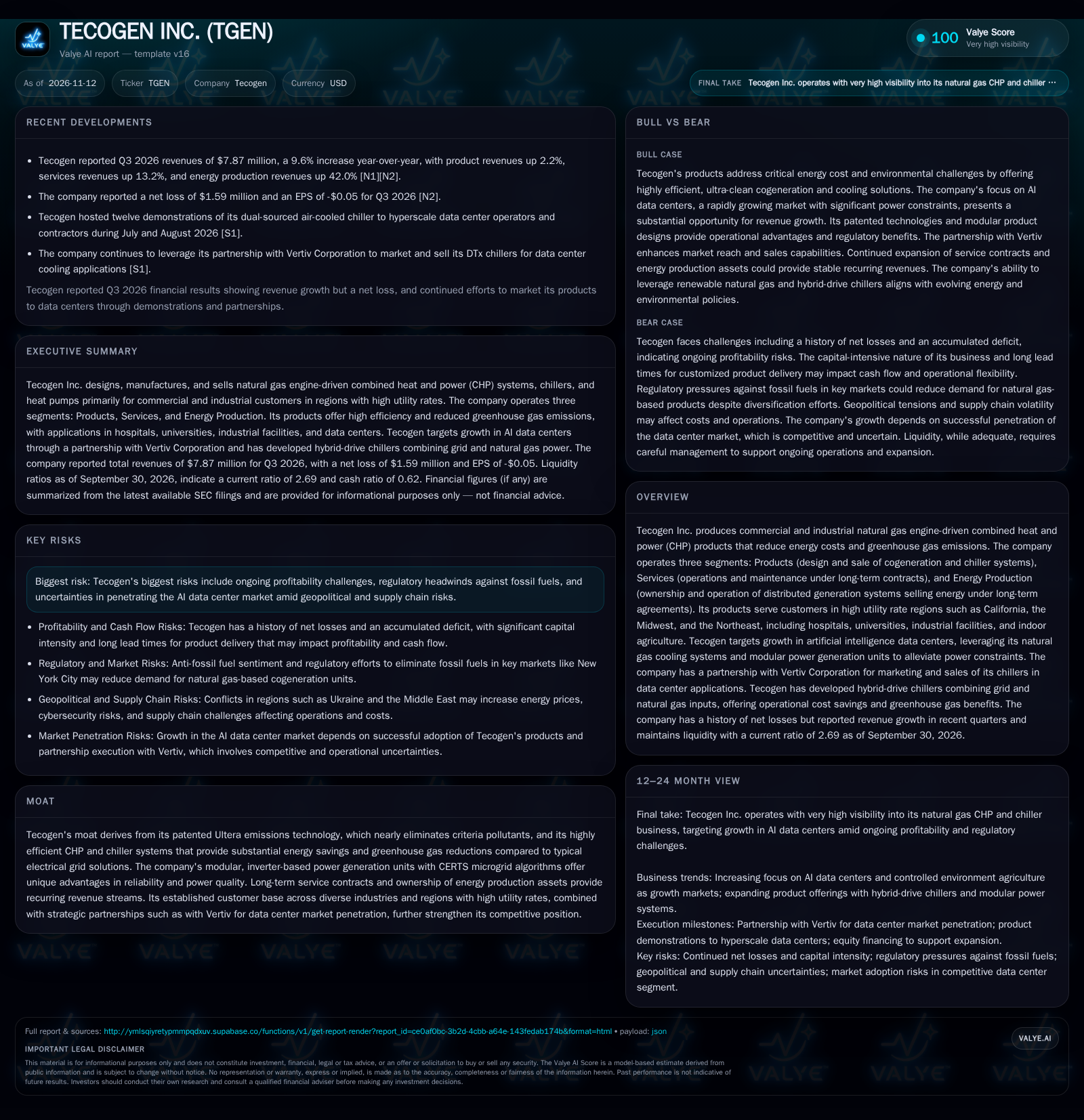
Tecogen’s Q3 2026 results show meaningful revenue growth, especially in energy production, as it targets expansion in AI data center cooling through Vertiv. However, the company remains unprofitable and faces regulatory pressure against natural gas in key markets. The core thesis now depends on successful data center adoption and the conversion of technical demonstrations into commercial wins. Watch for progress in service contract growth, Vertiv-driven sales, and evidence of margin improvement as key confirmatory signals. [S1] [S2] [N1] [N2]
Tecogen Inc., a long-time player in natural gas engine-driven combined heat and power (CHP) systems, is attempting to reposition itself amid the accelerating energy demands of AI data centers and tightening environmental regulations. While the firm’s Q3 2026 financials highlight robust revenue gains in energy production and steady service growth, persistent net losses and an accumulated deficit underscore ongoing profitability challenges. At the center of Tecogen’s current strategy is its partnership with Vertiv and a series of high-profile demonstrations to hyperscale data center operators—an effort to translate technical innovation in hybrid-drive chillers into a new avenue for recurring revenue. The coming quarters will test whether this pivot can overcome both regulatory skepticism and the capital intensity that has historically weighed on the business. [S1] [S2] [N1] [N2]
Shifting Focus to Data Centers and Recurring Revenue Streams
Tecogen reported Q3 2026 total revenues of $7.87 million, a 9.6% year-over-year increase, with notable strength in energy production revenues, up 42% compared to the prior year. Product and service segments also grew, though at a more modest pace. Despite these gains, Tecogen posted a net loss of $1.59 million for the quarter and maintains an accumulated deficit of $61.7 million as of September 30, 2026. The company is actively pursuing growth in the AI data center market, evidenced by twelve product demonstrations to hyperscale operators and a global partnership with Vertiv for chiller marketing and distribution. Liquidity as of quarter-end stood at $5.33 million in cash and equivalents, with a current ratio of 2.69 and a cash ratio of 0.62. These facts highlight both the progress in revenue diversification and the persistence of profitability and capital management challenges. [S1] [S2] [N1] [N2]
Tecogen’s Business Model: Efficiency Paired with Long-Term Contract Stability
Tecogen’s business economics are shaped by three segments: Products, Services, and Energy Production. Product sales—mainly CHP units and chillers—are capital-intensive and typically involve long sales cycles, customization, and installation. Margins are sensitive to input costs, project complexity, and regional utility rates. The Services segment, based on operations and maintenance contracts (currently covering over 1,000 units), represents a potentially higher-margin, recurring revenue stream that can smooth cash flows and increase customer lifetime value.
Energy Production, where Tecogen owns and operates distributed generation assets and sells energy under long-term agreements, is the fastest-growing segment by percentage. This model locks in revenue visibility but requires upfront capital and operational expertise. Operating leverage is plausible if the installed asset base expands, as incremental service and energy revenues may outpace associated fixed cost growth.
Pricing power is conditional: Tecogen’s value proposition combines lower operating costs for customers (especially where electricity rates are high and natural gas is cheap) with regulatory advantages from ultra-low emissions. However, capital intensity and regulatory risk constrain flexibility. Hybrid-drive chillers and modular systems may allow Tecogen to address a wider range of customer needs, but the path to scalable profitability likely requires both volume growth (especially in data centers) and expansion of the recurring revenue base.
Assessing Tecogen’s Competitive Strengths in a Complex Regulatory Landscape
Tecogen’s core competitive levers are its proprietary Ultera emissions technology—enabling near-zero pollutant output—and its focus on modular, highly efficient CHP and chiller systems. These features can be compelling in markets with strict air quality standards and high utility rates. The Vertiv partnership offers a credible channel into data center cooling, potentially accelerating adoption in a segment facing severe power and emissions constraints.
However, Tecogen faces formidable counterforces. The global shift toward full electrification and renewables, especially in urban markets, poses a structural headwind to natural gas-based solutions. Large HVAC and industrial power equipment firms, as well as emerging clean-tech startups, compete for the same customer base. Switching costs for customers can be high due to installation complexity, but upfront capex and regulatory uncertainty may slow adoption.
Substitution risk is rising as battery storage, grid-interactive building solutions, and all-electric HVAC systems become more cost-competitive and policy-favored. Tecogen’s ability to differentiate on operating cost, emissions, and reliability—especially in mission-critical environments like data centers—will determine whether its niche can be defended or expanded.
Potential for Transformation Through Expanded Data Center Market Share
In a favorable scenario, Tecogen successfully converts recent demonstrations and the Vertiv partnership into meaningful orders from hyperscale and colocation data centers. These customers, seeking to expand AI workloads amid grid constraints, may value Tecogen’s hybrid-drive chillers for their ability to reduce electric power draw, lower operating costs, and help meet carbon targets. If a handful of marquee data center wins translate into reference accounts, this could spur a sales flywheel via industry credibility and repeat orders.
Expansion of the installed base would also drive growth in high-margin service contracts and recurring energy production revenues. If regulatory bodies accept hybrid-drive or renewable natural gas solutions as transitional or compliant, Tecogen’s addressable market could expand even in regions with anti-fossil fuel sentiment.
Confirmation of this scenario would show up as: (1) large, multi-unit orders from data center customers; (2) a sharp uptick in service contract backlog; (3) evidence of margin expansion as scale improves; and (4) regulatory or policy signals favoring hybrid or RNG-based solutions.
Growth in Chillers and Services Counterbalanced by Regulatory and Capital Challenges
The most plausible outcome is one in which Tecogen achieves incremental growth in its core commercial and industrial markets, with modest traction in data center cooling through Vertiv but no step-change in order volume. Service and energy production revenues continue to rise, providing some buffer against the lumpy and capital-intensive product business. However, persistent net losses and the need for ongoing investment—whether for R&D, sales, or project financing—limit margin expansion and keep the company reliant on external capital.
Regulatory headwinds in key markets (e.g., New York City) continue to constrain demand for natural gas-based solutions, forcing Tecogen to focus on geographies with favorable utility economics or policy climates. The company’s efforts to diversify into hybrid-drive and renewable-compatible systems help, but not enough to offset broader electrification trends.
Evidence for this scenario includes: stable or modestly growing revenues in all segments; continued net losses of similar magnitude; incremental, rather than transformative, data center wins; and a continued focus on liquidity management without major balance-sheet stress.
Risks of Falling Behind as Market and Regulatory Changes Accelerate
In a bearish scenario, Tecogen’s efforts to penetrate the data center market stall—either due to lack of customer adoption, superior alternative technologies, or regulatory shifts that further penalize fossil fuel-based solutions. Product revenues stagnate or decline as core markets shrink and electrification accelerates. Service and energy production revenues plateau or even contract if the installed base erodes.
Persistent net losses and capital intensity lead to tighter liquidity and the need for additional dilutive financings. Supply chain disruptions or energy price volatility could exacerbate cost pressures. If regulators in high-potential markets close the door on hybrid or natural gas-based systems, Tecogen’s addressable market could shrink rapidly.
Confirmation would come from: declining product and service revenues; further increases in net losses and accumulated deficit; inability to secure large new contracts (especially in data centers); and negative regulatory developments regarding natural gas technologies.
Factors Influencing Tecogen’s Progress and Financial Outcomes in Data Center Cooling
Conversion rate of recent data center demonstrations to signed commercial orders—especially with Vertiv’s involvement.
Growth in the number and dollar value of long-term service contracts, particularly in the data center segment, if disclosed.
Sequential and year-over-year margin trends, especially at the gross and operating levels, to test for operating leverage.
Regulatory or policy developments affecting the eligibility of hybrid-drive or renewable natural gas systems in key target markets.
Expansion or renewal of the Vertiv partnership, or evidence of additional channel partnerships in the data center ecosystem.
Quarterly trajectory of net losses and changes in the accumulated deficit, as an indicator of progress toward break-even.
Updates on installed base growth in both the Products and Energy Production segments, as recurring revenue drivers.
Capital expenditure trends and any additional equity or debt financings, which would signal the pace—and risk—of expansion.
Disclaimer: This is research-only, informational analysis and not investment advice. It may include AI-generated interpretation and general industry context. Always verify important details using primary sources.

Comments