
CoinShares Bitcoin ETF: Operating at the Intersection of Crypto Adoption, Regulatory Evolution, and ETF Market Dynamics
Surging inflows and bitcoin price milestones spotlight CoinShares Bitcoin ETF, but regulatory uncertainty, operational constraints, and concentrated asset risks shape both its upside and existential vulnerabilities.
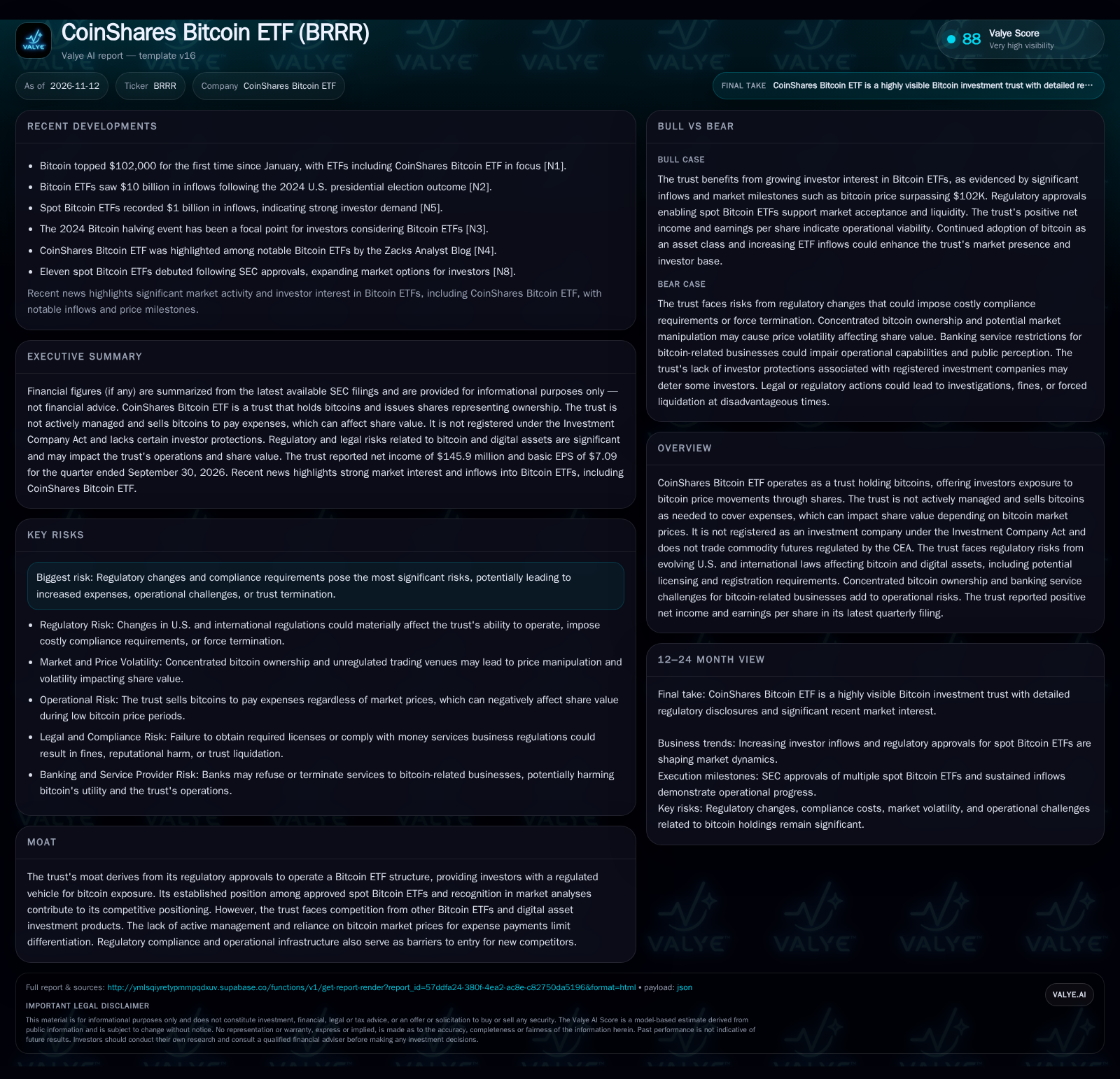
CoinShares Bitcoin ETF has reported strong net income and is riding robust inflows amid Bitcoin’s price rally and broader ETF adoption. However, its structure—selling bitcoin to pay expenses and lacking certain investor protections—makes it acutely sensitive to regulatory shifts, operational costs, and bitcoin market volatility. The durability of its current momentum will hinge on regulatory clarity, the stability of underlying bitcoin markets, and the ETF’s ability to maintain operational integrity in a rapidly evolving landscape. [S1] [S2] [N1] [N2] [N5]
CoinShares Bitcoin ETF stands at the heart of a transformative moment for digital asset investing: its recent net income surge and inclusion in record-breaking ETF inflows underscore both the appetite for regulated bitcoin exposure and the unique risks inherent in crypto-linked investment vehicles. While the ETF’s structure offers a direct, liquid entry point for mainstream investors, it also magnifies exposure to bitcoin market volatility, regulatory ambiguity, and operational frictions not present in traditional funds. As regulatory frameworks, market structure, and investor sentiment around digital assets evolve, CoinShares Bitcoin ETF’s long-term viability and growth will be shaped by its ability to navigate these intersecting pressures.
Recent Inflows, Profitability, and Regulatory Spotlight Define the ETF’s Current Moment
The CoinShares Bitcoin ETF reported net income of $145.9 million and basic earnings per share of $7.09 for the quarter ended September 30, 2026, a direct reflection of strong bitcoin price appreciation and robust investor inflows into bitcoin ETFs during this period. [S2]
Recent news highlights have pointed to Bitcoin surpassing $102,000 and spot Bitcoin ETFs—including CoinShares—recording $1 billion in inflows, with $10 billion attributed to the broader ETF category following high-profile political events. [N1] [N2] [N5]
However, the trust operates without registration under the Investment Company Act, does not hold cash or equivalents, and must periodically sell bitcoin to cover expenses—making its share value highly sensitive to both bitcoin price swings and regulatory developments. [S1] [S2]
The ETF’s operational model and regulatory positioning are therefore central to both its recent success and its future risk profile.
How the Trust Converts Bitcoin Exposure and Flows into Earnings—and Where Structural Friction Emerges
The core economics of the CoinShares Bitcoin ETF are relatively straightforward: it holds bitcoin and issues shares that represent fractional ownership of its bitcoin holdings. There is no active management; instead, the trust’s primary revenue stream is the appreciation of its bitcoin assets, with some offset from management or sponsor fees (if present, though not specified here).
Expenses—trustee, sponsor, custody, and administrative fees—are paid by selling bitcoin, regardless of the prevailing market price. This creates a direct drag on net asset value over time, especially pronounced during periods of bitcoin price weakness or heightened expense ratios.
The trust does not hold cash or equivalents, so it must liquidate a portion of its bitcoin holdings to meet ongoing obligations. This can amplify NAV erosion in downturns, particularly if expense ratios are high relative to asset appreciation.
Operating leverage is largely absent: fixed costs are low, but so is the trust’s ability to scale profit margins outside of bitcoin price appreciation or asset inflows. Unlike traditional asset managers, there is minimal scope for margin expansion via scale economies.
ETF Market Crowding, Regulatory Barriers, and the Elusive Edge in Passive Bitcoin Exposure
CoinShares Bitcoin ETF’s competitive edge is rooted in its regulatory approval to operate as a spot Bitcoin ETF—a status that remains a formidable barrier to entry, given the lengthy and uncertain SEC approval process. This allows the trust to offer mainstream investors a regulated, convenient means of accessing bitcoin price movements.
However, the ETF operates in a crowded and increasingly commoditized space: as of early 2024, at least eleven spot Bitcoin ETFs have launched, with most offering similar structures and fee profiles. This competition could pressure fees and erode any first-mover or brand advantage unless the trust can differentiate through liquidity, tracking efficiency, or sponsor reputation. [N8]
The absence of active management, proprietary trading, or unique expense structures limits the potential for sustainable differentiation. The main friction for investors remains regulatory credibility, ease of access, and possibly sponsor scale or reputation.
Substitutes include direct bitcoin ownership (with associated custody and regulatory risks), other spot or futures-based ETFs, closed-end trusts, and even emerging digital asset products that may offer yield or additional features.
Sustained Inflows and Regulatory Stability Could Drive Asset Growth and Market Leadership
If U.S. and international regulators maintain a stable, permissive framework for spot bitcoin ETFs, CoinShares Bitcoin ETF could continue to benefit from accelerating institutional and retail inflows. This scenario is bolstered by the recent record-breaking ETF inflows and bitcoin’s price rally, suggesting mainstream adoption momentum. [N1] [N2] [N5]
Further upside could be realized if the ETF achieves scale advantages—such as tighter bid-ask spreads, greater liquidity, or lower effective tracking error—making it the preferred vehicle for large allocators and financial advisors.
A broadening investor base, especially if retirement platforms or wealth managers integrate bitcoin ETFs into standard portfolios, could drive persistent AUM growth and reinforce the trust’s market position.
Confirmation would come from continued outsized net inflows relative to peers, declining expense ratios (if disclosed), and growing share of total spot bitcoin ETF assets. Falsification would be rapid outflows, regulatory clampdowns, or loss of sponsor credibility.
ETF Growth Moderates as Structural Frictions and Regulatory Overhangs Persist
The most plausible mid-term outcome is that CoinShares Bitcoin ETF grows assets in line with general bitcoin ETF adoption, but faces margin and growth constraints from fee competition, ongoing regulatory ambiguity, and the need to periodically sell bitcoin to cover expenses.
Market share will likely be determined by sponsor reputation, trading liquidity, and operational resilience, rather than by unique product features. Fee compression, already a hallmark of ETF competition, could limit profitability even as AUM grows.
Operational risks—such as banking service disruptions or unexpected regulatory costs—would periodically surface, but not existentially threaten the trust unless there is a major policy shift.
This scenario would be confirmed by steady but not explosive net inflows, stable expense ratios (if disclosed), and the ETF maintaining its position among the leading spot bitcoin ETFs. Falsification would be either a surge in regulatory-driven costs or a structural outperformance relative to competitors.
Regulatory Shock or Operational Disruption Could Trigger Forced Liquidations or Trust Termination
A material downside scenario would unfold if U.S. or international regulators impose new registration, licensing, or compliance requirements—such as money services business status or BitLicense mandates—that the trust cannot meet without incurring prohibitive costs or operational delays.
Banks could withdraw or refuse services to the sponsor or trust, severely impairing the trust’s ability to process transactions, manage custody, or interact with investors. This could destabilize trust operations and force asset sales at unfavorable prices.
Extreme bitcoin price volatility, especially if triggered by 'whale' liquidations or market manipulation, could force the trust to sell assets at depressed prices to cover expenses, amplifying NAV erosion and potentially triggering investor redemptions.
Downside confirmation would come from forced regulatory disclosures, news of banking relationship terminations, or a sudden, outsized spike in trust-level expenses. Falsification would be the maintenance of stable operations and regulatory status despite heightened scrutiny.
Milestones That Will Shape the CoinShares Bitcoin ETF Thesis
Net inflows and outflows relative to other spot bitcoin ETFs, as reported in regulatory filings or industry data—persistent inflows would support the growth thesis.
Expense ratio trends (if disclosed) and any changes to sponsor or administrative fees, which could materially impact NAV drag over time.
Regulatory developments: any proposal or enactment of new licensing, registration, or compliance requirements for bitcoin ETFs or their sponsors.
Operational updates on banking relationships—news of service disruptions, new partnerships, or changes in custody arrangements.
Material changes in the concentration of bitcoin ownership, or evidence of significant 'whale' transactions affecting bitcoin price volatility.
Announcements of forced bitcoin sales to cover extraordinary expenses or liabilities, which could signal operational or legal stress.
Updates on the ETF’s market share or liquidity position relative to the field of spot bitcoin ETFs.
If disclosed, tracking error or NAV deviation metrics, indicating how closely the ETF is mirroring bitcoin price movements and the potential impact of operational frictions.
Disclaimer: This is research-only, informational analysis and not investment advice. It may include AI-generated interpretation and general industry context. Always verify important details using primary sources.

Comments