
Fast Casual Concepts, Inc.: Navigating the Pivot from Restaurants to AI-Driven Marketing Services
Fast Casual Concepts, Inc. has fully exited its original restaurant chains, rebranding as a marketing specialist focused on digital and AI-enabled services for the fast-casual segment. The company’s development of integrated analytics products, lean operational structure, and targeted industry focus could unlock new revenue streams, but competition and execution risks loom large as it seeks to establish itself amid aggressive incumbents.
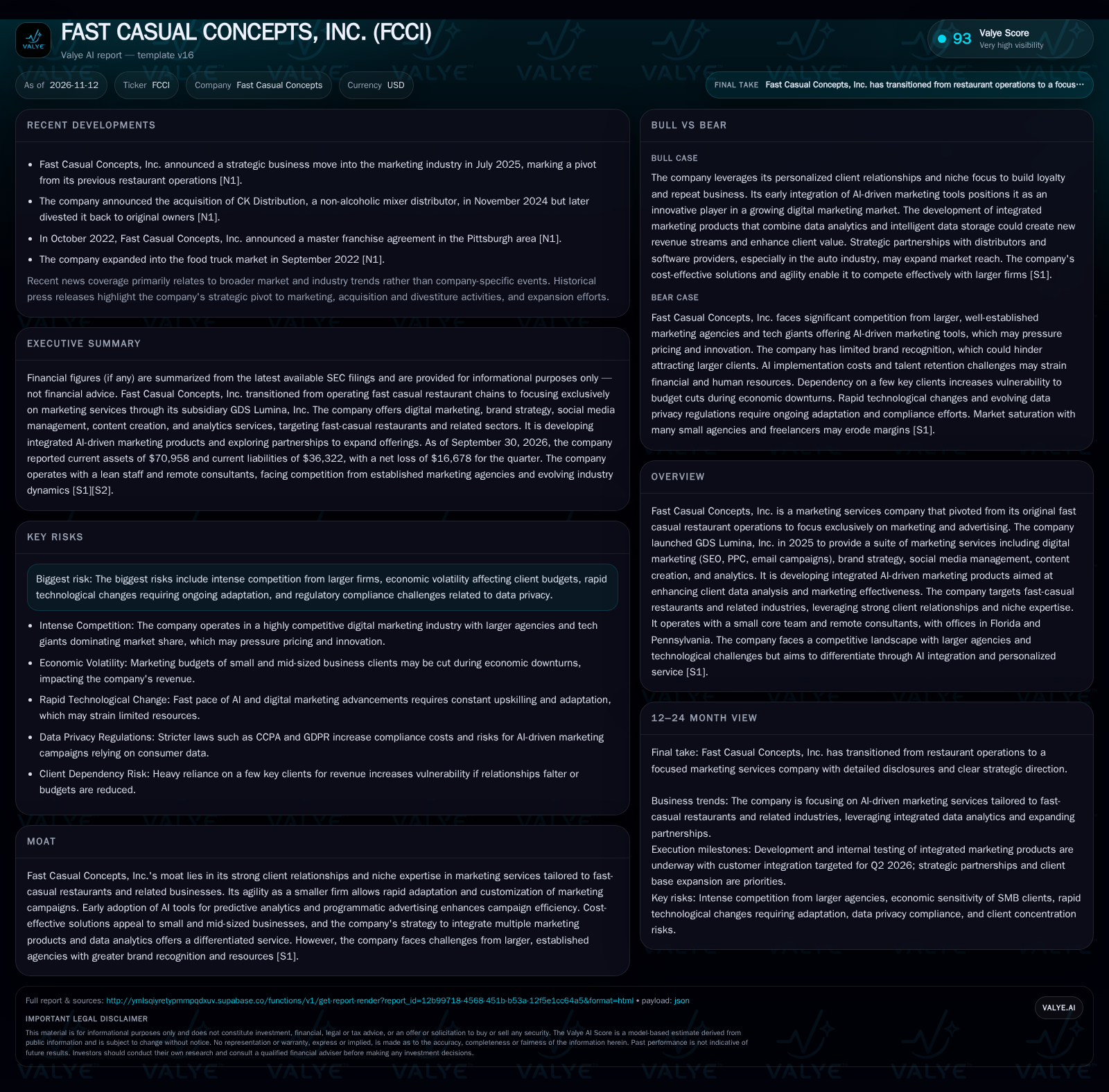
Fast Casual Concepts, Inc. has transitioned from operating restaurants to providing digital marketing services, with a focus on AI-enabled solutions for the fast-casual sector. The company faces a highly competitive environment, limited financial resources, and client concentration risks, but aims to differentiate through personalized service and integrated analytics tools. Execution of its product roadmap and successful partnership development in 2026 will be critical to validating its new business model. [S1] [S2]
Fast Casual Concepts, Inc. has undergone a dramatic transformation, selling off its restaurant brands to reinvent itself as a marketing services provider tailored to the fast-casual industry. With the launch of GDS Lumina, the company is betting on AI-driven marketing solutions and integrated analytics to carve out a niche in a saturated, highly competitive market. Operating with a lean team and targeting Q2 2026 for rollout of new marketing products, Fast Casual Concepts must now demonstrate that its pivot can deliver sustainable growth and withstand the dual headwinds of limited resources and formidable competition. [S1] [S2]
From Restaurant Operator to AI Marketing Specialist: What’s Changed and Why It Matters
The most material current fact is Fast Casual Concepts, Inc.’s completed divestiture of its fast-casual restaurant operations and its 2025 rebranding as a marketing company, with GDS Lumina as its central subsidiary. This complete business model pivot fundamentally changes its revenue streams, cost structure, and risk profile, moving the company from capital-intensive food service to asset-light, service-based marketing offerings. [S1]
The company’s focus is now on developing integrated, AI-driven marketing products for fast-casual restaurants and related businesses, with internal testing underway and customer integration targeted for Q2 2026. This signals a move toward productization and recurring revenue potential, but execution risk remains high until customer adoption is demonstrated. [S1] [S2]
Financially, Fast Casual Concepts reported current assets of $70,958 versus current liabilities of $36,322 as of September 30, 2026, and a quarterly net loss of $16,678. The company reported cash and liquidity metrics for the period; these figures do not by themselves establish operating runway, investment capacity, financial flexibility, or financing capacity. [S2]
How the New Marketing Model Could Drive Profits—or Strain Resources
Fast Casual Concepts has shifted to a service-oriented revenue model, with potential for recurring revenue if customers adopt its integrated marketing products on a subscription or retainer basis. The economics of digital marketing agencies are typically characterized by high gross margins (especially on software-enabled services), but significant competition keeps pricing under pressure, especially for undifferentiated offerings.
The company’s lean structure—with one full-time employee and a network of consultants—minimizes fixed costs and capital requirements, supporting agility but limiting in-house capacity for business development, product iteration, and client support. If the integrated AI products gain traction, operating leverage could be significant, as incremental software or analytics clients add revenue with relatively modest incremental cost. However, onboarding, retention, and upskilling in AI tools may require investment in talent and technology.
The company’s small scale and modest financial resources mean that even moderate investments in product development or marketing could quickly stress liquidity. Unless recurring contracts are secured, cash flow could remain lumpy and unpredictable, especially if client concentration persists.
Facing Giants: Fast Casual Concepts’ Place in a Crowded Digital Marketing Arena
The digital marketing sector is dominated by established agencies (e.g., WebFX, SmartSites, Ignite Visibility) and global players with deep resources, brand recognition, and established client rosters. Technology giants are also increasingly integrating AI-driven marketing tools, raising the bar for product sophistication and customer expectations.
Fast Casual Concepts’ potential advantages lie in its niche focus on fast-casual restaurants, strong client relationships, and early AI integration. By offering personalized, cost-effective solutions and positioning itself as a specialist, the company could attract SMB clients overlooked by larger agencies. Yet, limited brand awareness, resource constraints, and challenges in scaling service delivery and innovation represent meaningful counterforces.
Switching costs in digital marketing are generally low unless proprietary analytics, integrations, or workflow tools are deeply embedded. The company’s success will likely depend on demonstrable ROI from its AI-enabled products and the depth of its client partnerships, rather than on technical barriers to exit.
Unlocking Recurring Revenue Through AI Product Adoption and Strategic Partnerships
The most favorable scenario sees Fast Casual Concepts successfully launching and integrating its AI-driven marketing products with clients beginning in Q2 2026. If these products deliver measurable improvements in campaign performance, client retention could increase and referrals could accelerate word-of-mouth growth, especially within the fast-casual segment.
Strategic partnerships with distributors and software providers—particularly those in adjacent verticals like automotive—could provide access to broader customer bases and new revenue streams, allowing the company to scale without proportionate increases in fixed costs. Early client case studies showing ROI from integrated analytics would help validate the offering and could support premium pricing.
Confirmation would come from rising revenue per client, successful partnership announcements, and a shift from project-based work to multi-month or annual contracts. Evidence of recurring revenue, growing client count, and positive cash flow would strongly support the upside thesis.
Incremental Progress: Modest Growth and Ongoing Execution Challenges
A more plausible near-term trajectory is gradual revenue growth from a small base, with the company onboarding additional fast-casual restaurant clients and modestly expanding its offering through GDS Lumina. Product development milestones may be met, but adoption could be slower than hoped, with small-scale pilots rather than large rollouts dominating early results.
Competition from established agencies and emerging AI platforms may limit pricing power and force Fast Casual Concepts to continue competing on service and niche expertise rather than proprietary technology. Client turnover could remain elevated, and limited resources may constrain investments in marketing, talent, or further product iteration.
This scenario would be confirmed by slow but steady increases in revenue, continued modest net losses, and no clear breakout in client concentration or recurring revenue metrics. The company would remain operational but without significant evidence of scalable, defensible economics.
When Product Rollout and Client Acquisition Stall: Risks of Flatlining or Retreat
In a negative scenario, Fast Casual Concepts fails to differentiate its AI-driven marketing products, faces tepid client adoption, and is unable to secure meaningful partnerships or recurring contracts. Larger agencies and tech platforms could outpace its innovation, eroding the appeal of its niche specialization.
The company’s lean structure could become a liability if it cannot attract or retain talent capable of delivering and supporting increasingly sophisticated marketing solutions. If one or more key clients reduce budgets or exit, revenue could contract sharply given the company’s small scale.
Evidence supporting this scenario would include stagnant or declining revenue, persistent or widening net losses, an inability to announce material client wins or partnerships, and signs that product development is delayed or fails to reach market fit.
Milestones and Metrics That Will Determine Fast Casual Concepts’ Marketing Pivot Success
Progress on internal testing and on-schedule customer integration of integrated AI-driven marketing products in Q2 2026. Delays or limited uptake would increase execution risk.
Growth in the number of active clients served by GDS Lumina, particularly new client acquisition beyond the company’s legacy network. If disclosed, client concentration metrics would help clarify revenue stability.
The proportion of revenue derived from recurring contracts versus one-off projects. A shift toward multi-month or annual service agreements would support greater visibility and valuation.
Announcements of strategic partnerships—especially those that expand distribution or embed the company’s products with third-party platforms—would signal the company’s ability to scale beyond organic sales.
Net cash flow trends and quarterly operating losses, as the company’s reported cash balance could be quickly depleted if revenue growth lags or expenses rise.
Evidence of successful AI implementation in client campaigns, such as case studies or published ROI metrics, would validate the technology thesis.
Talent retention and recruitment—if disclosed—including the company’s ability to attract consultants or staff with the expertise to deliver and support advanced marketing solutions.
Material regulatory changes in data privacy or digital marketing compliance that could increase the cost of doing business or restrict the effectiveness of AI-driven campaigns.
Disclaimer: This is research-only, informational analysis and not investment advice. It may include AI-generated interpretation and general industry context. Always verify important details using primary sources.

Comments