
UTG INC: Policy Runoff Dynamics, Investment Focus, and Shareholder Influence in a Mature Life Insurance Portfolio
UTG INC operates as a focused insurance holding company, servicing a legacy block of life policies with little new business, significant exposure to oil and gas investments, and majority ownership by a single shareholder. While recent profitability and capital levels are solid, the company’s geographic and asset concentration, regulatory constraints, and related-party relationships define both its stability and its vulnerabilities.
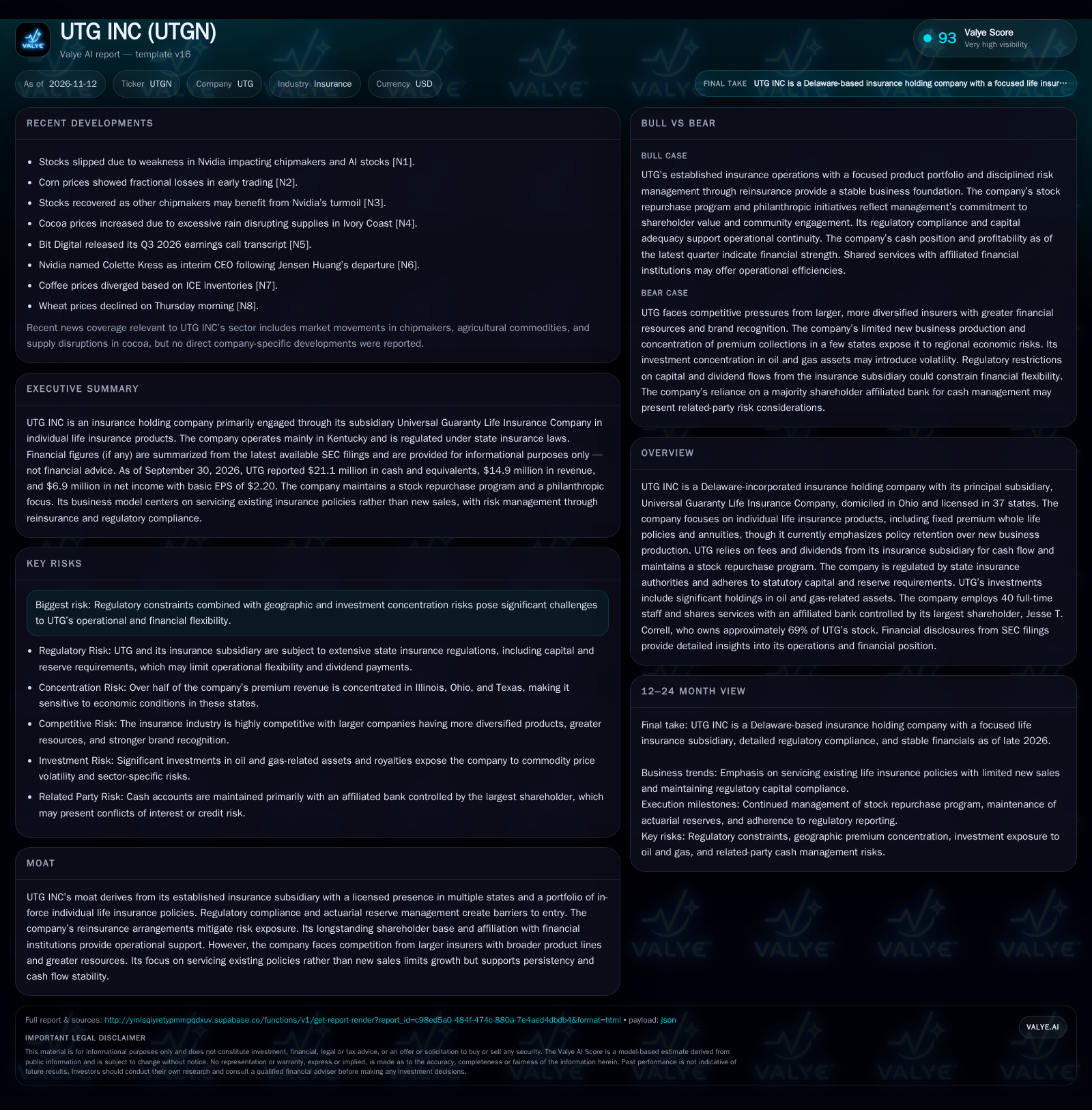
UTG INC’s current business centers on managing an in-force portfolio of individual life policies, with little emphasis on new sales. Profitability remains strong, but over half of premium revenue comes from just three states, and investment exposure to oil and gas assets introduces volatility. The company’s majority shareholder also controls its primary banking affiliate, raising related-party risk considerations. Regulatory capital and dividend constraints further limit flexibility. UTG’s future depends on prudent runoff management, investment outcomes, and its ability to navigate concentrated risks and governance structure. [S2]
UTG INC stands as a niche insurance holding company, focused on managing a legacy block of life insurance policies rather than driving new sales. Its profitability and capital base remain solid, but the business is shaped by unique concentration risks—geographically, in investment holdings, and in its governance structure. With more than half of its premium inflows coming from just three U.S. states and material exposure to oil and gas investments, UTG’s risk profile is not typical for a diversified insurer. The company’s reliance on affiliated entities, including its majority shareholder’s bank, and ongoing regulatory constraints, add further complexity to its future trajectory. [S1] [S2]
Financial Strength and Concentration Define UTG’s Current Profile
As of September 30, 2026, UTG INC reported $14.9 million in revenue, $6.9 million in net income, and $21.1 million in cash and equivalents. The company’s consolidated assets totaled $491 million, with liabilities of $258 million and shareholders’ equity of $233 million at year-end 2025. UTG’s core insurance subsidiary, Universal Guaranty Life Insurance Company, is licensed in 37 states but now focuses on retaining and servicing existing individual life policies rather than actively writing new business. More than half of UTG’s premium revenue is concentrated in Illinois, Ohio, and Texas, making company performance sensitive to economic shifts in these regions. The firm’s investment portfolio includes significant oil and gas exposure, introducing added volatility. Additionally, Jesse T. Correll controls roughly 69% of outstanding shares and the affiliated bank where UTG keeps most of its cash, highlighting a unique governance and related-party dynamic. [S1] [S2]
Economics of Policy Runoff and Investment Returns
UTG’s revenue base is built almost entirely on in-force life insurance policies, producing predictable premium inflows and investment income, but with little contribution from new sales. In a runoff model, profitability hinges on disciplined expense management, mortality experience, and investment returns. Fixed costs, such as personnel (40 full-time employees) and regulatory compliance, are spread over a declining block of policies unless offset by administrative efficiency or cost-sharing with affiliates. The company’s significant exposure to oil and gas assets introduces a variable component to investment returns, which can either supplement or undermine core insurance profitability depending on commodity cycles.
Because the holding company lacks independent operations, all parent-level liquidity depends on fees and distributions from its regulated insurance subsidiary. State insurance regulations restrict the amount and timing of dividends upstreamed to the parent, tying potential financial flexibility to regulatory approval and subsidiary capital adequacy. The ongoing stock repurchase program, with $21.6 million spent through 2025, is discretionary and could be limited by regulatory or cash flow constraints. UTG’s reinsurance policies limit per-life risk exposure, but the company ultimately depends on prudent management of actuarial reserves and investment risk to sustain long-term economics. [S1] [S2]
Market Position: Niche, Stable, but Not Immune to Larger Players
UTG operates in a highly competitive industry dominated by large, diversified insurers with broader product offerings, greater brand recognition, and more robust distribution networks. By focusing on policy retention rather than new sales, UTG avoids direct head-to-head competition for new business but forfeits opportunities for organic growth and scale efficiencies. Its regulatory compliance and multi-state licensing create some entry barriers, but these are less defensible in a runoff scenario where the competitive threat is less about losing policyholders to rivals and more about managing persistency, expenses, and investment performance.
UTG’s third-party administrative services for other insurers are currently insignificant, suggesting limited diversification or alternative revenue streams. Its investment in oil and gas assets is unusual for a life insurer and could either provide portfolio differentiation or expose the company to unique sector risks not faced by traditional peers. The company’s operational reliance on affiliated entities—particularly the bank controlled by its majority shareholder—may offer cost advantages but also raises questions about independence and governance. In sum, UTG’s competitive position is stable but fundamentally limited by its lack of growth initiatives and its exposure to concentration risks. [S1] [S2]
What a Successful Runoff and Investment Cycle Could Deliver
If UTG’s management maintains strong expense discipline, achieves favorable mortality experience, and benefits from a sustained recovery or rally in oil and gas markets, the company could generate robust free cash flow from its legacy policy block. This would support continued share repurchases and potentially special dividends, rewarding shareholders even as the in-force portfolio naturally declines. Regulatory capital ratios could remain strong if policy liabilities run off as expected and investment returns are positive, allowing for continued upstreaming of cash from the insurance subsidiary.
Upside would be confirmed by ongoing profitability, stable or rising book value per share, and visible distributions to shareholders in the form of buybacks or dividends. Evidence of oil and gas investment gains, or successful risk mitigation in this segment, would further support the thesis. On the operational side, persistently low lapse rates and expense reductions through shared services or automation would signal successful management of runoff economics. [S1] [S2]
Sustaining Value Amid Policy Runoff and Market Cycles
The most plausible trajectory for UTG is a steady, managed runoff of its legacy life insurance block, with profitability and book value gradually declining as the policy base shrinks and investment returns fluctuate. Cash distributions to the parent company would be governed by regulatory capital requirements and the performance of both insurance operations and the oil and gas portfolio. Share repurchases would likely continue but at a pace dictated by available distributable cash and regulatory approval.
The base scenario would be supported by stable net income, modest declines in revenue and policyholder liabilities, and periodic but not aggressive capital returns. Persistency rates would remain adequate, and expense ratios would be held in check through continued cost-sharing and operational discipline. Investment results would be mixed, with oil and gas volatility introducing some earnings variability but not fundamentally undermining solvency or capital adequacy. [S1] [S2]
How Concentration and Related-Party Risks Could Unravel Value
A negative scenario could unfold if adverse economic conditions in Illinois, Ohio, or Texas—UTG’s three key states—drive policyholder lapses, lower premium collections, or worsen mortality experience. Simultaneously, a sustained downturn in oil and gas prices could impair investment income or even result in realized losses, eroding capital and limiting the insurance subsidiary’s ability to upstream cash. Regulatory intervention due to capital shortfalls or adverse reserve developments could further restrict dividend payments to the parent, curtailing share repurchases and threatening potential financial flexibility.
Additional downside risk stems from the company’s reliance on affiliated entities. If the affiliated bank were to encounter stress or regulatory scrutiny, UTG’s liquidity management could become complicated, especially given the concentrated shareholder control structure. Evidence of rising policy surrenders, reserve strengthening, investment write-downs, or regulatory actions would confirm the downside. [S1] [S2]
Milestones and Metrics to Clarify UTG’s Runoff Value and Risk Exposure
Persistency and lapse rates in the in-force policy block—if disclosed—would help test whether policyholder retention is supporting stable cash flows.
Changes in investment income, particularly from oil and gas holdings, would provide early signals of either upside or downside to overall profitability.
Updates to regulatory capital and surplus levels at the insurance subsidiary would clarify the scope for dividend payments and share repurchases.
Policyholder benefit and reserve development trends would reveal whether actuarial assumptions are holding or require adjustment.
Any material change in the geographic mix of premium collections, especially declines in Illinois, Ohio, or Texas, would signal rising concentration risk.
Disclosures regarding related-party transactions with the affiliated bank or other entities would help assess governance and liquidity risks.
Announcements of new business initiatives, third-party administration contracts, or changes in product focus would indicate a shift from pure runoff.
Disclaimer: This is research-only, informational analysis and not investment advice. It may include AI-generated interpretation and general industry context. Always verify important details using primary sources.

Comments