
Broadwind’s Diversification Efforts Meet Margin Pressure Amid Wind Energy Volatility
Broadwind, Inc. is shifting from a wind-energy-centric manufacturer to a more balanced, multi-industry supplier, but persistent customer concentration and recent quarterly losses highlight the challenges of this transition. The company’s ability to leverage its manufacturing footprint, navigate regulatory crosswinds, and integrate new acquisitions will determine whether diversification translates into sustainable profitability.
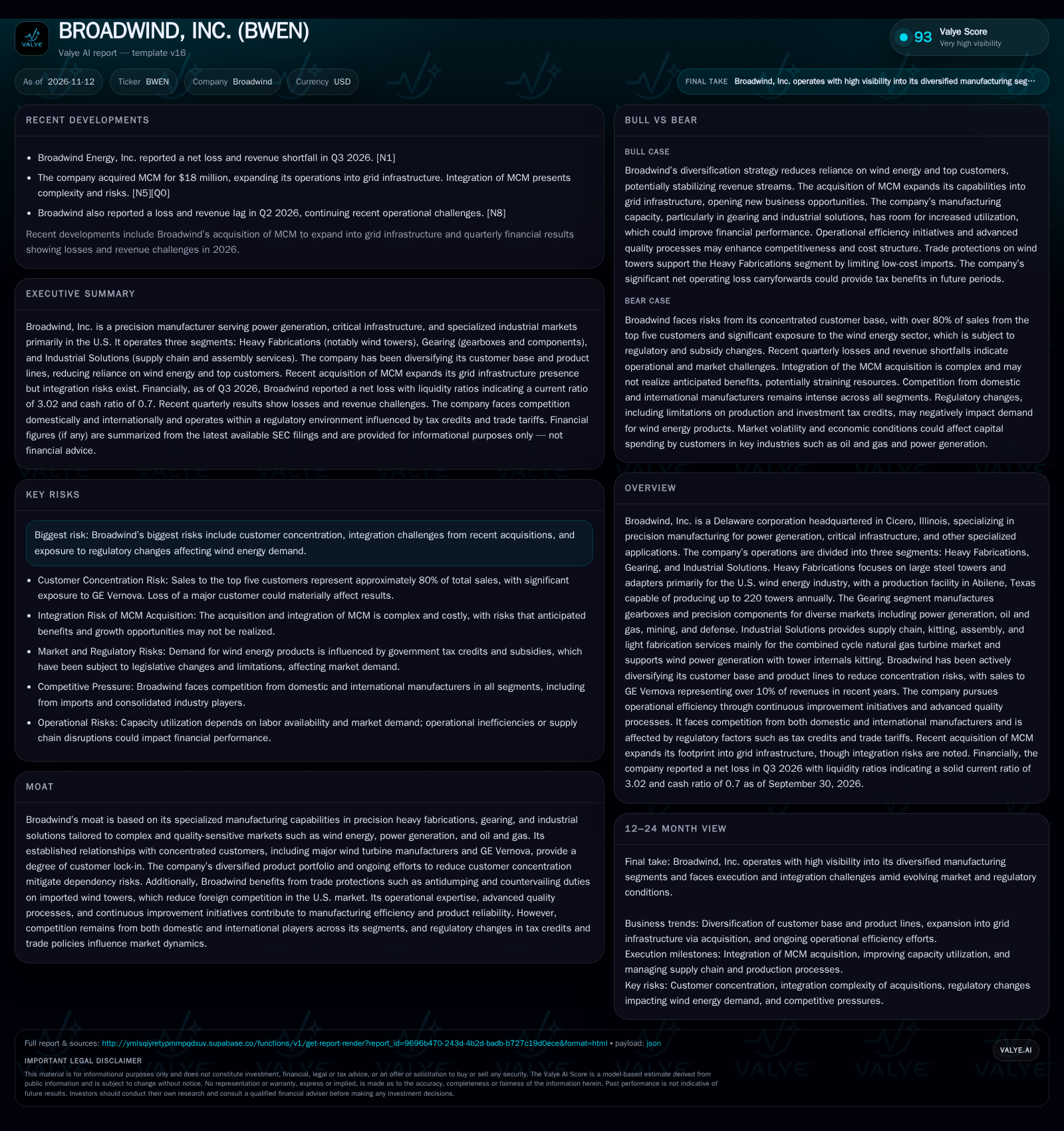
Broadwind, Inc. continues to reduce its dependence on the wind energy sector and top customers, aiming for greater stability through expanded product lines and markets. However, Q3 2026 results showed a net loss and revenue shortfalls, underscoring operational and demand challenges. The company’s future hinges on improving capacity utilization, integrating acquisitions, and mitigating regulatory and customer concentration risks. [S2] [N1] [N8]
Broadwind, Inc. is navigating a critical phase as it seeks to transform its business mix away from a wind-energy-dominated model toward a more diversified, multi-segment manufacturing portfolio. Recent quarterly losses signal the operational and market hurdles the company must overcome, even as it makes progress reducing sales concentration and expanding into new infrastructure markets. The success of this transition will depend on Broadwind’s ability to drive higher capacity utilization, realize synergies from acquisitions, and manage regulatory and competitive headwinds.
Recent Losses and Reduced Wind Concentration Define the Present
As of Q3 2026, Broadwind reported a net loss of $2.39 million and basic and diluted EPS of -$0.10, continuing a trend of revenue shortfalls and operational losses extending back to Q2 2026. [S2] [N1] [N8] This weak performance comes despite ongoing efforts to diversify: the company reduced wind energy’s share of sales from 70% in 2020 to 51% in 2025, and the top five customers now account for 80% of sales, down modestly from 84%. [S1] The company’s Abilene, Texas facility remains a large asset, with capacity for up to 220 wind towers annually, but actual utilization depends on volatile wind market demand. [S1] Broadwind’s recent $18 million acquisition of MCM signals a push into grid infrastructure, introducing new integration challenges and potential growth avenues. [N5]
Fixed-Cost Leverage and Customer Mix Drive Earnings Volatility
Broadwind’s economics are shaped by high fixed costs, particularly in its Heavy Fabrications segment, where large-scale tower production requires substantial plant, equipment, and labor. When wind market demand is robust, higher capacity utilization can drive significant operating leverage and margin expansion. However, underutilization—common during wind market lulls—quickly erodes profitability. The Gearing and Industrial Solutions segments offer more diverse end markets and potentially smoother revenue streams, but they remain smaller in scale.
Pricing power is limited by the company’s concentrated customer base and intense competition from both domestic and international manufacturers. The presence of long-standing relationships, notably with GE Vernova, may support volume stability but also compress margins due to customer bargaining leverage. In its newer markets—such as grid infrastructure following the MCM acquisition—Broadwind may face a steep learning curve before realizing synergies or premium pricing.
The company reported cash and liquidity metrics for the period; these figures do not by themselves establish operating runway, investment capacity, financial flexibility, or financing capacity. [S2] However, persistent operating losses highlight the need for higher utilization or margin improvement to achieve sustainable free cash flow. Acquisitions, while strategic, introduce additional integration costs and working capital requirements.
Specialized Manufacturing Skills Meet Global and Domestic Rivals
Broadwind’s core advantage lies in its ability to manufacture large, complex structures and precision components for demanding applications in wind energy, power generation, and infrastructure. Advanced quality processes and operational efficiency initiatives help differentiate its offerings, especially where reliability and compliance are critical.
Nevertheless, the company faces persistent competition from both U.S. and international manufacturers. In wind towers, trade protections (such as antidumping tariffs) have historically helped domestic producers like Broadwind, but any changes in trade policy could erode this advantage. In gearing and industrial solutions, the competitive field is broader, with established players serving oil and gas, mining, defense, and infrastructure sectors.
Customer lock-in is partially supported by the complexity of supplied components and the cost of qualifying new vendors, but the high sales concentration means that losing a major account would have outsized impact. Entry into grid infrastructure through the MCM acquisition could diversify the competitive set further, pitting Broadwind against both legacy grid equipment suppliers and new entrants targeting the energy transition.
If Diversification and Integration Unlock Growth and Margin Expansion
A favorable trajectory for Broadwind would require the company to ramp up utilization across its manufacturing footprint, especially in Abilene, as well as to achieve rapid and effective integration of the MCM acquisition. If grid infrastructure demand accelerates—driven by federal energy transition initiatives or utility capex—Broadwind could secure new long-term contracts, smoothing revenue volatility and reducing wind sector dependency.
Confirmation of this scenario would come from sustained increases in capacity utilization rates, improved gross margins, and evidence of new customer wins or expanded product lines outside wind energy. Announcements of multi-year supply agreements in grid or industrial markets, or a step-down in top-five customer concentration, would further validate this thesis. Watch for margin improvement and a return to quarterly profitability, particularly if achieved without heavy reliance on wind tower orders.
Diversification Softens Volatility, But Margin Recovery Remains Elusive
The most plausible near-term outcome is that Broadwind continues to make slow progress reducing wind sector and customer concentration, aided by its expanded portfolio. However, the pace of growth in new segments may not be fast enough to fully offset wind market cyclicality and pricing pressure from large customers. Margin recovery could be constrained by ongoing underutilization in key facilities and integration costs from MCM.
Evidence supporting this scenario would include incremental improvements in segment mix, stable or modestly rising revenues from non-wind sectors, and continued but narrowing losses. If disclosed, modest gains in utilization rates, but persistent gross margin compression, would suggest the company is managing volatility but not yet achieving breakout profitability. Stagnant or only slightly improved customer concentration metrics would reinforce this middle path.
A Prolonged Wind Downturn or Integration Misstep Exacerbates Losses
The adverse pathway is one in which wind energy demand weakens further—due to subsidy reductions, project delays, or trade policy changes—leading to deeper underutilization of Broadwind’s tower production assets. If the company fails to successfully integrate MCM, or if grid infrastructure demand proves slower to materialize than anticipated, diversification efforts may stall, leaving Broadwind exposed to its legacy concentration risks.
This scenario would be confirmed by further revenue declines, widening operating losses, and potential impairment charges related to underutilized assets or unsuccessful acquisitions. Increased customer churn, loss of a major account (such as GE Vernova), or negative developments in trade policy could accelerate downside risks. Deterioration in liquidity metrics or the need for external capital infusions would reinforce the thesis that Broadwind’s current diversification is insufficient to counteract end-market headwinds.
Testing Broadwind’s Transition: What Could Confirm or Challenge the Thesis
Quarterly capacity utilization rates for the Abilene wind tower facility—if disclosed—would clarify operating leverage and margin potential.
Gross margin trends by segment, particularly as new grid infrastructure and industrial projects ramp, would help detect whether diversification is improving profitability.
Revenue share from non-wind sectors (e.g., grid infrastructure, oil and gas, defense) is a key indicator of successful customer and product line diversification.
Customer concentration metrics, especially sales to the top five customers and GE Vernova, will reveal whether dependency risks are receding.
Integration milestones for the MCM acquisition—such as cross-selling wins, cost synergies, or new project awards—would validate execution capability.
Regulatory developments affecting wind energy tax credits, tariffs, or infrastructure funding should be monitored for potential demand inflection points.
Working capital requirements and free cash flow trends, especially in the context of acquisitions and growth initiatives, would clarify financial sustainability.
Disclaimer: This is research-only, informational analysis and not investment advice. It may include AI-generated interpretation and general industry context. Always verify important details using primary sources.

Comments