
Corvex, Inc.: AI Infrastructure Ambition Meets Early-Stage Commercial Realities and Goodwill Risk
Corvex, Inc. is scaling GPU-accelerated AI infrastructure and data center services, reporting early revenue traction and operational expansion. Yet large goodwill from a recent merger, persistent net losses, and market volatility raise questions about future profitability, customer offtake, and the risk of material asset impairment.
Corvex, Inc. is an engineering-led AI cloud computing platform focused on GPU-accelerated infrastructure and data center services, with recent revenue growth and an ambitious expansion plan. However, the business is still in early commercialization, facing substantial net losses, significant goodwill impairment risk, and market uncertainty. The next phase hinges on customer adoption, execution on expansion, and the ability to translate infrastructure investment into sustainable, profitable demand.
Corvex, Inc. is positioning itself at the intersection of AI infrastructure and modern data center services, aiming to provide scalable, secure, and cost-efficient GPU-accelerated platforms for enterprises embracing artificial intelligence. While the company has reported initial revenue growth and is moving forward with an ambitious data center expansion, its financials reflect an early-stage business with steep net losses, a balance sheet dominated by goodwill from a recent merger, and acute sensitivity to capital market sentiment. The company's trajectory now depends on its ability to convert infrastructure investments into durable customer relationships and profitable growth, while navigating the risks of asset impairment and intense industry competition.
Recent Results Spotlight Revenue Progress Amid Structural Losses and Goodwill Overhang
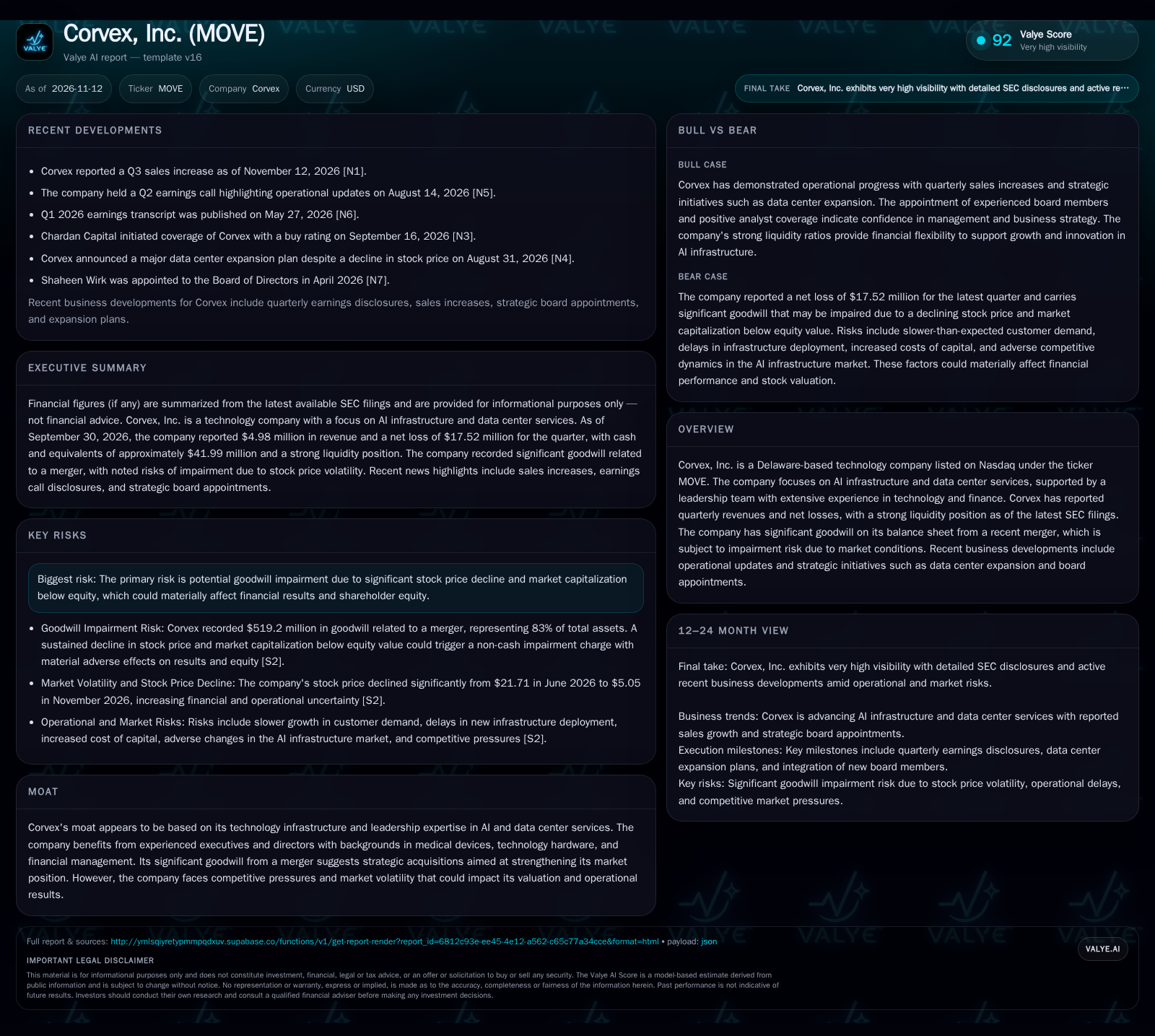
Corvex reported $4.98 million in revenue for the quarter ended September 30, 2026, but this was overshadowed by a net loss of $17.52 million and negative EPS of -$0.60, reflecting the high fixed costs and investment requirements typical of early-stage AI infrastructure providers [S2]. The company reported cash and liquidity metrics for the period; these figures do not by themselves establish operating runway, investment capacity, financial flexibility, or financing capacity. [S2] However, the balance sheet is dominated by $519.2 million in goodwill (83% of assets), stemming from a recent merger. This goodwill is at heightened risk of impairment, as the company’s stock price fell dramatically from $21.71 in June 2026 to $5.05 by November, pushing market capitalization below equity value and raising the prospect of a material non-cash charge that could further erode shareholder equity [S2].
Operationally, Corvex is pushing forward with a new data center expansion, aiming to increase capacity for AI workloads [N4]. Yet, the market’s muted reaction and ongoing losses highlight the challenge of translating infrastructure buildout into profitable, recurring demand.
How Corvex’s AI Compute Model Could Scale—And Where the Economics Are Most Sensitive
Corvex’s core business model is to provide GPU-accelerated compute clusters and data center services—delivered as managed Kubernetes, bare metal, or multi/single-tenant solutions—targeting organizations with intensive AI training and inference needs [S2]. Revenue may be generated through a mix of usage-based billing, reserved capacity, and premium API access to proprietary or open-source AI models. The company’s Token Factory product, for example, allows customers to integrate premium AI models via API, potentially introducing a scalable, high-margin software revenue stream if adoption materializes [S2].
Fixed costs are substantial, given the capital intensity of building and maintaining state-of-the-art data centers and GPU clusters. Variable costs include hardware, energy, and support, but the model may offer operating leverage if utilization rates rise and customer offtake becomes more predictable. However, the early-stage revenue base ($4.98M in Q3 vs. $17.52M net loss) highlights the risk that growth in capacity could outpace demand, especially if customer adoption is slower than anticipated or if pricing comes under pressure from hyperscale competitors.
Ongoing investment in technology, talent, and infrastructure will likely require further capital raises, as evidenced by the recent ATM facility registration for up to $250 million in new equity [S2]. The company’s ability to achieve positive cash flow will depend on rapid scaling of revenue, disciplined cost management, and demonstrating differentiated value to customers willing to pay premium prices for specialized AI compute.
Intense Competition and Substitution Risks in the AI Data Center Value Chain
Corvex operates in a fiercely competitive segment. The company faces direct competition from hyperscale cloud providers (such as AWS, Google Cloud, Microsoft Azure), specialized AI infrastructure startups, and established colocation/data center operators entering the AI compute market. These rivals often have advantages in scale, customer reach, and ability to absorb losses during ramp-up periods.
If Corvex’s platform can deliver superior performance, security (e.g., confidential computing features), or cost efficiency for enterprise AI workloads, it could carve out a niche among customers requiring specialized infrastructure or regulatory compliance. However, switching costs for large customers may be low if competing platforms offer similar performance, and hyperscalers could respond with aggressive pricing or bundled services.
The company’s future moat may depend on the strength of its proprietary technology stack (e.g., patent-pending secure model weights), ecosystem integration, and the ability to build long-term, sticky customer relationships. Until recurring contracts, high utilization rates, or unique platform advantages are proven, Corvex remains vulnerable to both price competition and technology substitution.
What Would It Take for Corvex to Become a Profitable AI Infrastructure Contender?
A favorable trajectory would see Corvex rapidly onboarding enterprise customers, securing multi-year offtake agreements for GPU-accelerated compute, and achieving high utilization across its expanded data center footprint. This would drive operating leverage, improve gross margins, and enable positive cash flow as fixed costs are absorbed by a broader revenue base.
Differentiation through proprietary offerings—such as secure model weights or performance-optimized inference APIs—could justify premium pricing and attract customers with sensitive or mission-critical AI workloads. Successful execution of the Token Factory strategy, resulting in API-driven, recurring software revenue, would further enhance margins and reduce reliance on pure infrastructure economics.
Evidence to confirm this scenario would include: a sharp sequential rise in contracted revenue and backlog, disclosure of major customer wins or partnerships, improving gross and operating margins, and a reduction in net losses. Demonstrated pricing power and customer retention would validate the platform’s value proposition.
Early-Stage Scaling, Losses Persist—Awaiting Proof of Sustainable Demand
The most plausible near-term path is that Corvex continues to grow revenue at a moderate pace, with quarterly sales increases reflecting some traction in attracting customers to its AI compute offerings. However, losses remain substantial as infrastructure and R&D investments continue to outpace top-line growth.
The company may secure some anchor customers or partnership announcements, but persistent utilization gaps or competitive pricing pressure limit the pace of margin improvement. Goodwill remains at risk of impairment if market capitalization does not recover, potentially triggering a material reduction in reported equity.
This scenario would be confirmed by continued, but modest, sequential revenue growth, ongoing net losses, and management commentary focused on customer pipeline development and infrastructure ramp. Lack of transparency on contract duration, renewal rates, or backlog would suggest limited revenue visibility and reinforce the need for further proof of product-market fit.
If Customer Uptake Falters and Goodwill Is Impaired, Shareholder Value Could Erode Quickly
A negative outcome could materialize if Corvex is unable to secure sufficient customer demand to fill its expanded data center capacity, leading to persistently low utilization, weak pricing, and continued steep losses. In this scenario, the company may be forced to raise dilutive capital or cut back on growth initiatives, further dampening investor confidence.
Should market capitalization remain below the carrying value of equity, a substantial goodwill impairment charge would be likely, resulting in a significant write-down of assets and possible covenant or listing complications. This could exacerbate share price declines and limit access to affordable capital.
Confirmation of this scenario would include: stagnant or declining revenue, widening net losses, an announced goodwill impairment, and management shifting focus from growth to cost containment or restructuring. Lack of customer announcements, delayed expansion milestones, or negative analyst revisions would further reinforce downside risks.
Milestones That Will Determine Corvex’s Transition from Buildout to Sustainable Growth
Quarterly revenue growth rate and composition (infrastructure vs. API/software) should be monitored to assess traction and mix shift.
Gross margin trends, if disclosed, would help test the ability to achieve operating leverage as capacity is utilized.
Utilization rates of GPU clusters and data center capacity—if reported—would indicate demand elasticity and efficiency of capital deployment.
Disclosure of backlog, multi-year contracts, or major customer wins would provide visibility into future revenue stability.
Any announcement or quantification of goodwill impairment would materially affect equity value and investor perception.
Capital raise activity under the ATM facility, and resulting dilution, should be tracked to gauge funding needs and market appetite.
Updates on the competitive landscape, including pricing moves by hyperscalers or specialist rivals, may signal shifts in market structure.
Board and management commentary on the pace of infrastructure expansion and customer pipeline conversion would clarify execution risk.
Disclaimer: This is research-only, informational analysis and not investment advice. It may include AI-generated interpretation and general industry context. Always verify important details using primary sources.

Comments