
Alpha Cognition: Commercializing Alzheimer’s Innovation in a Genericized Market
Alpha Cognition’s Q3 2026 results show early revenue traction from ZUNVEYL, its FDA-approved Alzheimer’s therapy.
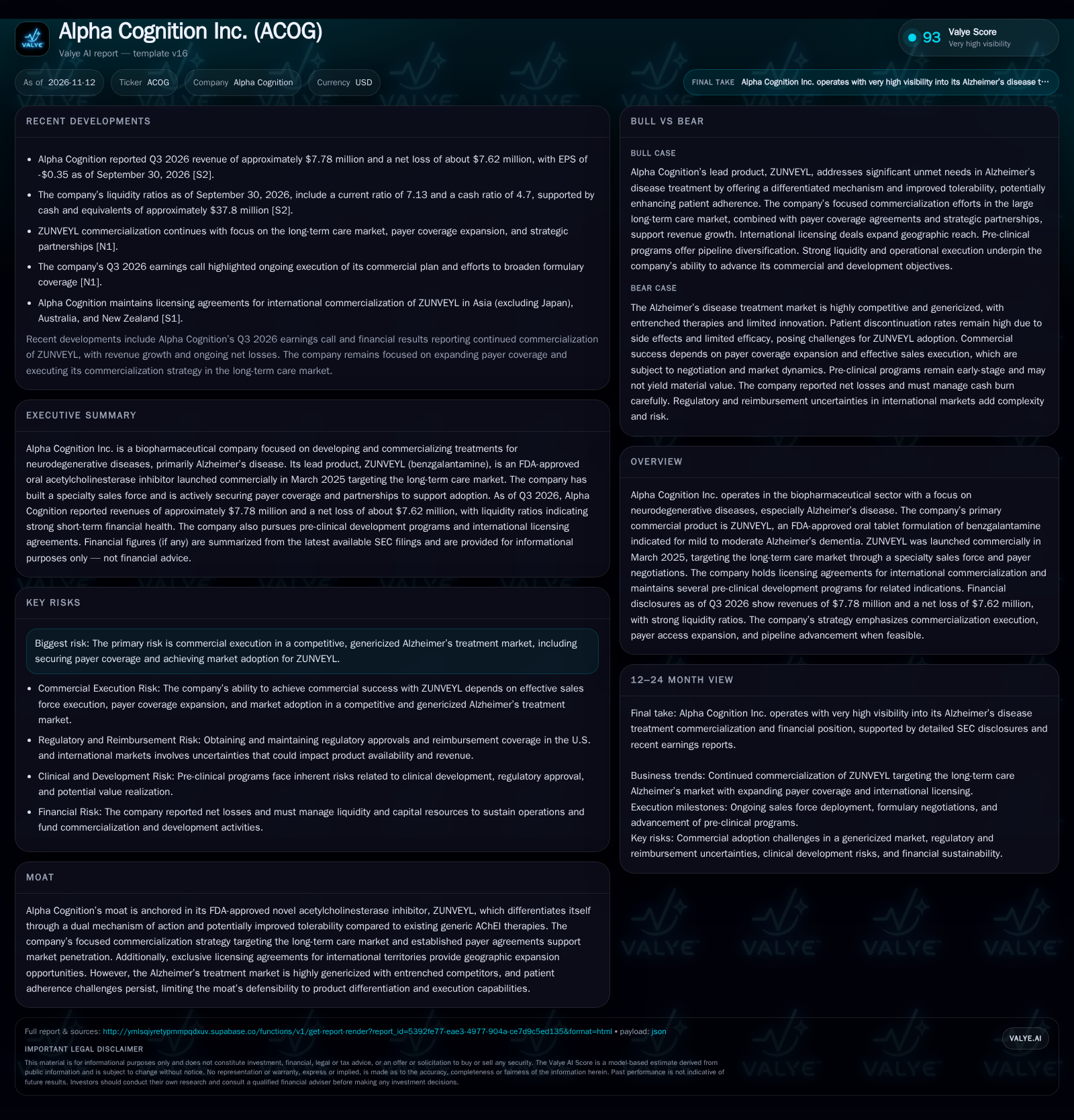
Alpha Cognition’s Q3 2026 results show early revenue traction from ZUNVEYL, its FDA-approved Alzheimer’s therapy. The company’s reported cash position underpins ongoing commercialization and payer negotiations, but sustained losses highlight the need for rapid adoption and disciplined execution in a highly genericized market. International licensing and pipeline programs offer optionality but remain unproven. Key milestones include LTC market penetration, formulary wins, and evidence of improved patient adherence or efficacy over incumbents. [S2] [N1]
Alpha Cognition’s commercialization of ZUNVEYL, a next-generation acetylcholinesterase inhibitor for Alzheimer’s disease, is a rare attempt to break through the generic-dominated treatment landscape. The next phase depends on expanding payer coverage, demonstrating real-world benefits, and managing the high hurdles of Alzheimer’s market dynamics. Strategic partnerships and pre-clinical programs offer long-term upside but are unlikely to offset near-term execution risk.
Early Commercialization Results and Financial Position
As of Q3 2026, Alpha Cognition reported $7.78 million in revenue and a net loss of $7.62 million, reflecting the initial commercial ramp of ZUNVEYL, its lead Alzheimer’s therapy [S2]. The company reported a current ratio of 7.13 for the period. [S2] ZUNVEYL was FDA-approved in July 2024 and launched in March 2025, focusing on the long-term care (LTC) Alzheimer’s market—a segment characterized by complex payer dynamics and entrenched prescribing patterns. The company has secured formulary coverage with two of the four major national PBMs, a key threshold for market access and reimbursement [N1]. International licensing agreements and a pre-clinical pipeline provide optionality, but commercial viability for these remains to be established.
Revenue Drivers, Cost Structure, and Margin Potential in Alzheimer’s Care
Alpha Cognition’s core revenue opportunity currently rests on ZUNVEYL’s uptake in the LTC Alzheimer’s market. The drug’s wholesale acquisition cost (WAC) is set at $820 per month, positioning it above many generics but below branded specialty drugs, reflecting a balance between perceived value and payer sensitivity [S1]. The LTC channel is typically characterized by consolidated buying, heavy influence from PBMs and payers, and high price elasticity due to budget constraints. If ZUNVEYL’s claimed tolerability and cognitive benefits translate into reduced discontinuation and better outcomes, it could justify premium pricing or secure preferred formulary status. However, in practice, AChEI therapies have suffered from high discontinuation rates and low adherence, limiting duration per patient and thus true lifetime value.
The company’s specialty sales force and targeted marketing increase fixed costs in the near term, with operating leverage dependent on sales scaling faster than SG&A growth. Gross margin economics will be dictated by manufacturing scale, payer rebates, and the mix of payor contracts; the specialty pharmaceutical model can deliver high gross margins if volume and pricing hold. However, net margins in neurology are often constrained by ongoing R&D, medical affairs, and sales force requirements, especially when building a new brand in a genericized category.
Pipeline programs and ex-U.S. licensing introduce potential milestone and royalty revenue but are unlikely to offset core burn until they achieve material scale. The company reported cash and liquidity metrics for the period; these figures do not by themselves establish operating runway, investment capacity, financial flexibility, or financing capacity.
Differentiation Versus Generics and the Challenge of Shifting Prescriber Behavior
Alpha Cognition’s principal challenge is to carve out share in a U.S. Alzheimer’s treatment market dominated by generic acetylcholinesterase inhibitors (AChEIs) such as donepezil, rivastigmine, and galantamine. ZUNVEYL’s dual mechanism of action—targeting both acetylcholinesterase and alpha-7 nicotinic receptors—offers a plausible clinical rationale for improved cognition and fewer gastrointestinal side effects, which could support higher adherence. However, real-world adoption depends on whether prescribers and payers perceive these benefits as clinically meaningful and sufficiently differentiated to justify switching from low-cost generics.
The company’s focus on LTC settings is strategic: these institutions have high concentrations of Alzheimer’s patients and often standardized formularies, enabling targeted sales efforts. Still, institutional inertia and cost constraints are formidable. PBM formulary positioning is a gatekeeper; with agreements in place with two major PBMs, Alpha Cognition has made progress, but full market access requires broader coverage and ongoing negotiation. Substitution risk from pipeline or next-generation Alzheimer’s drugs, including disease-modifying therapies, is a medium- to long-term threat; however, such agents have yet to broadly displace AChEIs in the LTC setting due to cost, administration, and eligibility barriers.
Internationally, out-licensing to partners for Asia-Pacific and Oceania provides a capital-light expansion path, but regulatory, reimbursement, and commercial execution risks remain high. Overall, any sustainable moat will depend on proven clinical and real-world outcomes, payer acceptance, and the company’s ability to overcome institutional inertia.
If ZUNVEYL Demonstrates Tangible Adherence and Outcome Benefits
The most favorable scenario for Alpha Cognition is that real-world data validate ZUNVEYL’s differentiated profile, leading to measurable improvements in patient adherence, reduced discontinuation, and better cognitive or functional outcomes compared to generic AChEIs. This could drive stronger LTC institutional adoption, improved formulary placement, and possibly even preferred status with additional PBMs. If prescriber and patient advocacy groups endorse ZUNVEYL’s tolerability and efficacy, the company could defend its WAC and limit rebate pressure.
Successful execution would be evidenced by a rapid ramp in script volume, expansion to the remaining major PBMs, and visible share gains in the LTC segment. International licensing milestones and royalty streams could begin to build if ex-U.S. launches proceed. Confirmation of this scenario would come from sequential revenue acceleration, public disclosure of improved adherence or outcomes from LTC partners, and updates on ex-U.S. regulatory or commercial progress.
Commercial Progress Meets Market Friction: Gradual Uptake and Ongoing Losses
The most plausible path is that Alpha Cognition achieves moderate penetration in the LTC Alzheimer’s market, with ZUNVEYL gaining a foothold in some institutional formularies but facing slow prescriber conversion and persistent price pressure. Revenue grows sequentially but is offset by continued high SG&A and R&D spend, leading to ongoing net losses. PBM and payer negotiations continue, with partial but not universal coverage, while patient discontinuation rates, though improved, remain a limiting factor on duration per script.
Pipeline and ex-U.S. licensing provide occasional milestones but do not materially change the financial profile in the near term. This scenario would be confirmed by steady but unspectacular revenue growth, persistent operating losses, and incremental rather than transformative partnership or licensing news.
Entrenched Generics and Payer Barriers Limit Adoption, Forcing Strategic Retrenchment
In the adverse case, ZUNVEYL fails to gain meaningful share due to entrenched generic use, payer resistance to premium pricing, and lack of compelling real-world outcome data. Institutional LTC buyers may resist switching due to cost and inertia, and payer rebates or step therapy requirements erode net pricing. If adverse coverage decisions or negative formulary reviews occur, or if real-world tolerability benefits fail to materialize, revenue stagnates or declines. Ongoing net losses and cash burn force Alpha Cognition to scale back commercial efforts, delay pipeline investments, or seek additional dilutive financing.
This scenario would be confirmed by flat or declining sequential revenue, negative trends in formulary coverage, or public disclosure of failed payer negotiations or discontinuation of commercial expansion. International licensing milestones stall, and pipeline programs fail to advance beyond pre-clinical stages.
Milestones and Evidence to Clarify Alpha Cognition’s Alzheimer’s Commercialization Trajectory
Quarterly ZUNVEYL revenue growth and script volume trends, especially in the LTC channel, will indicate real market traction.
Expansion of formulary coverage, including additional major PBM agreements and LTC institution wins, would signal improved market access.
Disclosure of real-world adherence rates or patient discontinuation data for ZUNVEYL compared to generic AChEIs, if available, would help test the product’s differentiation.
Updates on net pricing, rebate levels, or gross-to-net adjustments would clarify how much of the WAC is being realized.
Progress on international licensing milestones, regulatory submissions, or ex-U.S. launches would provide evidence of pipeline and global optionality.
Pipeline advancement for ALPHA-1062 and other pre-clinical programs, including IND filings or clinical trial initiations, would diversify risk.
Cash burn and operating expense trends should be monitored for signs of financial discipline or need for additional capital.
Any signals of payer or institutional resistance—such as negative formulary decisions, step therapy requirements, or exclusion from key LTC buyers—would be red flags for the commercial thesis.
Disclaimer: This is research-only, informational analysis and not investment advice. It may include AI-generated interpretation and general industry context. Always verify important details using primary sources.

Comments