
USANA Health Sciences: Navigating Direct-Selling Headwinds, Channel Evolution, and Regulatory Uncertainty
USANA Health Sciences confronts margin compression and declining sales amid regulatory scrutiny and changing consumer behaviors. While omni-channel expansion and recent acquisitions diversify reach, execution risk remains high as the company adapts its compensation model and seeks new growth levers.
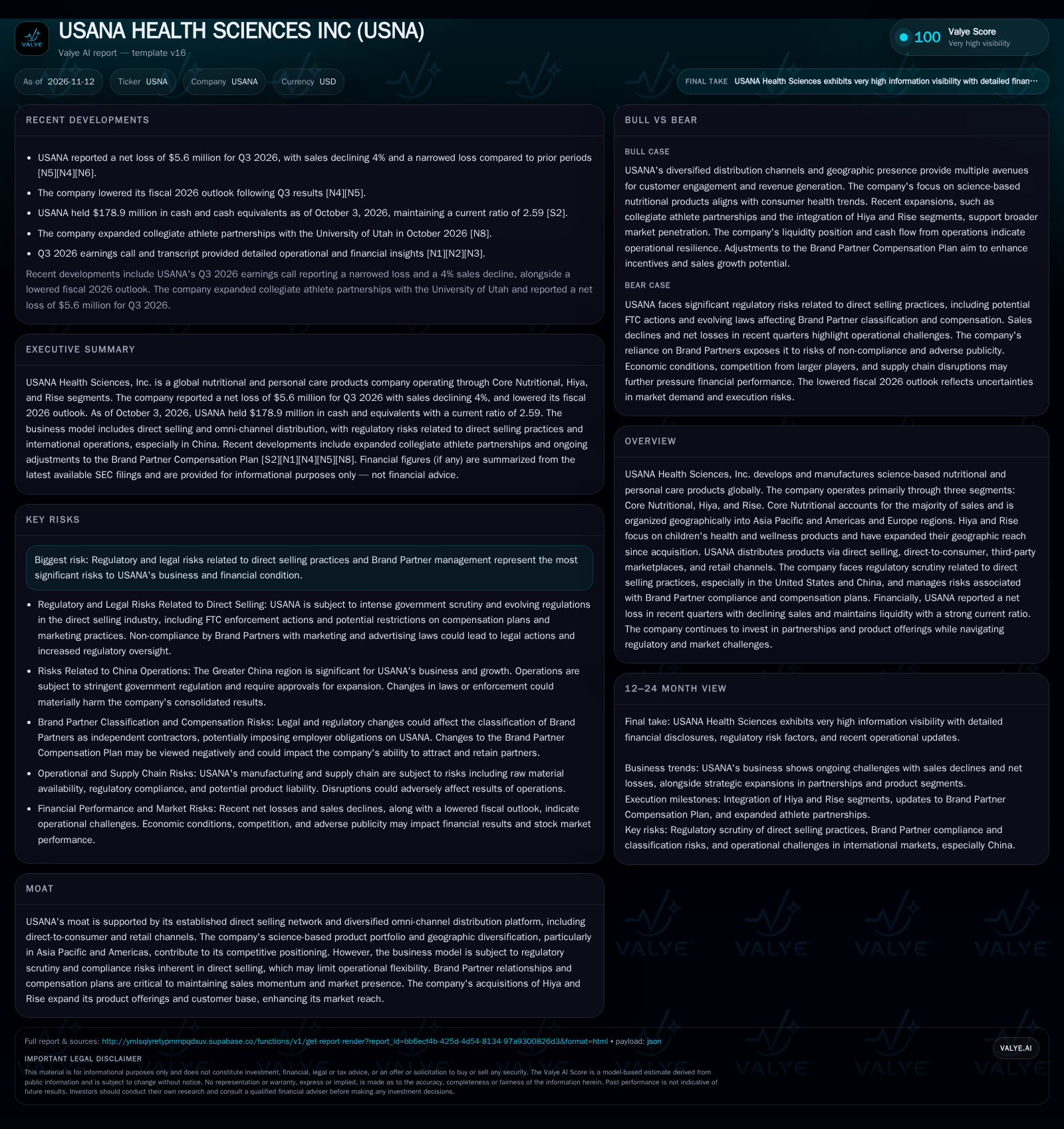
USANA reported a Q3 2026 net loss of $5.6 million on $205.9 million in sales, with revenue down 4% and a lowered outlook for the year. Recent acquisitions (Hiya, Rise) and omni-channel moves broaden exposure, yet margin pressure and Brand Partner incentive costs weigh on profitability [S2] [N4] [N5].
USANA Health Sciences stands at a critical crossroads as its legacy direct selling model contends with both regulatory and market-driven pressures. Despite a narrowed Q3 2026 loss, sales continued to contract and the company reduced its full-year guidance, signaling persistent headwinds. However, with incentive costs still high and regulatory risk elevated, the company’s ability to adapt its business model without further margin erosion is now the central challenge.
Recent Performance Flags Structural Challenges and Execution Risks
USANA reported a Q3 2026 net loss of $5.6 million on $205.9 million in sales, reflecting a 4% year-over-year revenue decline and ongoing margin pressure. While this loss is narrower than in previous periods, it comes alongside a lowered fiscal 2026 outlook, underscoring the company’s struggle to stabilize core revenue and profitability [N4] [N5].
The financials also highlight the cost structure: Brand Partner incentives alone totaled $71.9 million in Q3, nearly 35% of quarterly sales, illustrating the heavy expense burden of the direct selling model [S2].
The company reported a current ratio of 2.59 for the period. [S2]
Strategically, USANA has continued to expand its product and channel mix, most notably through its Hiya and Rise acquisitions and new collegiate athlete partnerships, signaling an intent to diversify revenue streams beyond legacy channels [N8].
Economic Model Under Strain: Margin Dynamics and Channel Trade-Offs
USANA’s traditional business model relies on high-margin, science-based nutritional products sold primarily via direct selling through Brand Partners. This approach historically offered operating leverage as revenue scaled, with Brand Partner incentives acting as a variable cost tied to sales.
However, recent results suggest this model is under strain. Brand Partner incentive costs remain elevated at $71.9 million for Q3 2026, limiting gross margin expansion even as sales shrink [S2]. Fixed costs for manufacturing and R&D, combined with variable incentive payouts, create a profit structure highly sensitive to revenue declines—if sales fall, margin contraction accelerates due to the persistence of fixed and semi-variable costs.
The acquisitions of Hiya and Rise, both with direct-to-consumer (DTC) and digital-first distribution, introduce new margin structures. DTC channels may offer higher gross margins per unit but often require increased marketing spend and customer acquisition costs, especially when scaling outside the core Brand Partner network. The net margin impact depends on the ability to build repeat purchasing and retention in these new segments.
Capital needs for USANA are moderate, with recent periods showing positive operating cash flow ($45.0 million for the nine months ended October 3, 2026) [S2]. However, continued net losses and investment in new segments could pressure future cash flows if top-line declines persist.
Direct Selling Moat Faces Erosion from Regulatory and Channel Shifts
USANA’s historical competitive advantage stemmed from its established direct selling network, science-backed product portfolio, and geographic reach—especially in Asia Pacific and the Americas. This offered access to hard-to-reach markets and built-in customer loyalty via Brand Partners.
However, the direct selling model is increasingly vulnerable. Regulatory scrutiny of multi-level marketing (MLM) compensation structures has intensified, particularly in the US and China, raising compliance costs and uncertainty. Legal risks around Brand Partner classification (independent contractor vs. employee) could further erode the cost advantage if regulations force higher fixed labor costs or limit incentive programs.
Digital-native competitors and wellness brands leveraging influencer marketing, subscription e-commerce, and retail partnerships are bypassing the traditional direct selling playbook. These players may achieve faster customer acquisition and lower churn by offering greater transparency, convenience, and digital engagement.
USANA’s recent expansion into DTC with Hiya and Rise is a strategic response to these pressures, but the company must now compete on digital marketing, user experience, and product innovation—areas where established e-commerce brands may hold an edge.
A Return to Growth If Channel Diversification and Brand Partner Evolution Deliver
A bullish scenario for USANA would see the company successfully leveraging its omni-channel platform, using Hiya and Rise to access new customer segments (especially parents seeking children’s wellness products), and revitalizing Brand Partner engagement through updated incentives.
If the new compensation plan increases Brand Partner productivity and retention without inflating costs, and if DTC channels scale with high repeat purchase rates, USANA could stabilize or even grow sales while gradually improving margins.
Confirmation of this scenario would come from several quarters of sequential sales growth, improved net margins (through either higher DTC mix or lower Brand Partner churn), and evidence that incentive costs as a percentage of sales are falling. Regulatory clarity—such as no new adverse rulings in China or the US—would further support upside.
Falsification would be indicated by continued sales declines, rising incentive costs, or inability to deliver profitable growth in Hiya and Rise despite omni-channel investment.
Incremental Progress Amid Persistent Margin and Regulatory Pressures
The most plausible trajectory for USANA is one of gradual stabilization rather than a sharp turnaround. Sales may continue to decline modestly as the legacy direct selling segment contracts, partially offset by growth in DTC (Hiya, Rise) and retail partnerships.
Margins likely remain compressed due to the high cost of Brand Partner incentives and ongoing investment in digital and omnichannel capabilities.
Execution risk remains high: integrating new acquisitions, managing regulatory compliance, and evolving the Brand Partner model without triggering attrition or legal liabilities are all non-trivial challenges.
Confirmation would be quarterly results showing flattish or slightly declining sales, ongoing but narrowing net losses, and stable to slightly improved cash flow. Falsification would involve accelerating sales declines, regulatory headwinds materializing, or cash burn increasing materially.
Margin Compression Accelerates If Regulatory and Channel Transitions Falter
The adverse scenario sees USANA’s core direct selling model further undermined by regulatory intervention—such as new FTC or Chinese government actions limiting MLM compensation plans or reclassifying Brand Partners as employees. This could force higher fixed costs, reduce incentive flexibility, and trigger Brand Partner attrition.
If Hiya and Rise fail to achieve scale or encounter higher-than-expected customer acquisition costs, USANA could see DTC expansion erode margins rather than support them.
Evidence supporting this scenario would include sharp increases in legal or compliance expense, regulatory fines or sanctions, further reductions in sales outlook, and negative operating cash flow. Falsification would require regulatory stability, successful DTC scaling, and signs of margin stabilization.
Milestones That Will Test USANA’s Ability to Adapt Its Business Model
Quarterly net sales growth or sequential stabilization across Core Nutritional, Hiya, and Rise would clarify whether omni-channel expansion is offsetting direct selling contraction.
Brand Partner incentive costs as a percentage of sales—if this ratio falls, it may signal improved productivity or successful compensation plan changes.
Gross and net margin trends by segment (if disclosed), especially in Hiya and Rise, as a test of DTC economic viability.
Brand Partner count, retention, and productivity metrics—any significant attrition or declining productivity would indicate structural pressure.
Regulatory developments in the US and China, including any FTC or government actions impacting direct selling, compensation plans, or independent contractor classification.
Operating cash flow trajectory—continued positive cash flow would buy time for business model transition, while negative trends would raise risk.
Customer acquisition cost and repeat purchase rates in Hiya and Rise (if disclosed) as evidence of scalable DTC economics.
Updates on collegiate athlete and other marketing partnerships, with any quantifiable impact on customer acquisition or segment sales.
Disclaimer: This is research-only, informational analysis and not investment advice. It may include AI-generated interpretation and general industry context. Always verify important details using primary sources.

Comments