
CuriosityStream’s Factual Content Ecosystem: Managing Diversification, Credit Risk, and Market Competition
Its multi-pronged distribution and licensing model offers resilience, yet long-term success hinges on sustaining subscription relevance, expanding high-value licensing, and mitigating counterparty risk.
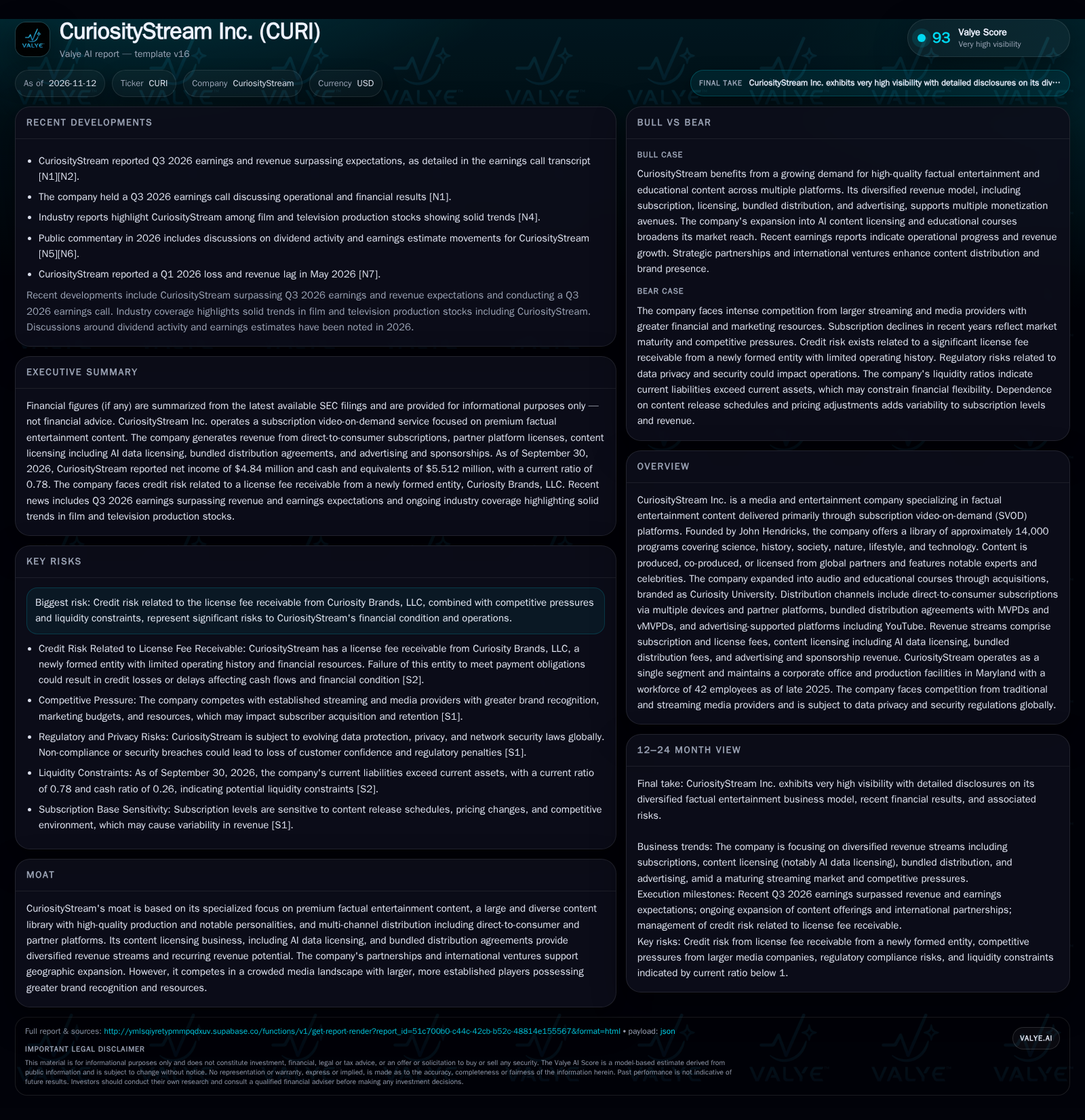
The company’s business spans direct subscriptions, bundled distribution, content and AI data licensing, and advertising, competing in a crowded factual entertainment market. Sustainable growth likely depends on strengthening recurring revenue, successfully monetizing its content library—including AI use cases—and managing financial and competitive risks. [S2] [S1]
Its differentiated focus on factual content, broad library, and multi-channel distribution—spanning subscriptions, licensing, and advertising—create multiple monetization levers. However, a significant credit exposure to a newly formed licensee and intense competition from both traditional and digital media giants heighten uncertainty. The company’s next phase will test whether its creative and commercial diversification can drive sustainable value or if financial constraints and market realities will limit its trajectory.
Recent Profitability Amid Liquidity Limits and Significant Credit Exposure
CuriosityStream reported net income of $4.84 million for Q3 2026, reversing losses seen earlier in the year and delivering $0.08 in earnings per share. This quarterly profit signals operational progress amid a challenging environment for niche streaming platforms. The company reported cash and liquidity metrics for the period; these figures do not by themselves establish operating runway, investment capacity, financial flexibility, or financing capacity. Most notably, CuriosityStream faces material credit risk related to a license fee receivable from Curiosity Brands, LLC—a newly formed entity with limited operating history—whose payments are scheduled over four years starting in mid-2027. This receivable both defers cash realization and exposes the company to counterparty default risk. [S2]
Revenue Models, Cost Breakdown, and Leverage in Factual Content Monetization
CuriosityStream’s economics are anchored in its ability to monetize a large, evergreen library of factual content across multiple channels. Its revenue mix includes direct-to-consumer (DTC) subscriptions, content licensing (including emerging AI data licensing), bundled distribution through MVPDs and vMVPDs, and advertising/sponsorship. DTC subscriptions and partner licenses are typically higher-margin, scalable with subscriber growth and platform efficiency, while bundled distribution agreements may provide steadier, long-cycle recurring revenue but often at lower per-user economics due to wholesale pricing.
Content costs—whether produced, co-produced, or licensed—represent the primary fixed and variable outlay. Operating leverage is possible if subscriber and licensing growth outpaces incremental content and marketing spend, but this is counterbalanced by ongoing investment required to refresh and expand the library. The company’s lean workforce (42 full-time employees) suggests a relatively low fixed overhead, though content acquisition and technology costs are likely to remain significant.
AI data licensing and educational course offerings (Curiosity University) may provide higher-margin incremental revenue, especially if they leverage existing content assets with minimal new production expense. However, the commercial scale of these newer streams is not yet established. Advertising, while additive, is typically lower-margin and volatile for niche factual brands compared to mainstream entertainment platforms.
Balancing Specialization and Scale in a Competitive Streaming and Licensing Market
CuriosityStream’s competitive position is built on specialization: its focus on factual and educational content, a curated library of approximately 14,000 programs, and access to recognized experts and personalities. This differentiation appeals to a segment of viewers underserved by generalist platforms. The company’s content licensing business—including AI data licensing—is a notable strategic extension, as the demand for high-quality factual datasets rises with the proliferation of AI-driven media applications.
However, the company faces formidable counterforces. Large streaming services and legacy media conglomerates have ramped up their own factual and documentary offerings, often bundling them within broader content ecosystems and leveraging superior brand, data, and marketing resources. In distribution, CuriosityStream must compete for shelf space on partner platforms and in bundled deals, often facing price pressure and limited negotiating leverage. Substitutes include free or ad-supported documentary content on platforms like YouTube, as well as specialized competitors in educational and science media. The company’s ability to maintain relevance and pricing power will depend on continual content investment, brand positioning, and its success in forging sticky distribution partnerships.
Growth Potential from Expanding Library Scale and Licensing Revenues
A favorable outcome would see CuriosityStream leveraging its extensive content library and distribution relationships to drive sustainable, high-margin revenue growth. Key mechanisms could include: (1) expanding DTC and partner subscriber bases through targeted marketing and differentiated content drops; (2) scaling AI data licensing, as demand for structured factual content for training models and educational platforms accelerates; (3) converting bundled distribution deals into multi-year, recurring revenue streams with improved terms as the company proves its audience value; and (4) growing Curiosity University and audio courses into a meaningful, sticky revenue contributor.
Evidence that would confirm this scenario includes: sustained sequential growth in total revenue and margin expansion; disclosure of long-term, multi-year licensing or distribution contracts with large partners; material increases in AI licensing revenue; and a growing, diversified base of recurring cash flows. A reduction in credit risk exposure—such as accelerated collection or successful performance by Curiosity Brands, LLC—would further validate the upside thesis.
Maintaining a Niche with Controlled Growth, Risk Oversight, and Margin Fluctuations
The most plausible trajectory is that CuriosityStream sustains a modest growth profile, with recurring revenue from core subscriptions and bundled distribution offset by churn, pricing competition, and content investment needs. The company continues to experiment with licensing and new formats, generating incremental revenue but not yet at transformative scale. Credit risk from the Curiosity Brands receivable remains a watchpoint, with deferred cash inflows and the possibility of partial impairment.
This scenario would be confirmed by stable or slowly growing top-line revenue, periodic profitability interspersed with quarters of net loss, and continued reliance on tight working capital. Modest improvements in gross margin would suggest operating leverage, but persistent liquidity constraints or lack of material progress on new licensing streams would signal the limits of the current model.
Risks When Liquidity Constraints and Credit Exposure Overshadow Diversification
In an adverse scenario, CuriosityStream’s constrained liquidity and heavy reliance on a single, unproven licensee for a significant receivable precipitate cash flow stress. If Curiosity Brands, LLC fails to meet its payment obligations, the company could face a write-down and a material hit to operating cash flows, forcing cutbacks in content acquisition or technology investment. Intensifying competition from larger platforms could accelerate subscriber losses or pressure licensing fees, further eroding revenue.
Regulatory or data privacy setbacks could exacerbate financial and reputational risk.
Key Developments Shaping CuriosityStream’s Future Trajectory
Quarterly growth or decline in total revenue, broken down by DTC subscriptions, licensing, bundled distribution, and advertising (if disclosed), to assess the sustainability and mix of monetization.
Updates on the performance and payment schedule of the Curiosity Brands, LLC license fee receivable, including any early payments, defaults, or renegotiations.
Gross margin and operating margin trends, indicating whether content investment is translating into scalable, profitable growth.
Subscriber acquisition and retention metrics—particularly churn rates and ARPU (if disclosed)—to test the stickiness of the DTC offering.
Disclosure of new or expanded multi-year licensing agreements, especially in AI data licensing or with large educational/technology partners.
Liquidity developments, including changes in cash, short-term investments, and current ratios, to monitor potential financial flexibility.
Progress on Curiosity University and audio/educational course revenue, to gauge the impact of diversification efforts.
Any announcements of regulatory, data privacy, or network security incidents, as these could have financial and reputational repercussions.
Disclaimer: This is research-only, informational analysis and not investment advice. It may include AI-generated interpretation and general industry context. Always verify important details using primary sources.

Comments