
M-tron Industries: High-Performance Niche, Customer Concentration, and the Challenge of Scaling Custom Electronics
M-tron Industries' focus on engineered frequency and spectrum control components for aerospace and defense end-markets has yielded reported liquidity position and recent contract wins. Yet, high customer concentration, supply chain pressures, and competitive intensity create a nuanced outlook for sustainable growth and margin resilience.
M-tron Industries leverages deep engineering and certification credentials to supply mission-critical frequency control and RF solutions to aerospace, defense, and avionics customers. Recent outperformance in Q3 and a major air defense order highlight ongoing demand, but reliance on a handful of large clients and exposure to supply chain volatility temper the long-term risk/reward balance. Monitoring contract flow, customer retention, and input costs will be essential as M-tron seeks to defend and extend its niche.
M-tron Industries stands at the intersection of deep engineering capability and high-stakes end-markets, supplying frequency and spectrum control components to aerospace, defense, and industrial customers worldwide. The next phase for M-tron will test whether high-reliability custom electronics can scale profitably while defending margins and sustaining technical differentiation.
Recent Wins and Persistent Risks Define M-tron's Operating Backdrop
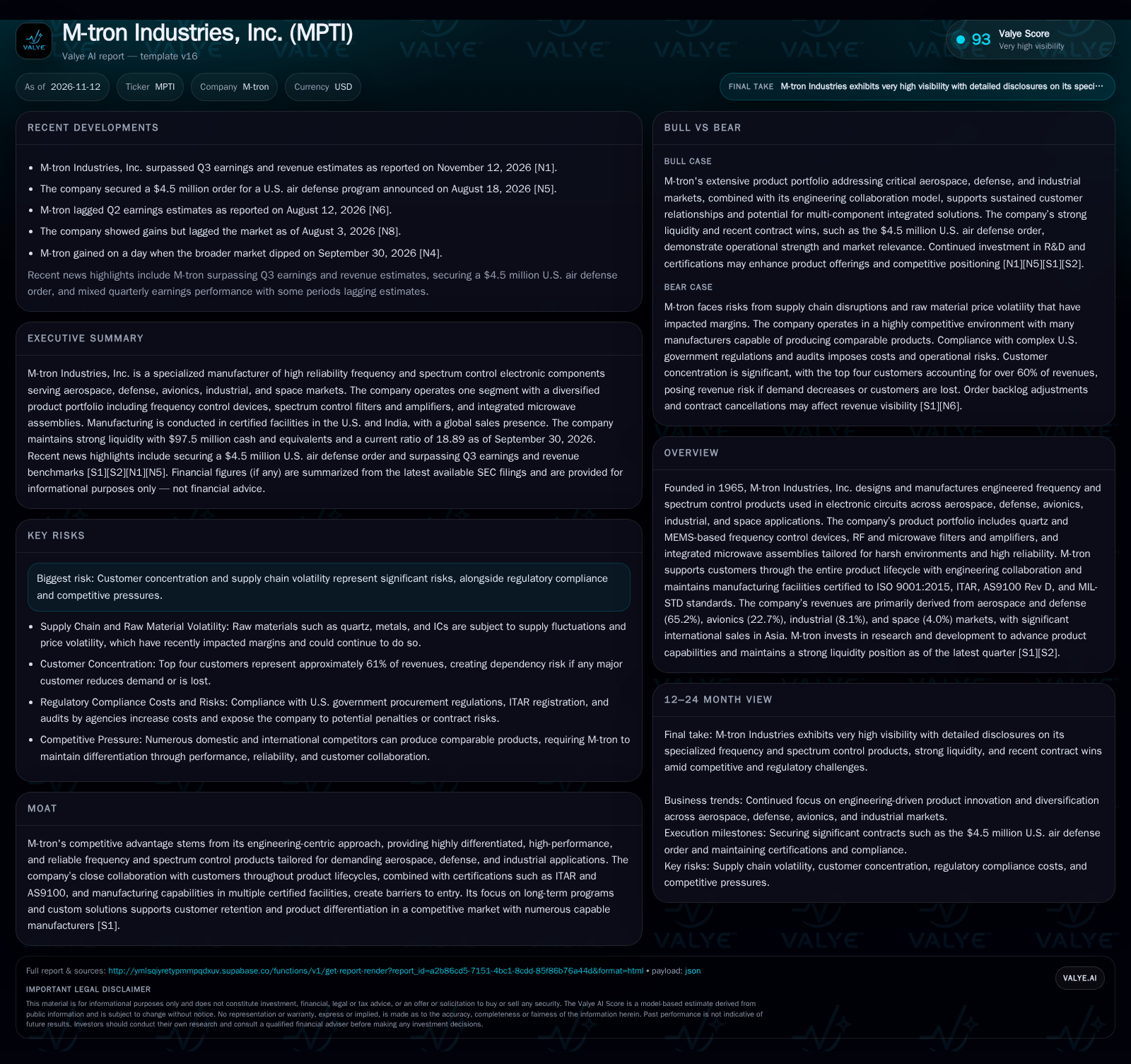
M-tron Industries reported Q3 2026 net income of $3.05 million, exceeding both earnings and revenue estimates, which points to continued momentum in its core markets [N1] [S2]. The company secured a $4.5 million order for a U.S. air defense program in August 2026, reinforcing its strategic relevance in defense electronics [N5]. Liquidity is notably robust, with $97.5 million in cash and a current ratio of 18.89 as of September 30, 2026 [S2]. However, the concentration of revenue among the top four customers (61% in 2025) exposes the company to significant counterparty risk [S1]. These facts frame a business with strong near-term execution but persistent structural dependencies.
Beyond the headline liquidity and order wins, it is critical to consider the underlying dynamics of M-tron’s customer relationships and contract structure. The concentration among a few large customers may afford negotiation leverage and repeat business, but it also heightens vulnerability to shifts in defense budgets or program priorities. Contract durations, renewal probabilities, and the pace of new program awards will materially influence revenue visibility. The company reported cash and liquidity metrics for the period; these figures do not by themselves establish operating runway, investment capacity, financial flexibility, or financing capacity.
Custom High-Reliability Electronics: Margin Opportunities and Cost Exposure
M-tron’s business model is rooted in the design and manufacture of highly engineered frequency control and RF spectrum products—such as quartz and MEMS oscillators, filters, amplifiers, and integrated microwave assemblies—primarily for aerospace, defense, and avionics programs [S1]. These applications typically demand long qualification cycles, stringent certification, and ongoing customer engineering support, which can justify premium pricing and support higher gross margins relative to commodity electronics. The company’s ability to integrate multiple RF components into custom assemblies further increases switching costs and can embed M-tron deeper into its customers’ supply chains.
On the expense side, M-tron faces both fixed and variable cost pressures. Manufacturing certifications (AS9100, ITAR, MIL-STD) and R&D investment ($3.16 million in 2025) are necessary to maintain technical edge and program eligibility, but they also lock in a baseline of overhead [S1]. Meanwhile, raw material costs—quartz, metals, ICs—are variable and subject to supply chain disruptions and price swings, which have recently impacted margins [S1]. The combination of program-driven revenue, high touch engineering, and input cost volatility creates a business model with potentially attractive but variable operating leverage.
The interplay between fixed overhead and variable input costs shapes M-tron’s operating leverage in nuanced ways. High fixed costs related to certifications and engineering talent create a baseline expense that must be absorbed even during revenue downturns, potentially compressing margins if program awards slow. Conversely, when volumes increase, these fixed costs dilute, enhancing profitability. However, the volatility of raw materials and component availability introduces a countervailing risk; sudden cost spikes or supply shortages can erode margins before price adjustments take effect. Effective cost pass-through mechanisms or hedging strategies could mitigate this exposure, but their presence and efficacy are key variables to monitor.
Engineering Depth Versus Scale: Navigating a Crowded Specialty Market
M-tron operates in a fragmented but highly competitive field, facing numerous domestic and international manufacturers capable of producing custom frequency and spectrum control products [S1]. The company’s differentiation stems from its engineering-centric approach, close customer collaboration, and strong track record in meeting demanding reliability and certification standards. These factors help M-tron win long-cycle, mission-critical programs—particularly in aerospace and defense—where switching costs and qualification hurdles are meaningful.
However, the competitive landscape is not static. Advancements in MEMS, RF integration, and software-defined radio technologies could lower barriers to entry or shift value away from discrete hardware. Larger players with broader manufacturing scale or vertically integrated component portfolios may exert pricing pressure on less differentiated SKUs. As government and commercial customers seek cost efficiencies, M-tron’s ability to maintain technical edge and integrated solutions will be tested against both traditional and emerging substitutes.
Technological evolution in frequency control and RF components may redefine competitive boundaries over time. For instance, advances in integrated semiconductor solutions or software-based frequency synthesis could commoditize certain product segments, pressuring traditional hardware suppliers like M-tron. In this context, maintaining a differentiated value proposition through proprietary designs, certification credentials, and customer intimacy becomes paramount. Additionally, strategic partnerships or alliances with larger system integrators could provide scale benefits and market access, but might also dilute margin capture or increase dependency. The balance between specialization and scale economies will likely influence M-tron’s competitive positioning in an evolving market landscape.
Integrated Solutions and Contract Expansion Unlock Margin and Revenue Growth
The most favorable outcome for M-tron would involve accelerating adoption of its integrated microwave assemblies and custom RF modules in next-generation aerospace and defense platforms. If the company can deepen its role as a systems-level partner—moving beyond component supply to deliver bundled solutions that are difficult to displace—it could secure longer-term contracts, drive higher per-program revenue, and capture better margins due to increased switching costs.
Evidence supporting this scenario would include a rising mix of integrated solutions in the revenue base, new multi-year program wins (especially outside the existing top customers), and expansion into adjacent markets such as space or advanced industrial IoT. Confirmation would also come from sustained R&D investment leading to patent filings or publicized technology partnerships. Falsification would be evident if M-tron remains tied to legacy component supply roles without meaningful contract scope expansion.
Customer Concentration and Input Costs Create a Volatile, but Defensible, Core Franchise
The most plausible trajectory is that M-tron continues to supply specialized frequency and spectrum control products to a relatively concentrated set of aerospace, defense, and avionics customers, with periodic contract wins and losses but stable core demand. Revenue growth would be driven by program cycles among existing clients, modest expansion of industrial and space applications, and incremental improvements in product performance.
In this scenario, margin variability persists as raw material and supply chain pressures offset pricing power in high-reliability niches. Confirmation would be quarterly revenue stability, recurring contract announcements from core sectors, and R&D spending in line with historical levels. Falsification would occur if customer concentration worsens, input cost spikes erode margins, or contract losses materially impact top-line results.
Program Losses or Supply Shocks Expose Structural Vulnerabilities
A negative outcome could develop if one or more of M-tron’s largest customers reduce orders, delay programs, or shift sourcing to competitors, triggering a disproportionate impact on revenue given the 61% concentration [S1]. Simultaneously, persistent input cost inflation or supply chain disruptions could compress gross margins, especially if M-tron is unable to pass through higher costs or renegotiate terms on government contracts.
Additional downside risks include regulatory or certification lapses that disqualify the company from critical programs, or competitive encroachment by larger or more technically advanced suppliers. Evidence confirming this scenario would include a drop in revenue or contract announcements from top customers, margin compression in quarterly results, or disclosure of compliance-related penalties or lost certifications. Falsification would be visible through customer diversification, margin recovery, or successful mitigation of supply chain issues.
Thesis-Testing Developments That Could Shift M-tron's Risk/Reward Profile
Revenue contribution by product category (frequency control, spectrum control, integrated solutions) if disclosed, to gauge mix shift toward higher-value assemblies.
Customer concentration trends—specifically, whether the top four customers' share of revenue increases or decreases in upcoming filings.
Contract announcements or backlog disclosures indicating new program wins, extensions, or cancellations, especially with new or diversified clients.
Quarterly gross and operating margin trends, to assess the impact of input cost volatility and pricing power.
R&D expenditure as a percentage of sales and evidence of new product or technology introductions.
Any commentary on supply chain resilience, raw material sourcing strategies, or successful cost pass-throughs.
Certification status updates (ITAR, AS9100, MIL-STD) and any disclosed regulatory or audit findings impacting program eligibility.
International revenue growth or new market entries beyond current Asian contract manufacturing relationships.
Disclaimer: This is research-only, informational analysis and not investment advice. It may include AI-generated interpretation and general industry context. Always verify important details using primary sources.

Comments