
CreditRiskMonitor.com: Niche SaaS Analytics in a Market of Giants
CreditRiskMonitor.com sits at the intersection of credit risk analytics and supply chain monitoring, leveraging proprietary bankruptcy prediction models and a SaaS subscription model to serve a diversified global clientele. As the company navigates net losses and scale challenges in a market dominated by much larger players, the durability of its analytics, renewal rates, and product differentiation will determine its trajectory.
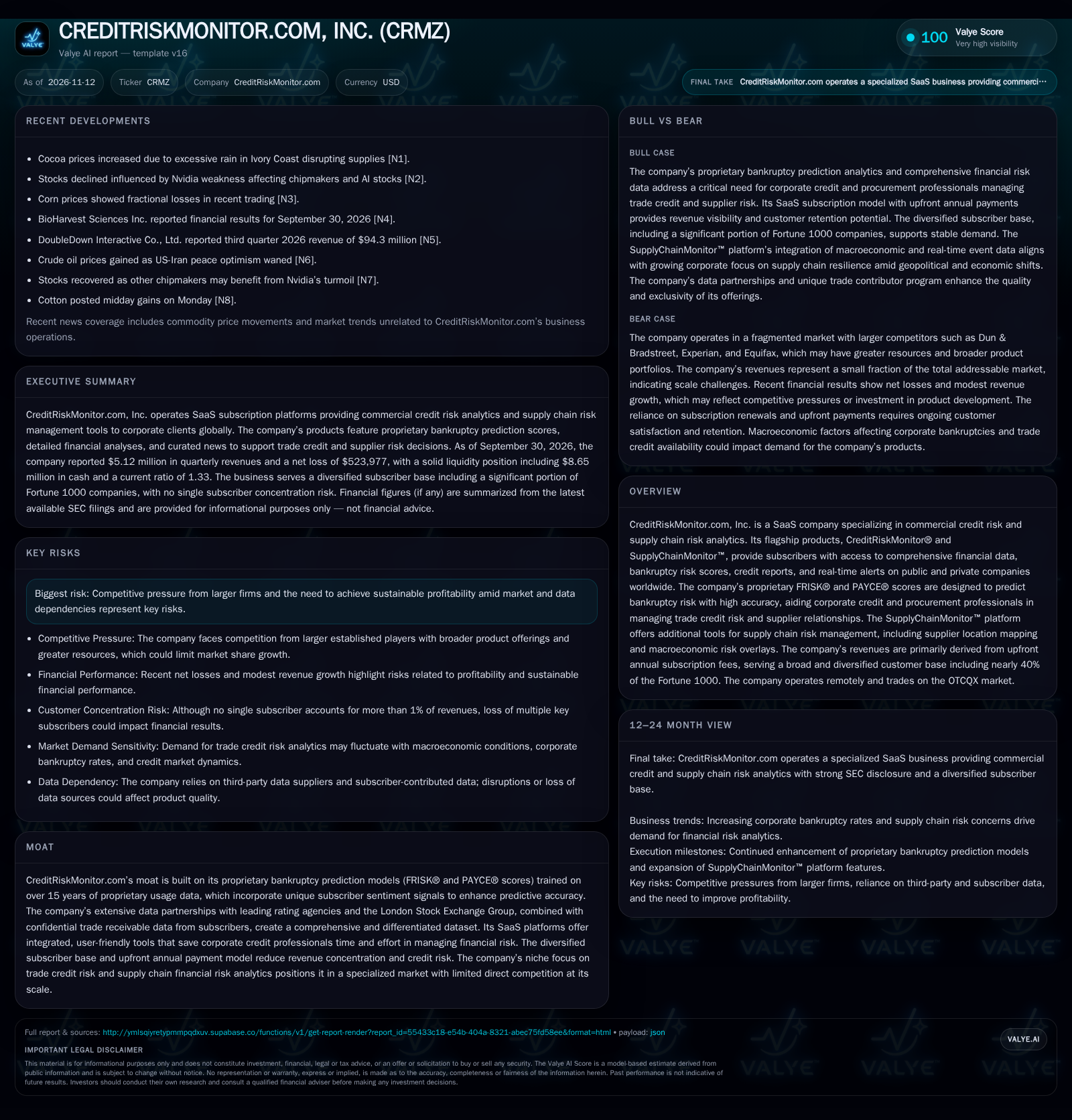
CreditRiskMonitor.com delivers commercial credit and supply chain risk analytics through SaaS subscriptions, with proprietary scores and a diversified Fortune 1000-heavy customer base. Despite nearly all revenue arriving via upfront annual subscriptions and no customer concentration risk, the company’s modest share of a large addressable market and ongoing net losses highlight scale and profitability hurdles. The company’s future will hinge on its ability to demonstrate pricing power, retain and expand accounts, and continue innovating amid intense competition from much larger data providers. [S1] [S2]
CreditRiskMonitor.com, Inc. has carved out a specialized role in the SaaS landscape by providing commercial credit and supply chain risk analytics to a global roster of large corporate clients. Its business model is anchored by proprietary bankruptcy prediction algorithms and a subscription-based revenue structure that emphasizes upfront payments and customer diversification. However, the company’s persistent net losses, modest revenue scale, and competition from dominant data providers underscore both the potential and the limitations of its current strategy. The next phase for CreditRiskMonitor.com will likely be defined by its ability to deepen product value, justify pricing, and convert its niche expertise into sustainable profitability.
Recent Financials and Customer Landscape Highlight Scale and Profitability Tensions
For the quarter ending September 30, 2026, CreditRiskMonitor.com reported operating revenues of $5.12 million and a net loss of $523,977, with a year-to-date net loss of $1.05 million and negative EPS. The company reported cash and liquidity metrics for the period; these figures do not by themselves establish operating runway, investment capacity, financial flexibility, or financing capacity. [S2]
A critical fact is the company’s customer diversification: nearly 40% of the Fortune 1000 use its services, and no single subscriber accounts for more than 1% of total revenue [S1]. Over 99% of operating revenues derive from annual SaaS subscriptions, most paid upfront [S1].
Despite its established client base and subscription-centric revenue model, CreditRiskMonitor.com’s revenues represent just over 1% of the market segment dominated by Dun & Bradstreet, underscoring the company’s relatively small scale in a large addressable market [S1].
Subscription Model Economics: Predictable Revenue, Margin Leverage, and Scale Constraints
CreditRiskMonitor.com’s business model is built around annual SaaS subscriptions, with most revenue recognized ratably over the contract term but paid upfront, reducing working capital risk from receivables and providing a degree of revenue visibility [S1]. This structure typically leads to high gross margins, as the incremental cost of servicing additional users is low once the core platforms and data pipelines are established. Proprietary analytics (FRISK® and PAYCE® scores) serve as product hooks, supporting premium pricing if their predictive value is validated by customers.
Operating leverage in SaaS models can be substantial, but only if revenue growth meaningfully outpaces the fixed cost base. The company’s continued net losses suggest either that current scale is insufficient to absorb operating and development costs, or that reinvestment in product and data partnerships is limiting profit conversion at present [S2].
However, expansion—whether through acquisitions, new data integrations, or enhanced analytics—could necessitate external funding if organic cash flow does not improve. The company’s remote-only structure may reduce fixed overhead, but ongoing investment in data quality, AI-driven analytics, and customer support remains essential to retain and grow accounts.
Proprietary Analytics as a Differentiator—But Scale and Brand Lag Market Leaders
CreditRiskMonitor.com competes in the fragmented and highly competitive commercial credit risk and supply chain analytics market. Major players such as Dun & Bradstreet, Experian, and Equifax offer broader product suites, deeper data pools, and greater global reach, often bundling credit risk analytics with other business intelligence solutions. These incumbents benefit from scale economies, entrenched customer relationships, and significant marketing resources.
The company’s primary competitive strengths are its proprietary FRISK® and PAYCE® bankruptcy prediction models, which claim high predictive accuracy based on a blend of financial, market, and subscriber sentiment data [S1]. Its trade contributor program and partnerships with rating agencies and exchanges allow for differentiated data coverage, especially for mid-market and supply chain risk scenarios.
However, the modest revenue base relative to the addressable market suggests scale disadvantages. The question is whether CreditRiskMonitor.com’s niche focus and product depth can command loyalty and pricing power, or if customers will consolidate spend with larger, multi-product vendors. Switching costs may be moderate: while integration and workflow disruption are hurdles, credit analytics are often used alongside other data tools, and procurement teams frequently reevaluate solutions based on price and utility.
If Product Differentiation Drives Account Expansion and Retention
The most favorable scenario for CreditRiskMonitor.com is one in which its proprietary analytics and supply chain tools are increasingly recognized as essential by corporate credit and procurement teams. If the FRISK® and PAYCE® scores continue to demonstrate superior predictive value—especially in an environment of rising corporate bankruptcies and supply chain disruptions—the company could see improved renewal rates, higher average contract values, and new Fortune 1000 wins.
Expansion of the SupplyChainMonitor™ platform, particularly with integration of real-time event overlays and macro risk analytics, could deepen customer engagement and justify upsell or cross-sell opportunities. Strong customer testimonials, public case studies, and independent validation of predictive models would reinforce the value proposition.
Evidence supporting this scenario would include accelerating revenue growth, margin expansion as scale improves, a rising proportion of multi-year or expanded contracts (if disclosed), and public references from large enterprise customers. Conversely, if renewal rates stagnate or customer concentration increases, the upside case would be undermined.
Incremental Growth Amid Market Headwinds and Competitive Pressure
The most plausible outcome is that CreditRiskMonitor.com continues to deliver steady, if modest, growth by serving a loyal base of large enterprises and expanding gradually into new accounts. The company’s focus on upfront annual subscriptions and diversified customer base should provide revenue stability, while ongoing investment in data and analytics sustains relevance.
This scenario assumes competitive pricing pressure from larger vendors limits the company’s ability to materially expand market share or raise prices. Net losses may persist or narrow slowly as incremental revenue growth is partially absorbed by continued investments in product and data partnerships.
Confirmation would come from consistent year-over-year revenue and subscriber growth, stable or improving gross margins, and disclosure of enhancements to the core analytics engine. Signs of margin compression, customer churn among top-tier clients, or inability to keep pace with AI-driven competitors would challenge the baseline view.
Competitive Encroachment and Product Commoditization Erode Economics
The primary risk is that larger data providers further encroach on CreditRiskMonitor.com’s niche by integrating similar bankruptcy prediction analytics into broader product suites—potentially at lower bundled prices. If customers perceive diminishing differentiation or superior value elsewhere, renewal rates could fall and price concessions may become necessary.
A further risk is that macroeconomic shifts reduce discretionary spending on risk analytics or spur consolidation of vendor relationships, making it harder for niche providers to defend share. Additionally, any disruption in third-party data partnerships or trade contributor programs could impair the perceived quality and accuracy of the company’s analytics.
Downside evidence would include declining operating revenues, rising customer churn, margin compression despite cost controls, and public disclosures of lost or downgraded enterprise contracts.
What Will Define CreditRiskMonitor.com’s Competitive and Financial Trajectory?
Annualized renewal and retention rates, especially among Fortune 1000 subscribers—if disclosed—would clarify the stickiness and value of the company’s analytics.
Average contract value and upsell/cross-sell metrics: Evidence of customers expanding their subscriptions or adopting new platform features would signal product traction.
Gross margin trends: Sustained or improving margins could confirm operating leverage and pricing power, while compression may indicate competitive or data cost pressures.
Pace of new customer acquisition, particularly in previously underpenetrated sectors or geographies, as a sign of the company’s ability to grow beyond its current base.
Product development milestones, such as enhancements to FRISK®, PAYCE®, or new SupplyChainMonitor™ features, which would demonstrate ongoing innovation.
Third-party data partnership stability: Any changes in data access or quality could materially affect product differentiation and customer satisfaction.
Disclosure of multi-year contracts or backlog figures, if provided, would improve visibility into forward revenue and customer commitment.
Disclaimer: This is research-only, informational analysis and not investment advice. It may include AI-generated interpretation and general industry context. Always verify important details using primary sources.

Comments