
Beyond Air’s LungFit Platform: Scaling Novel Nitric Oxide Therapy Amid Commercial, Clinical, and Capital Hurdles
Beyond Air, Inc. is leveraging its LungFit® nitric oxide generator and delivery platform to challenge traditional cylinder-based therapies in pulmonary hypertension and severe lung infections. Regulatory traction and early sales momentum contrast with the company’s persistent losses, ongoing product development, and capital constraints—shaping a thesis where commercial execution, pipeline progress, and market adoption will determine long-term value.
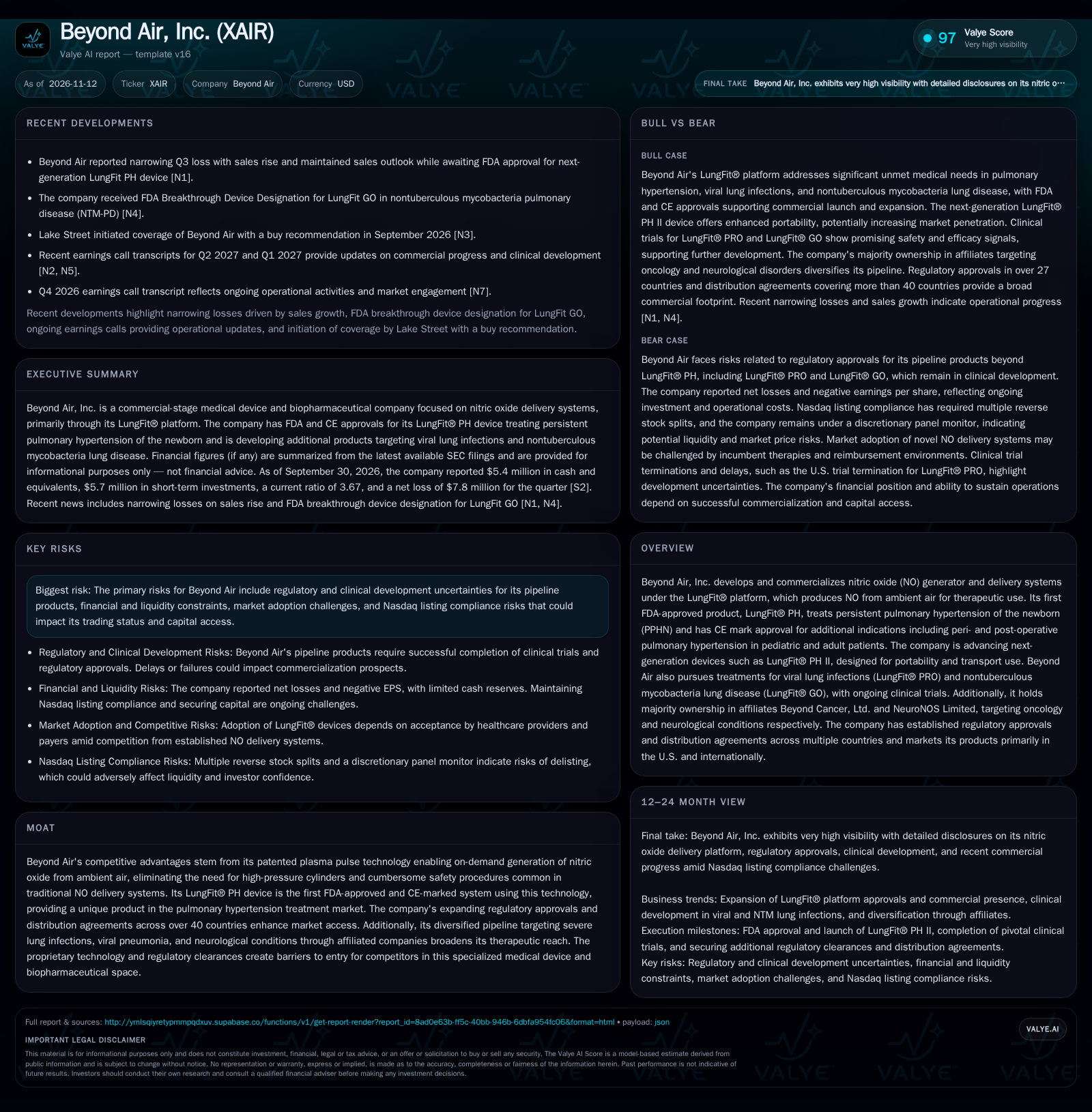
Beyond Air’s LungFit® platform offers a differentiated, cylinder-free nitric oxide delivery solution for pulmonary hypertension and other severe lung diseases, supported by FDA and CE approvals. The company is expanding commercially and developing next-generation and pipeline products, but faces ongoing net losses, clinical and regulatory uncertainty, and capital needs. Success depends on broader adoption, regulatory milestones for new indications, and sustained access to funding as the platform scales.
Beyond Air, Inc. is seeking to disrupt the therapeutic nitric oxide market with its LungFit® platform, a device suite that generates NO from ambient air—eliminating the logistical and safety burdens of traditional cylinder-based delivery. The company’s FDA- and CE-approved LungFit® PH has achieved early commercial traction in the U.S. and internationally, while next-generation and pipeline products target additional high-need indications. However, persistent operating losses, ongoing clinical risk, and capital constraints highlight the importance of execution and market uptake for the company’s long-term prospects.
Recent Milestones: Regulatory Approvals and Financial Snapshot Shape the Near-Term Thesis
Beyond Air’s LungFit® PH is now FDA-approved for persistent pulmonary hypertension of the newborn (PPHN) and CE-marked for peri- and post-operative pulmonary hypertension in pediatric and adult patients, enabling commercial launch and expansion into over 27 countries with distribution agreements spanning more than 40 countries [S1]. This regulatory momentum establishes a rare platform-level validation for a novel therapeutic device in a field dominated by cylinder-based NO delivery.
The company reported a narrowed Q3 loss as sales rose, but remains unprofitable with a quarterly net loss of $7.8 million and cash plus short-term investments of $11.1 million as of September 30, 2026 [S2]. While the current ratio stands at 3.67, persistent losses underscore the need for continued capital access and successful commercialization.
LungFit® GO, targeting nontuberculous mycobacteria pulmonary disease (NTM-PD), received FDA Breakthrough Device Designation—a potential accelerator for regulatory review, but not a guarantee of approval or commercial uptake [N4].
Nasdaq listing compliance remains a live issue, evidenced by two reverse splits in 2025 and 2026 and ongoing discretionary monitoring until August 2027, highlighting both market and financial fragility.
Economic Model: Platform Leverage, Device Economics, and the Capital Equation
Beyond Air’s economics hinge on the LungFit® platform’s ability to generate recurring revenue through device sales, potential disposables/consumables, and service or licensing fees—though the mix and structure are not fully disclosed. The main differentiator is the elimination of gas cylinders, which could reduce hospital logistics costs and safety risks, potentially enabling premium pricing or greater adoption if clinical and economic benefits are realized.
The reported total addressable market for inhaled NO is approximately $350 million in the U.S. and $700 million or greater worldwide [S1], but actual penetration will depend on the pace of clinical adoption, reimbursement, and competitive displacement. While device sales may offer upfront revenue, sustainable economics likely require installed-base expansion and utilization, suggesting a mix of capital equipment and recurring revenue from consumables or service.
Operating leverage is plausible as the installed base grows, with fixed costs in R&D, regulatory, and commercial infrastructure spread over higher volumes. The company reported cash and liquidity metrics for the period; these figures do not by themselves establish operating runway, investment capacity, financial flexibility, or financing capacity. [S2]
Capital needs are acute for a company commercializing medical devices with a pipeline of new indications—each requiring trial investment, regulatory filings, and often new commercial infrastructure. The company’s current asset base, while sufficient for near-term obligations, may not support long-term growth or setbacks without additional capital raises.
Competing with Cylinder-Based NO and Incumbent Device Makers: Advantages and Counterforces
Beyond Air’s main advantage is its patented plasma pulse technology, which enables on-demand NO generation from ambient air—removing the need for bulky, high-pressure gas cylinders and associated safety protocols [S1]. This could translate into workflow improvements, lower total cost of ownership for hospitals, and differentiated positioning versus traditional NO delivery systems.
However, the company faces entrenched competitors in the hospital respiratory-care market, where incumbent NO delivery devices are backed by established supplier relationships, reimbursement familiarity, and clinical inertia. Adoption of LungFit® will depend not only on clinical efficacy and cost, but also on the ability to integrate into existing protocols and gain provider trust.
Pipeline expansion into viral pneumonia and NTM-PD brings new competitor categories, including both device and drug-based therapies. For rare diseases like NTM lung infection, Beyond Air could benefit from orphan drug/device dynamics and limited competition, but must still demonstrate clear clinical and economic value to drive uptake.
Broader platform ambitions—such as oncology (Beyond Cancer) and neurological conditions (NeuroNOS)—are early stage and face their own competitive landscapes. The question is whether the core LungFit® technology can be credibly leveraged into these adjacent markets, or whether they represent capital-dilutive distractions.
If Platform Adoption Accelerates: Clinical Wins and Commercial Traction Drive a Step-Change in Value
A favorable scenario would see LungFit® PH and successor devices achieve rapid adoption in neonatal and peri/post-operative pulmonary hypertension, with hospitals switching from cylinders to on-demand NO due to superior economics, ease of use, and safety. Regulatory approvals in new geographies and indications (e.g., LungFit® PH II for transport use) could further expand the addressable market.
Pipeline progress—such as successful pivotal trials and swift regulatory approval for LungFit® GO (NTM-PD) and LungFit® PRO (viral pneumonia)—would unlock new revenue streams and diversify product risk. FDA Breakthrough Device Designation for LungFit® GO suggests regulatory tailwinds, but confirmation will require positive trial results and subsequent adoption [N4].
The company’s platform could achieve operating leverage as device sales and installed base grow, reducing per-unit costs and supporting a transition to profitability. Strategic partnerships or licensing deals in international markets could accelerate commercialization without excessive capital outlay.
Evidence confirming this scenario would include: rapid acceleration of sales, positive clinical trial readouts for pipeline products, expanded regulatory approvals, and meaningful improvement in gross and operating margins.
The Most Likely Trajectory: Steady Uptake, Clinical Progress, and Ongoing Capital Pressure
The most plausible path is that LungFit® PH continues to gain adoption in select U.S. and international centers, but faces a gradual ramp due to entrenched practices and reimbursement friction. Next-generation and pipeline products (PH II, PRO, GO) may achieve regulatory milestones, but each will require incremental investment and face commercial adoption lags.
Revenues likely grow, but not fast enough to offset R&D and commercial costs in the near term, leading to continued net losses and periodic capital raises. The company may maintain Nasdaq compliance through further operational or financial maneuvers but remains exposed to market volatility.
Clinical progress in NTM-PD and viral pneumonia is plausible, but the timing and magnitude of impact on revenue and margins remain uncertain. International distribution agreements may provide some diversification, but meaningful contribution will depend on local regulatory and reimbursement environments.
Evidence supporting this scenario would be moderate sequential revenue growth, successful but incremental regulatory milestones, ongoing net losses, and additional funding events.
When Clinical, Regulatory, or Capital Setbacks Compound: What Could Derail the Thesis
A negative scenario could emerge if pivotal clinical trials for LungFit® GO or PRO fail to demonstrate efficacy or safety, resulting in regulatory delays or denials. Without new indications, revenue growth could stagnate, leaving the company reliant on a limited neonatal pulmonary hypertension market.
Commercial adoption may disappoint if hospitals are slow to switch from incumbent cylinder-based NO systems, either due to integration complexity, lack of reimbursement, or insufficient economic incentive. International expansion could be hampered by regulatory hurdles or weak distributor performance.
Persistent losses and limited cash could force the company into dilutive financings or operational cutbacks—especially if capital markets tighten or Nasdaq compliance becomes problematic. If the discretionary panel monitor does not grant extensions or waivers, a delisting could further constrain access to capital and erode investor confidence.
Downside evidence would include clinical trial failures or major delays, regulatory setbacks, stagnant or declining sales, worsening operating losses, and capital-raising under distressed terms or at unfavorable valuations.
What Will Determine Whether Beyond Air’s Platform Can Scale and Deliver Shareholder Value
Quarterly revenue growth and installed base expansion for LungFit® PH and successor devices, especially in the U.S. hospital market [N1].
Regulatory progress and approval timelines for LungFit® PH II, LungFit® PRO, and LungFit® GO—especially conversion of Breakthrough Device Designation into actual approvals [N4].
Clinical trial outcomes for NTM-PD and viral pneumonia indications; a useful metric would be pivotal trial enrollment, completion, and top-line results if disclosed.
Gross margin trends, reflecting the device/consumables mix and operating leverage as commercial scale increases—would help test the path to profitability if disclosed.
Nasdaq listing status, reverse split activity, and discretionary panel monitor updates—ongoing compliance is a gating factor for capital access.
International sales contribution and distributor uptake—actual revenue from outside the U.S. would help test the global commercial thesis.
Disclaimer: This is research-only, informational analysis and not investment advice. It may include AI-generated interpretation and general industry context. Always verify important details using primary sources.

Comments