
STEELE BANCORP INC: Profitability, Acquisition Accounting, and the Limits of Public Visibility
The company’s accounting for acquisition-related fair value adjustments hints at banking or financial services activity, raising questions about future integration, expense management, and capital requirements.
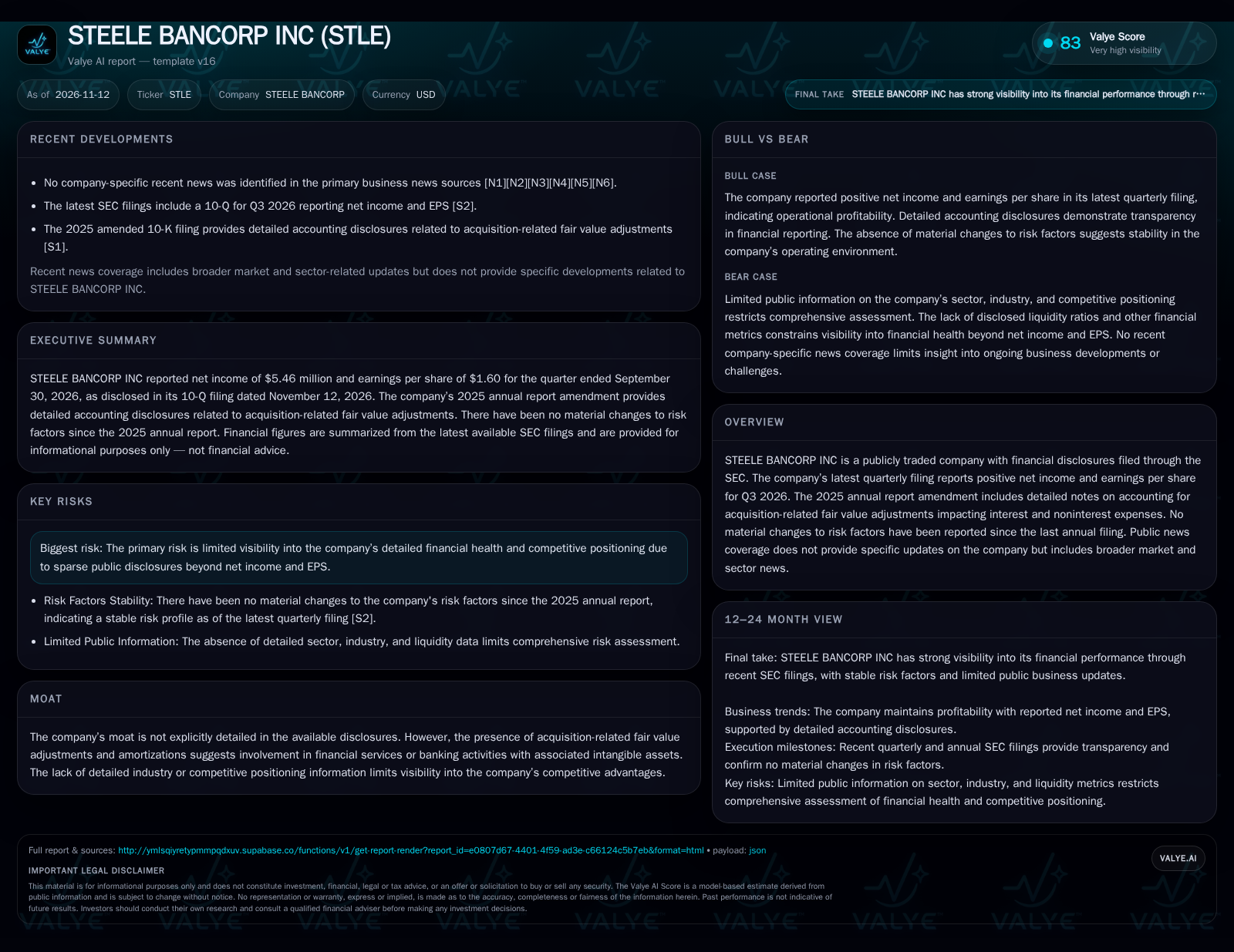
STEELE BANCORP INC is profitable as of Q3 2026, with net income of $5.46 million and EPS of $1.60 per share. The company continues to account for acquisition-related fair value adjustments, suggesting ongoing integration or amortization of intangible assets. Future developments may hinge on the nature of its core lending, deposit, or fee-based activities and how it manages acquired assets and expenses. [S1] [S2]
STEELE BANCORP INC enters late 2026 reporting consistent profitability, with $5.46 million in net income and $1.60 in earnings per share for Q3. These headline results, alongside stable risk disclosures and detailed accounting for acquisition-related fair value adjustments, paint a picture of a company with operational discipline and ongoing integration activity. However, the absence of public detail on sector, liquidity, or business model mechanics means that key questions about the company’s core economics, growth prospects, and competitive positioning remain unanswered for outside stakeholders.
Profitability and Acquisition Accounting: What the Latest Filings Reveal
STEELE BANCORP INC reported net income of $5.46 million and basic and diluted EPS of $1.60 for the quarter ended September 30, 2026, according to its latest 10-Q. Profitability at this level suggests the company is generating sufficient revenue to cover its costs and deliver earnings to shareholders, at least in the short term. [S2]
The company’s amended 2025 10-K highlights ongoing accounting for acquisition-related fair value adjustments and amortizations. These adjustments affect both interest and noninterest expense lines, indicating that STEELE BANCORP continues to integrate acquired assets or businesses, and that these accounting impacts remain material to reported results. [S1]
No material changes have been reported in risk factors since the 2025 annual filing, signaling a period of stability in the company’s operating and regulatory environment. [S2]
Earnings Drivers: The Unseen Mechanics Behind the Numbers
While STEELE BANCORP INC’s profitability is clear, the mechanisms underlying its earnings remain opaque due to the absence of public detail on its sector or business model. If, as the acquisition-related accounting suggests, the company is a bank or financial services provider, its core economics likely depend on net interest margin (NIM), loan and deposit growth, fee income, and expense management.
In such a scenario, revenue would be driven by the spread between interest earned on loans and securities and interest paid on deposits and borrowings. Noninterest income—such as service fees, wealth management, or mortgage origination—could supplement core lending income. Recent fair value adjustments and amortizations may reflect the integration of acquired loan books or branch networks, impacting both interest (through acquired loan yields) and noninterest expenses (through amortization of intangible assets and restructuring costs).
Operating leverage could be achieved if the company grows assets faster than expenses, particularly if integration synergies or scale advantages are realized from acquisitions. However, without detail on cost structure or asset composition, it is unclear how sustainable current profitability is or how exposed the company is to credit losses, interest rate swings, or integration setbacks.
Capital needs in banking are typically dictated by regulatory requirements and risk-weighted asset growth. If STEELE BANCORP is expanding through acquisitions, capital planning and integration discipline will be critical to avoid dilution or regulatory constraints.
Assessing Advantage: What Could Set STEELE BANCORP Apart?
The company’s public filings do not define its competitive landscape or peer group, limiting assessment of its current market position. If STEELE BANCORP operates as a regional bank or financial services provider, its potential advantages could include local market share, customer relationships, specialized lending niches, or operational efficiency gained from recent acquisitions.
Counterforces might include intense competition from larger banks, credit unions, fintech firms, or digital-first lenders, all of which can pressure margins and customer retention. Technology adoption and regulatory compliance are also persistent challenges in banking, especially for institutions navigating post-acquisition integration.
The ongoing impact of acquisition-related fair value adjustments indicates that integration is still a live issue, and successful absorption of acquired assets could determine whether the company realizes scale benefits or incurs elevated costs. If STEELE BANCORP can leverage cross-selling, digital engagement, or branch rationalization, it may carve out a defensible niche. However, without specifics on its product mix, customer base, or regional footprint, these remain conditional observations.
Unlocking Value Through Integration and Cost Control
An optimistic scenario for STEELE BANCORP INC hinges on successful integration of acquired businesses, realization of operating synergies, and prudent risk management. If fair value adjustments and amortizations taper off as integration concludes, reported expenses could decline, boosting core profitability and freeing up capital for organic growth or further expansion.
Evidence that would confirm this trajectory includes a declining run-rate for noninterest expense attributable to acquisition amortization, stabilization or growth in net interest income, and improved efficiency ratios. Disclosure of expanding loan or deposit balances, higher fee income, or new market entries would further support the case for sustainable growth.
Falsification would come from persistent or increasing noninterest expenses tied to integration, asset quality problems emerging in acquired portfolios, or regulatory constraints on growth.
Maintaining the Status Quo: Profitability Amid Limited Transparency
The most plausible middle path for STEELE BANCORP INC is continued moderate profitability, with integration-related expenses gradually declining but still material to reported results. The company may maintain a stable risk profile and steady earnings, but public disclosure remains limited, making it difficult for outside analysts to track core business momentum or risk exposures.
Confirmation of this scenario would come from consistent net income and EPS in future SEC filings, stable risk disclosures, and incremental reduction in acquisition-related expense impacts. The absence of negative surprises in asset quality, regulatory actions, or expense spikes would also support this view.
Falsification would require a material shift in reported risks, a sudden decline in earnings, or disclosure of significant credit losses or integration failures.
Integration Stumbles or Asset Quality Deterioration Could Pressure Results
A negative scenario could unfold if STEELE BANCORP faces difficulties integrating acquired businesses, leading to protracted or escalating noninterest expenses, operational disruptions, or customer attrition. If acquired loan portfolios underperform or if economic conditions deteriorate, the company could face rising credit losses and regulatory scrutiny.
This scenario may be confirmed by increases in noninterest expense, new or heightened risk disclosures, spikes in loan loss provisions, or adverse regulatory commentary. A sudden drop in net income or negative EPS would also signal trouble.
The lack of detailed public disclosure on asset composition, capital adequacy, or liquidity means that external stakeholders would likely only see these risks materialize through lagged headline results or new SEC filings.
Testing the Thesis: What Future Filings Need to Clarify
Disclosure of net interest margin (NIM) trends, if provided, would clarify core lending profitability and sensitivity to rate changes.
Breakdown of noninterest expense, especially the portion attributable to acquisition-related amortization, would help assess integration progress and future earnings power.
Growth or contraction in loan and deposit balances, if disclosed, would reveal whether the company is successfully expanding its balance sheet or facing competitive pressure.
Updates on asset quality metrics—such as nonperforming loans or loan loss provisions—would indicate underlying credit risk.
Efficiency ratio trends, if provided, would show how well the company is managing operating costs relative to revenue.
Any new risk factor disclosures or changes in regulatory environment would be important for reassessing stability.
Disclosure of capital ratios (e.g., Tier 1 or total capital), if provided, would signal the company’s ability to absorb losses and support growth.
Clarity on the nature of acquired businesses or assets and the expected timeline for completing integration would help test the sustainability of current profitability.
Disclaimer: This is research-only, informational analysis and not investment advice. It may include AI-generated interpretation and general industry context. Always verify important details using primary sources.

Comments