
Mentor Capital’s Energy Royalty Pivot: Asset-Light Exposure, Cash Leverage, and the Challenge of Scaling an Acquisition Platform
The company’s asset-light model delivers revenue without operating costs, yet future value creation will depend on disciplined capital allocation, successful acquisition execution, and the ability to navigate sector volatility.
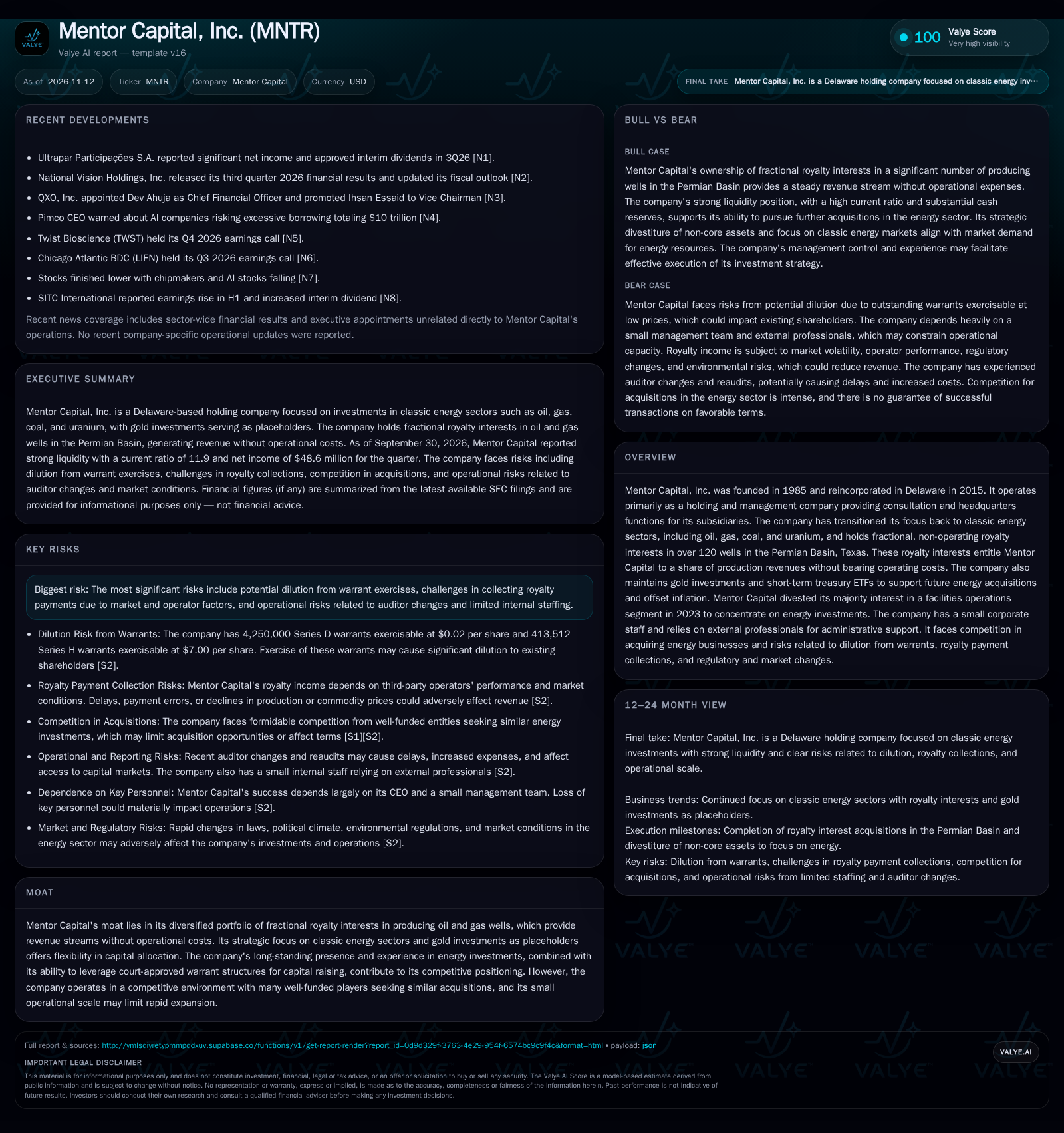
Mentor Capital, Inc. has repositioned itself as a cash-rich, asset-light holding company with a focus on energy sector royalty interests, particularly in the Permian Basin, while maintaining gold holdings and liquid investments to support further deals. Sustained value creation will hinge on deploying capital into attractive energy assets and managing operational and sector headwinds effectively. [S1] [S2]
Mentor Capital, Inc. has reoriented its business strategy toward classic energy investments, leveraging an asset-light model centered on royalty interests in oil and gas wells. With substantial liquidity following a major divestiture and a streamlined internal structure, the company is positioned to act nimbly in a volatile sector. However, Mentor’s future will be shaped by its ability to overcome dilution threats, execute new acquisitions, and manage the inherent risks of an externally dependent, small-scale operation. The next phase will test whether its potential financial flexibility can translate into durable, accretive growth.
Recent Financial and Strategic Moves Define Mentor Capital’s Current Posture
Mentor Capital reported $54.4 million in cash and equivalents and a current ratio of 11.9 as of September 30, 2026, reflecting a highly liquid balance sheet. This strength follows the October 2023 sale of its 51% stake in Waste Consolidators for $6 million plus interest, marking a strategic pivot away from non-energy assets. The company now holds fractional royalty interests in approximately 121 oil and gas wells in the Permian Basin, entitling it to a share of production revenues without direct operating costs. For the quarter ended September 30, 2026, Mentor posted $55.5 million in revenue and $48.6 million in net income, demonstrating current profitability. However, 4.25 million Series D warrants exercisable at $0.02 per share present a clear dilution risk if exercised, potentially expanding the share count materially. [S1] [S2]
Asset-Light Economics: Royalty Streams, Cash Reserves, and Acquisition Optionality
Mentor Capital’s core economics center on asset-light royalty interests, which provide income based on a fixed percentage of gross production revenues from underlying oil and gas wells. This model avoids direct exposure to operating costs, capital expenditures, and environmental liabilities, resulting in a high-margin, low-overhead revenue stream. The company’s small staff—just two full-time employees—keeps fixed costs low, while reliance on outside professionals introduces variable expenses tied to deal activity and compliance.
The company reported cash and liquidity metrics for the period; these figures do not by themselves establish operating runway, investment capacity, financial flexibility, or financing capacity. However, the company’s revenue base may be volatile, as royalty income depends on fluctuating commodity prices, production volumes, and the performance of third-party operators. The economics of future deals will hinge on Mentor’s ability to source accretive royalty or partnership opportunities at reasonable multiples, particularly as competition for attractive energy assets has intensified.
Mentor’s use of gold and treasury ETFs as capital placeholders provides some inflation hedge and liquidity, but these holdings do not generate operating income. The company’s business model may also include annuity-like financing and legal dispute resolution investments, but these remain minor relative to the energy focus. If Mentor can scale its royalty portfolio or layer in higher-yielding energy investments, operating leverage could improve meaningfully, but the company’s economics remain sensitive to the quality and terms of each new deal.
Navigating a Crowded Energy Investment Landscape with Limited Scale
Mentor Capital’s competitive position is defined by its flexibility and focus on asset-light, yield-generating interests in classic energy sectors. The company benefits from not having to operate wells directly, avoiding the operational risks and capital intensity that burden many upstream energy companies. Its experience in structuring court-approved warrant deals and its use of gold and treasury investments for capital management offer some differentiation.
However, Mentor competes with a broad array of well-capitalized private equity funds, energy-focused investment firms, and large corporations seeking similar royalty and non-operating interests, especially in the Permian Basin. These rivals often have deeper industry relationships, larger dedicated teams, and greater tolerance for illiquidity or operational risk, which can drive up acquisition prices or crowd out smaller players.
Furthermore, Mentor’s operational dependence on a small team and external advisors could limit its ability to source, diligence, and close deals at scale. Its modest internal resources may also constrain post-acquisition oversight. While management and board members collectively control about a third of shares (fully diluted), aligning incentives, this concentration could deter some outside investors or limit governance flexibility. The question is whether Mentor can leverage its liquidity and nimble structure to carve out a sustainable niche amid aggressive competition and sector volatility.
Accretive Energy Acquisitions and Royalty Expansion Drive Value Creation
In an upside scenario, Mentor Capital’s strong cash reserves and streamlined structure enable it to acquire additional royalty interests or minority stakes in high-quality energy assets at attractive valuations, particularly if sector volatility creates distressed or motivated sellers. Successful execution would expand the company’s revenue base while maintaining its asset-light, high-margin profile. If commodity prices remain favorable or increase, royalty income could rise meaningfully, supporting further acquisitions or shareholder returns.
Confirmation of this scenario would come from disclosed acquisitions of additional royalty or non-operating interests, rising royalty revenue, and sustained high net margins. Evidence of disciplined capital deployment—such as avoiding overpayment for assets, maintaining a conservative balance sheet, and mitigating dilution—would further validate the thesis. If Mentor can scale its portfolio while keeping overhead in check and sidestepping major collection or operator risks, the result could be compounding value for shareholders.
Falsification would occur if deal flow stalls, cash is depleted without accretive returns, or new investments underperform due to operator issues, commodity price collapses, or poor terms.
Incremental Portfolio Growth with Episodic Revenue and Dilution Overhang
The most plausible outcome is that Mentor Capital continues to operate as a small, opportunistic holding company, generating modest, episodic royalty income from its current interests while pursuing additional deals as opportunities arise. Its cash and liquid holdings provide runway for selective acquisitions, but competition and pricing discipline may limit the pace and scale of portfolio expansion.
Revenue and net income could fluctuate with commodity cycles and operator performance, while the company’s minimal fixed cost base helps buffer downside. The persistent overhang of low-priced warrants may periodically pressure the stock and dilute per-share value if exercised. The company may struggle to achieve material scale given its limited in-house resources, and execution risk remains high for each new deal.
This scenario would be confirmed by a continuation of current revenue levels, only occasional new acquisitions, and ongoing dependence on external professionals for operations. Falsification would occur if Mentor either rapidly scales its portfolio with high-quality deals or, conversely, faces a sharp decline in royalty income due to sector or operator disruptions.
Dilution, Execution Missteps, or Royalty Underperformance Erode Shareholder Value
In a negative scenario, Mentor Capital experiences significant dilution as a large portion of its 4.25 million Series D warrants are exercised at $0.02 per share, materially expanding the share base and reducing per-share earnings and asset value. Simultaneously, commodity price declines or operator-specific issues could cut royalty revenues, while legal or regulatory changes in the energy sector further erode income streams.
A failed or overpriced acquisition could consume a meaningful portion of Mentor’s cash reserves without generating offsetting cash flow, straining the balance sheet. Operational disruptions, such as auditor changes or loss of key personnel, add to execution risk, potentially resulting in compliance costs or delayed reporting. If the company’s small management team is unable to source or integrate new deals successfully, operational missteps could compound the impact of external shocks.
This scenario would be confirmed by a sharp increase in outstanding shares, declining royalty revenue, negative cash flow, or repeated delays in financial reporting. Falsification would require stable or growing royalty income, prudent management of share count, and continued positive net income.
Testing Mentor Capital’s Thesis: Concrete Developments to Monitor
The frequency, size, and terms of new energy royalty or partnership acquisitions—especially in the Permian Basin or other classic energy regions—would help test Mentor’s ability to deploy capital accretively.
Quarterly royalty revenue trends, including disclosures of production volumes, realized commodity prices, and operator performance, if provided, would clarify the underlying health and trajectory of the royalty portfolio.
Actual exercise of Series D and H warrants, and the resulting change in share count, will reveal the near-term magnitude of dilution and its impact on per-share metrics.
Disclosures around cash deployment for acquisitions versus maintenance of liquid reserves would signal the company’s capital allocation discipline and risk appetite.
Any material auditor changes, reaudits, or delays in SEC filings would indicate ongoing reporting and compliance risk.
Turnover or expansion in the core management team—currently only two full-time employees—would affect operational capacity and succession risk.
Competitive dynamics in the energy asset market—such as failed bids, acquisition multiples, or sector consolidation—would provide context for Mentor’s deal sourcing prospects.
If disclosed, the proportion of revenue derived from each significant royalty asset or operator would help assess concentration risk and portfolio diversification.
Disclaimer: This is research-only, informational analysis and not investment advice. It may include AI-generated interpretation and general industry context. Always verify important details using primary sources.

Comments